Alameda County Quitclaim Deed (Individual Grantor by Attorney-in-Fact) Form
Last validated August 28, 2026 by our Forms Development TeamFormatted for recording in Alameda County, for property anywhere in the county: rural and unincorporated areas as well as Alameda, Albany, Berkeley, Castro Valley, Dublin, Emeryville, Fremont, Hayward and 9 more.
- 3 documents included
- Immediate PDF download
- Formatting guarantee
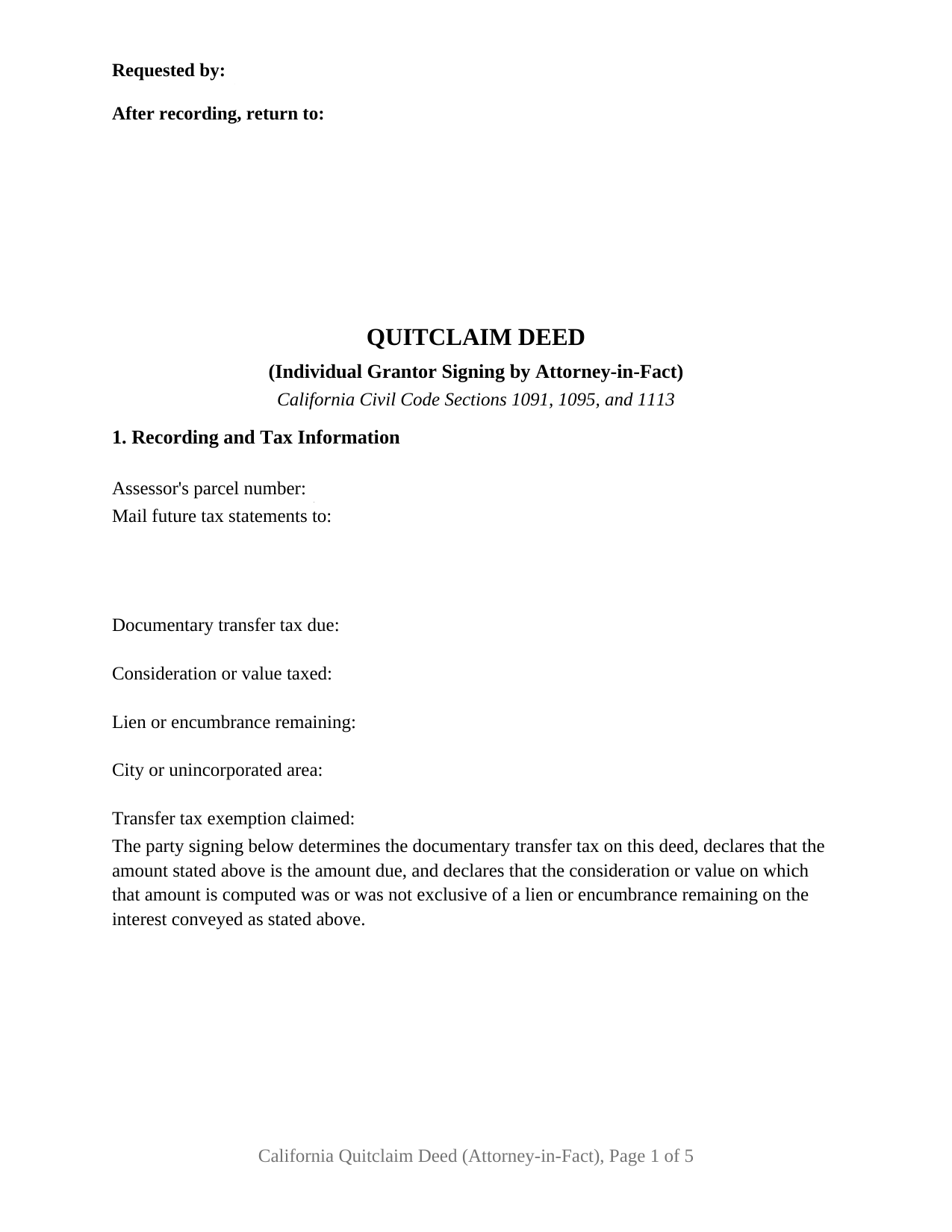
Alameda County Quitclaim Deed (Individual Grantor by Attorney-in-Fact) Form
Fill in the blank Quitclaim Deed (Individual Grantor by Attorney-in-Fact) form formatted to comply with all California recording and content requirements.
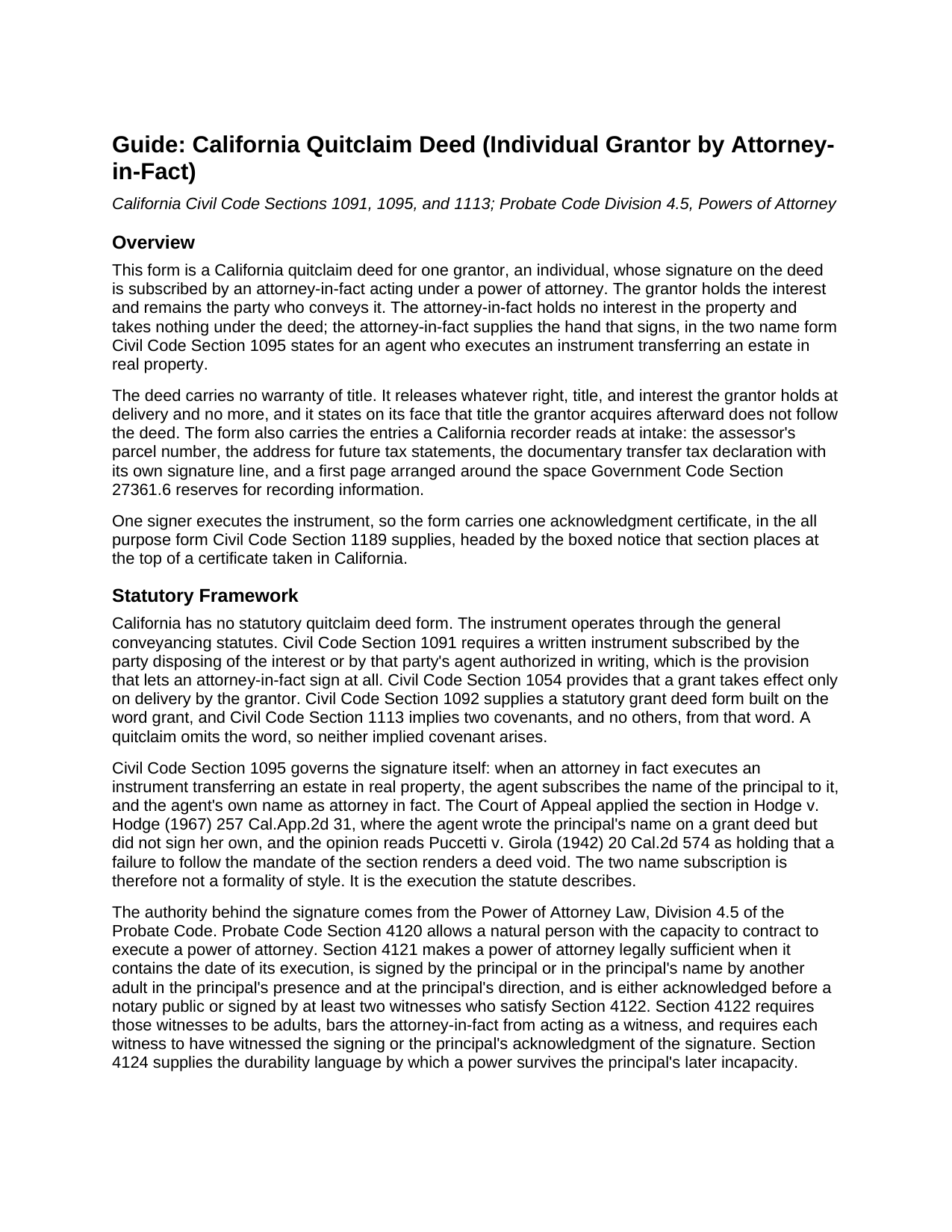
Alameda County Quitclaim Deed (Individual Grantor by Attorney-in-Fact) Guide
Line by line guide explaining every blank on the Quitclaim Deed (Individual Grantor by Attorney-in-Fact) form.
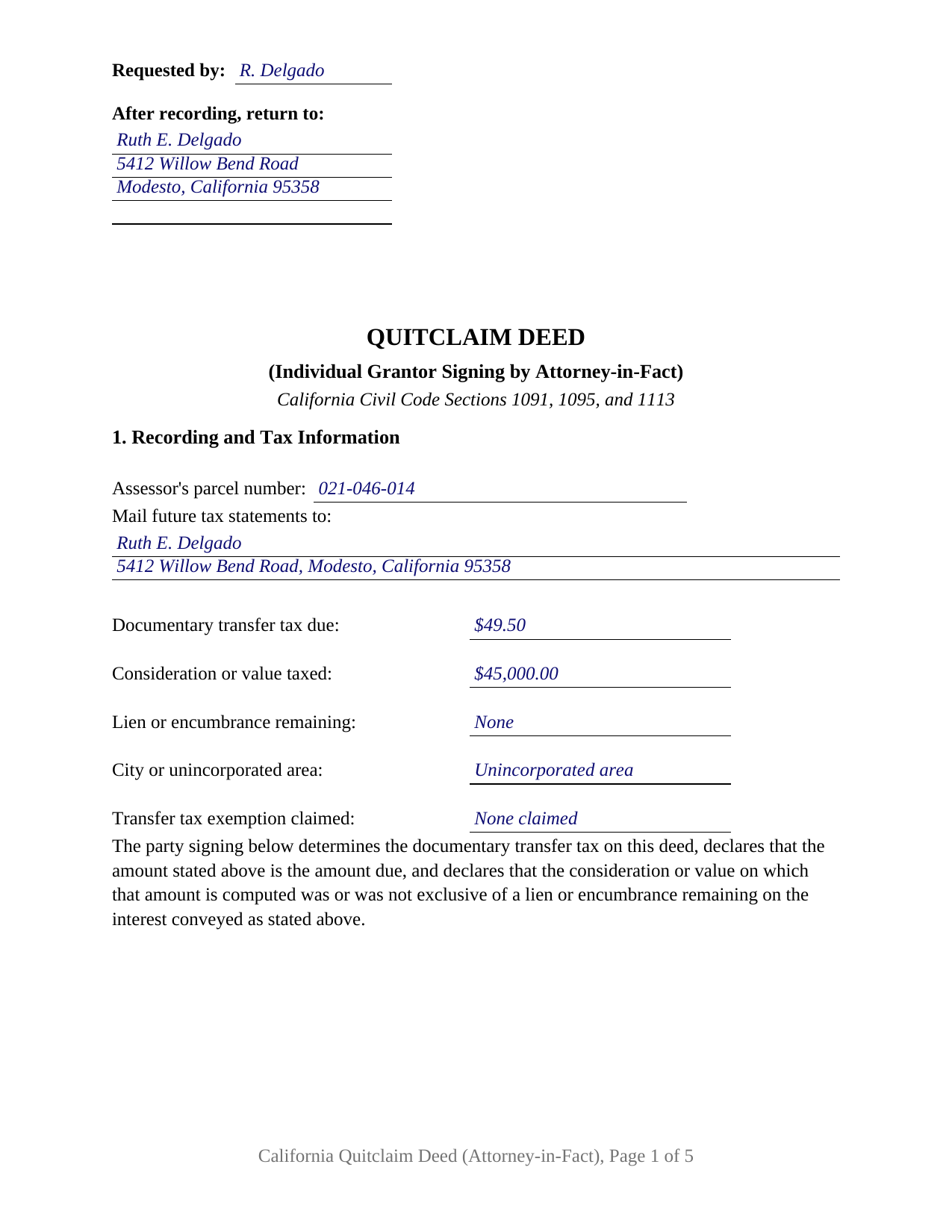
Alameda County Completed Example of the Quitclaim Deed (Individual Grantor by Attorney-in-Fact) Document
Example of a properly completed California Quitclaim Deed (Individual Grantor by Attorney-in-Fact) document for reference.
All 3 documents above included • One-time purchase • No recurring fees
Immediate Download • Secure Checkout
Additional California and Alameda County documents included at no extra charge:
Where to Record Your Documents
Alameda County Clerk-Recorder
Oakland, California 94607
Hours: Mon-Fri 8:30 to 4:30 (avoid 12:00 to 2:00)
Phone: 510-272-6362 or 888-280-7708
Dublin Office
Dublin, California 94568
Hours: Mon-Fri 8:30 to 4:30
Phone: as above
Recording Tips for Alameda County:
- Bring your driver's license or state-issued photo ID
- Ensure all signatures are in blue or black ink
- Recording fees may differ from what's posted online - verify current rates
- Request a receipt showing your recording numbers
- Ask about accepted payment methods when you call ahead
Cities and Jurisdictions in Alameda County
Properties in any of these areas use Alameda County forms:
- Alameda
- Albany
- Berkeley
- Castro Valley
- Dublin
- Emeryville
- Fremont
- Hayward
- Livermore
- Newark
- Oakland
- Piedmont
- Pleasanton
- San Leandro
- San Lorenzo
- Sunol
- Union City
Hours, fees, requirements, and more for Alameda County
How do I get my forms?
Forms are available for immediate download after payment. The Alameda County forms will be in your account ready to download to your computer. An account is created for you during checkout if you don't have one. Forms are NOT emailed.
Are these forms guaranteed to be recordable in Alameda County?
Yes. Our form blanks are guaranteed to meet or exceed the applicable formatting requirements used for recording in Alameda County, including margin requirements, font requirements, and other layout standards. This guarantee applies to formatting, not to the legal sufficiency of information entered by the user or the suitability of a form for a particular transaction.
Can I reuse these forms?
Yes. You can reuse the forms for your personal use. For example, if you have multiple properties in Alameda County you only need to order once.
What do I need to use these forms?
The forms are PDFs that you fill out on your computer. The free Adobe Acrobat Reader is recommended, and most PDF apps also work. You do NOT enter your property information online - you download the blank forms and complete them privately on your own computer.
Are there any recurring fees?
No. This is a one-time purchase. Nothing to cancel, no memberships, no recurring fees.
How much does it cost to record in Alameda County?
Recording fees in Alameda County vary. Contact the recorder's office at 510-272-6362 or 888-280-7708 for current fees.
Questions answered? Let's get started!
One California deed asks for two names on a single signature line. When an attorney-in-fact releases an owner's interest, Civil Code Section 1095 puts the principal's name on the instrument and the agent's own name beside it, as attorney in fact. The deed prepared here is built around that signature: one individual grantor who holds the interest, one attorney-in-fact who signs for that grantor under a power of attorney, and no warranty of title anywhere in the instrument.
The Two Names Section 1095 Calls For
Most execution rules describe who may sign. Section 1095 describes how: an attorney in fact executing an instrument that transfers an estate in real property subscribes the name of the principal to it, and the agent's own name as attorney in fact. In Hodge v. Hodge (1967) an agent wrote her husband's name on a grant deed and never signed her own, and the Court of Appeal, reading Puccetti v. Girola, treated a failure to follow the section as leaving the deed void. Section 9 of this form is built around that sentence: the signature line, a printed name blank for the grantor, and a second for the attorney-in-fact, so both executing names sit below the signature where Government Code Section 27280.5 looks for them.
Where the Authority Behind the Signature Sits
Civil Code Section 1091 is what lets an agent sign at all: an interest in real property passes by a written instrument subscribed by the party disposing of it, or by that party's agent authorized in writing. That writing is the power of attorney. Section 4121 makes a power legally sufficient when it is dated, signed by or for the principal, and either acknowledged before a notary public or signed by two adult witnesses. Section 4264 then withholds a list of acts from general authority, gifts of the principal's property and changes to survivorship interests among them, unless the power expressly grants them. Section 4 of the deed identifies the power by date and recording reference, and Section 8 states on the instrument that the deed exercises authority already granted and enlarges none of it.
One Grantor, One Agent, One Certificate
The form recites a single individual grantor and a single attorney-in-fact, and one Civil Code Section 1189 acknowledgment certificate follows, headed by the boxed identity notice that section places at the top of a certificate taken in this state. The agent, as the person who signed, is the one who appears before the notary. Patterns presenting this configuration turn up steadily in California's grantor indexes: an owner living outside the country whose agent signs at home, an agent under a durable power releasing an inherited undivided interest to the cotenant buying it out, and an agent completing a release under a power written to survive the principal's loss of capacity. A principal signing personally, and two agents whose power calls for them to act together, present patterns this single block does not carry.
A Release With Nothing Warranted
California keeps its two everyday deed covenants inside one statutory word. Civil Code Section 1113 implies them from the word grant, and a quitclaim, often typed as a quit claim deed, never uses it. What crosses is the interest the grantor holds at delivery; title picked up afterward stays behind.
The Power of Attorney and the Public Record
Powers of attorney answer to a recording rule of their own. Under Civil Code Section 1216, a recorded power to convey real property is not revoked by any act of the principal unless the revoking instrument is also acknowledged or proved, certified, and recorded in the same office, which is much of why California title practice expects the power to reach the county record with the deed it authorizes. Probate Code Section 4307 gives a certified copy the force of the original, and Section 4305 makes the agent's affidavit of nonrevocation recordable; both are prepared separately and are not included here. Page one carries what a recorder reads first: the reserved recording space with its requester and return entries, the parcel number, the future tax statement address, and the transfer tax declaration over the tax determiner's signature.
Three files ship: the fillable quitclaim deed, a completed example worked through a Stanislaus County release signed by an agent, and a plain language guide covering every section, the notarial certificate, the fees, and recorder intake. The materials describe California law in general terms and are not legal advice about a particular power of attorney or parcel.
Important: Your property must be located in Alameda County to use these forms. Documents should be recorded at the county recording office listed above.
This Quitclaim Deed (Individual Grantor by Attorney-in-Fact) meets all recording requirements specific to Alameda County.
Our Promise
The documents you receive here are guaranteed to meet or exceed the applicable Alameda County recording format requirements. If there is a rejection caused by our formatting, we will correct the issue or refund your payment. This guarantee applies to document formatting only and does not extend to information entered by the user, the selection of the form, or the legal effect of the completed document.
Save Time and Money
Get your Alameda County Quitclaim Deed (Individual Grantor by Attorney-in-Fact) form done right the first time with Deeds.com Uniform Conveyancing Blanks. At Deeds.com, we understand that your time and money are valuable resources, and we don't want you to face a penalty fee or rejection imposed by a county recorder for submitting nonstandard documents. We constantly review and update our forms to meet rapidly changing state and county recording requirements for roughly 3,500 counties and local jurisdictions.
4.8 out of 5 - ( 4,815 Reviews )
Richard G. 3 out of 5 stars
I was not able to add more linea to the deed and add up to four people and their addresses. The document should be able to be expanded.
Thank you for your feedback. We really appreciate it. Have a great day!
Michelle G. 5 out of 5 stars
EXCEPTIONAL CUSTOMER SERIVCE!!! THANK YOU!!!
Thank you for your feedback. We really appreciate it. Have a great day!
Barbara D. 5 out of 5 stars
Appreciate this service!
Thank you!
Miles B. 5 out of 5 stars
Fast, professional work at a great price.
We appreciate your business and value your feedback. Thank you. Have a wonderful day!
Lajeanne F. 5 out of 5 stars
Your service was as you promoted and I was able to get a copy of my deed and find the information on it I needed. Thank you.
Thank you for your feedback. We really appreciate it. Have a great day!
Susan A. 5 out of 5 stars
Very convenient. Instructions and samples are a plus because I often see documents incorrectly completed. Take the time to do it right.
We appreciate your business and value your feedback. Thank you. Have a wonderful day!
Charlene H. 5 out of 5 stars
Deeds.com is a wonderful website. I highly recommend them and would use them again in the future.
Thank you, Charlene! We're so glad to hear you had a great experience. We truly appreciate your recommendation and look forward to helping you again in the future.
Kim P. 5 out of 5 stars
I want to thank you so much. You made a stressful process easy. The customer service was amazing. There is no doubt I will use your service again.
Thank you!
annie m. 5 out of 5 stars
recently joined Deeds.com. still exploring the site. has been very helpful in providing local information for recording, such as fees and requirements. i am working to correct mistakes made within a deed. it is amazing how these municipalities operate outside the scope of Article 1, Section 8, Clause 17; to claim land is "in" the "State of ____. when the land is actually not ceded to the United States of America as for use for needful buildings. beware of the fraud perpetrated by Attorneys in the recording of your Deeds. Registration as "RESIDENTIAL" puts your private-use land on the TAX rolls with the use of that one word. i recommend this site as it appears there is information for each state and each county office. will update my review once i place an order.
Thank you!
Dale Mary G. 5 out of 5 stars
This was an easy site to use - saving so much time and allowing me to complete what I needed to do. All the added information, guidelines and even a sample completed form. Great!
We appreciate your business and value your feedback. Thank you. Have a wonderful day!
Joni Y. 5 out of 5 stars
Deeds.com is a very up to date & easy instruction website. I recommend this site to all who are looking for forms dealing with deeds. Thank you for making life easy in this aspect.
We appreciate your business and value your feedback. Thank you. Have a wonderful day!
Christian M. 5 out of 5 stars
Easy to find the necessary documents needed
We appreciate your business and value your feedback. Thank you. Have a wonderful day!
Maria Lucy A. 4 out of 5 stars
Very good service. Directions were easy to follow to obtain the document I needed.
Thank you!
LINDA J M. 5 out of 5 stars
NO PROBLEMS. I LIKE THE DEED DOCUMENT AND INSTRUCTIONS. MADE IT EASY.
We appreciate your business and value your feedback. Thank you. Have a wonderful day!
Joseph W. 5 out of 5 stars
good place to get documents and it seems like a sound place to get forms. Self explainitory and helpful
Thank you!