California Quitclaim Deed (Individual Grantor by Attorney-in-Fact)
County Specific Legal Forms Validated as recently as October 12, 2026 by our Forms Development Team
About the California Quitclaim Deed (Individual Grantor by Attorney-in-Fact)
How to Use This Form
- Select your county from the list
- Download the county-specific form
- Fill in the required information
- Have the document notarized if required
- Record with your county recorder's office
What Others Like You Are Saying
"Quick and easy to find the forms I needed. And the download was easy."
"Thank you. I was just looking but still think it is a great website. Used it a couple of years ago f…"
"Seamless and prompt service."
"Your product is amazing !"
"I found that it was easy-to-use and complete."
4.8/5 from 4,829 reviews. Read all
One California deed asks for two names on a single signature line. When an attorney-in-fact releases an owner's interest, Civil Code Section 1095 puts the principal's name on the instrument and the agent's own name beside it, as attorney in fact. The deed prepared here is built around that signature: one individual grantor who holds the interest, one attorney-in-fact who signs for that grantor under a power of attorney, and no warranty of title anywhere in the instrument.
The Two Names Section 1095 Calls For
Most execution rules describe who may sign. Section 1095 describes how: an attorney in fact executing an instrument that transfers an estate in real property subscribes the name of the principal to it, and the agent's own name as attorney in fact. In Hodge v. Hodge (1967) an agent wrote her husband's name on a grant deed and never signed her own, and the Court of Appeal, reading Puccetti v. Girola, treated a failure to follow the section as leaving the deed void. Section 9 of this form is built around that sentence: the signature line, a printed name blank for the grantor, and a second for the attorney-in-fact, so both executing names sit below the signature where Government Code Section 27280.5 looks for them.
Where the Authority Behind the Signature Sits
Civil Code Section 1091 is what lets an agent sign at all: an interest in real property passes by a written instrument subscribed by the party disposing of it, or by that party's agent authorized in writing. That writing is the power of attorney. Section 4121 makes a power legally sufficient when it is dated, signed by or for the principal, and either acknowledged before a notary public or signed by two adult witnesses. Section 4264 then withholds a list of acts from general authority, gifts of the principal's property and changes to survivorship interests among them, unless the power expressly grants them. Section 4 of the deed identifies the power by date and recording reference, and Section 8 states on the instrument that the deed exercises authority already granted and enlarges none of it.
One Grantor, One Agent, One Certificate
The form recites a single individual grantor and a single attorney-in-fact, and one Civil Code Section 1189 acknowledgment certificate follows, headed by the boxed identity notice that section places at the top of a certificate taken in this state. The agent, as the person who signed, is the one who appears before the notary. Patterns presenting this configuration turn up steadily in California's grantor indexes: an owner living outside the country whose agent signs at home, an agent under a durable power releasing an inherited undivided interest to the cotenant buying it out, and an agent completing a release under a power written to survive the principal's loss of capacity. A principal signing personally, and two agents whose power calls for them to act together, present patterns this single block does not carry.
A Release With Nothing Warranted
California keeps its two everyday deed covenants inside one statutory word. Civil Code Section 1113 implies them from the word grant, and a quitclaim, often typed as a quit claim deed, never uses it. What crosses is the interest the grantor holds at delivery; title picked up afterward stays behind.
The Power of Attorney and the Public Record
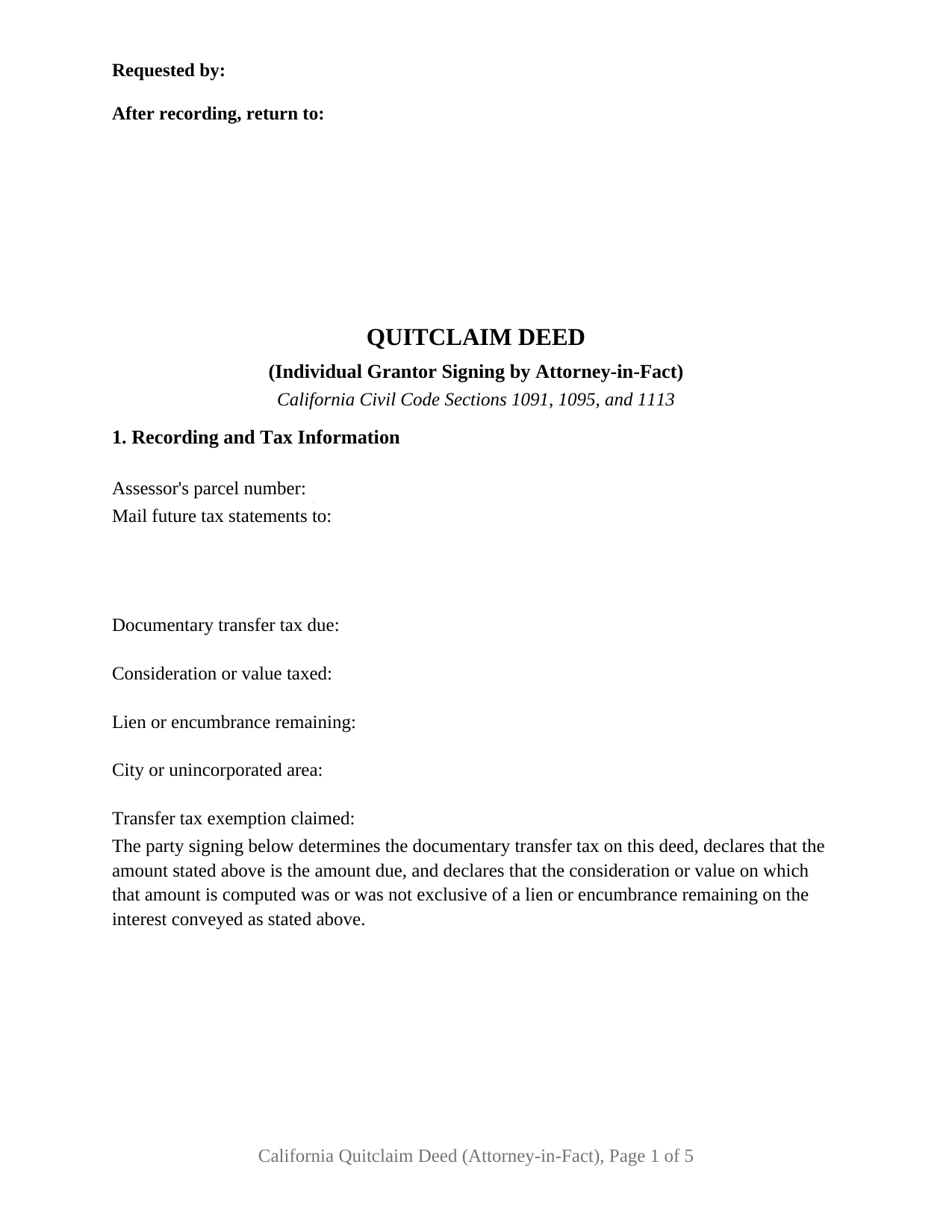
Powers of attorney answer to a recording rule of their own. Under Civil Code Section 1216, a recorded power to convey real property is not revoked by any act of the principal unless the revoking instrument is also acknowledged or proved, certified, and recorded in the same office, which is much of why California title practice expects the power to reach the county record with the deed it authorizes. Probate Code Section 4307 gives a certified copy the force of the original, and Section 4305 makes the agent's affidavit of nonrevocation recordable; both are prepared separately and are not included here. Page one carries what a recorder reads first: the reserved recording space with its requester and return entries, the parcel number, the future tax statement address, and the transfer tax declaration over the tax determiner's signature.
Three files ship: the fillable quitclaim deed, a completed example worked through a Stanislaus County release signed by an agent, and a plain language guide covering every section, the notarial certificate, the fees, and recorder intake. The materials describe California law in general terms and are not legal advice about a particular power of attorney or parcel.
Important: County-Specific Forms
Our quitclaim deed (individual grantor by attorney-in-fact) forms are specifically formatted for each of the 58 counties in California.
After selecting your county, you'll receive forms that meet all local recording requirements, ensuring your documents will be accepted without delays or rejection fees.