California Quitclaim Deed
County Specific Legal Forms Validated as recently as October 14, 2026 by our Forms Development Team
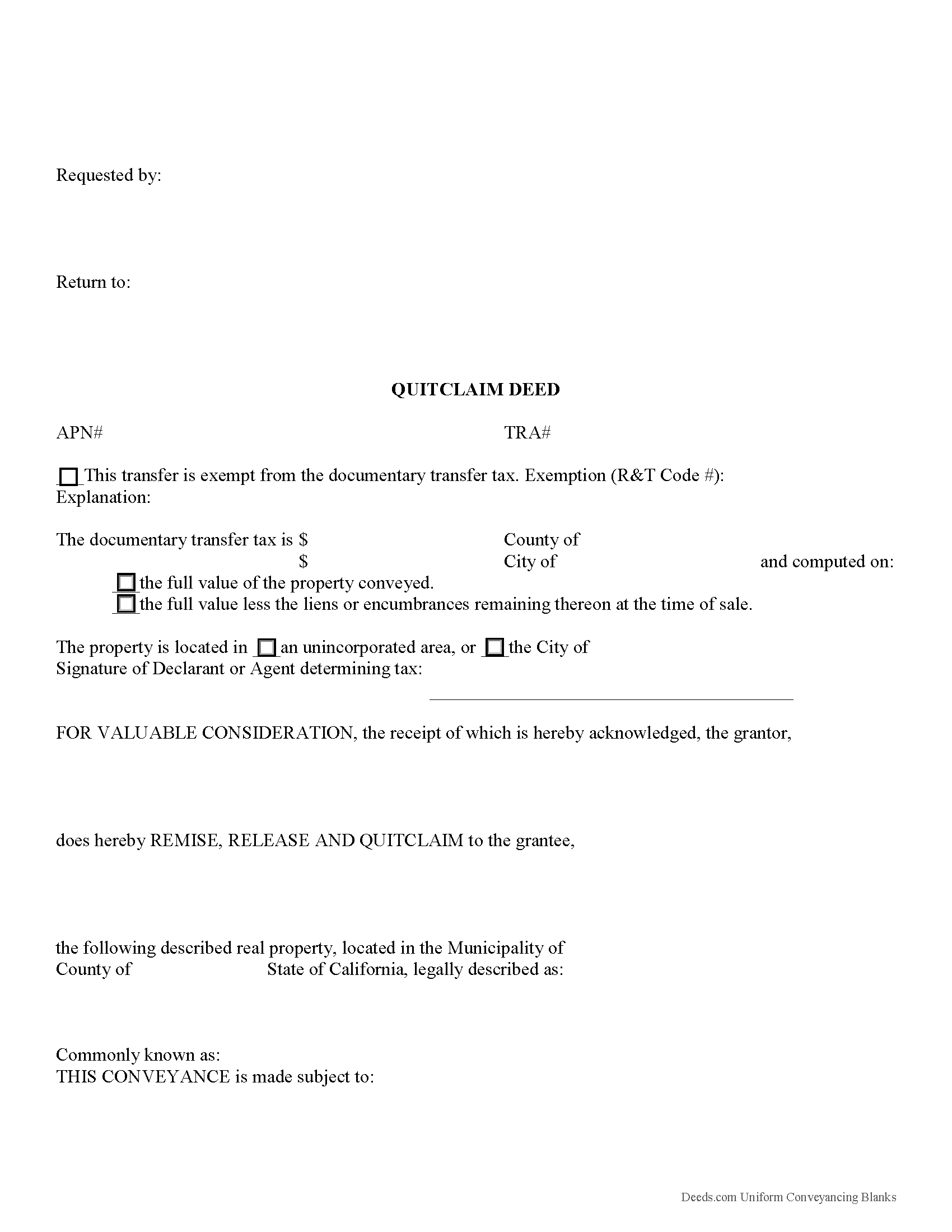
About the California Quitclaim Deed
How to Use This Form
- Select your county from the list
- Download the county-specific form
- Fill in the required information
- Have the document notarized if required
- Record with your county recorder's office
What Others Like You Are Saying
"An excellent resource for users."
"I haven't gotten around to filling out the forms yet, but they look fine to me on the surface. looki…"
"Very simple and made recording a breeze. Worth the fee!"
"Spot on, lets do that again now! Thanks."
"So far, I'm pleased. I am a first-time user, as most of my clients are in California. I look forward…"
4.8/5 from 4,828 reviews. Read all
California wrote a statutory form for the grant deed and none at all for this one. The quitclaim deed lives on practice and decision instead, and what marks it is a word it never uses. This form prepares that instrument in its general configuration: one or two people, signing in their own names, releasing whatever interest they hold to one or two grantees, with nothing promised about the title.
The Word This Deed Leaves Out
Civil Code Section 1092 supplies a statutory deed built on the word grant, and Civil Code Section 1113 attaches two implied covenants to that word and, in its own terms, no others: against a prior conveyance of the same estate by the grantor, and against encumbrances the grantor made or suffered. Drop the word and both covenants fall away, and Section 1106, which carries after-acquired title where an instrument purports to grant a fee simple, stays on the far side of that line too. What the deed does convey is not small: the California Supreme Court has described a quitclaim as being as effective as any other deed to pass whatever title the grantor holds, fee simple included, the difference lying in the absence of warranties.
Open Blanks Instead of Preprinted Status
The form decides as little as possible for the parties. The grantor block is open text sized for two names, and the words beside a name, whether an owner writes an unmarried woman, a married man as separate property, or nothing at all, are the filler's own. The grantee block works the same way and holds the manner of taking title where the grantees state one, whether that reads as joint tenants, tenants in common, or community property with right of survivorship. Four count patterns fit those blocks: one grantor to one grantee, one to two, two to one, and two to two, all of them individuals signing in their own capacity. Two signature blocks follow, each under its own Civil Code Section 1189 acknowledgment certificate headed by the boxed identity notice that section requires; where one person conveys, the second block and its certificate stay blank. What it is not set up for is a signer acting through a corporate office, a management title, a partnership name, a fiduciary capacity, or a power of attorney.
A First Page Built Around Reserved Space
California recorders read page one before anything else, and Government Code Section 27361.6 tells a drafter where to stay out of the way: the top 2.5 inches belong to recording information, with the requester line and return address in the left 3.5 inches of that band. The form places both there and puts the document title immediately below, where Government Code Section 27324 puts the title the recorder indexes. Two more entries follow: the assessor's parcel number, and the address for future tax statements Government Code Section 27321.5 asks for before a fee title deed is accepted.
The Tax Line, and the Signature Under It
Section 1 carries the documentary transfer tax declaration. Revenue and Taxation Code Section 11911 sets the county rate at 55 cents for each 500 dollars of consideration or value above one hundred dollars, exclusive of liens remaining at sale, and Sections 11932 and 11933 want the amount on the face of the document over a declaration signed by the party who determined it, stating whether the taxed amount was or was not exclusive of those liens. Charter cities layer taxes of their own above that rate. Where an exemption applies, county practice enters its code section on the amount line instead of a figure, and the guide walks through the exemptions a quitclaim commonly meets.
What Recording Settles
Government Code Section 27287 makes the notarial acknowledgment the condition of recording, with subscribing witness proof unavailable for deeds. California then runs a race-notice rule: the deed binds the parties without recording under Civil Code Section 1217, while an unrecorded conveyance loses to a later good faith purchaser who records first. Recording proves nothing about the underlying title: Government Code Section 27201 keeps legal sufficiency out of what the recorder examines.
Three files arrive together: the quitclaim deed as a fillable PDF, a completed example worked through a Sonoma County release, and a plain language guide covering every section, the vesting choices on the grantee side, the certificates, and the fees. All of it sets out what California law provides in general terms, and none of it is legal advice about a particular parcel or title.
Important: County-Specific Forms
Our quitclaim deed forms are specifically formatted for each of the 58 counties in California.
After selecting your county, you'll receive forms that meet all local recording requirements, ensuring your documents will be accepted without delays or rejection fees.