Alameda County Revocable Transfer on Death Deed (Trust Beneficiary) Form
Last validated October 7, 2026 by our Forms Development TeamFormatted for recording in Alameda County, for property anywhere in the county: rural and unincorporated areas as well as Alameda, Albany, Berkeley, Castro Valley, Dublin, Emeryville, Fremont, Hayward and 9 more.
- 3 documents included
- Immediate PDF download
- Formatting guarantee
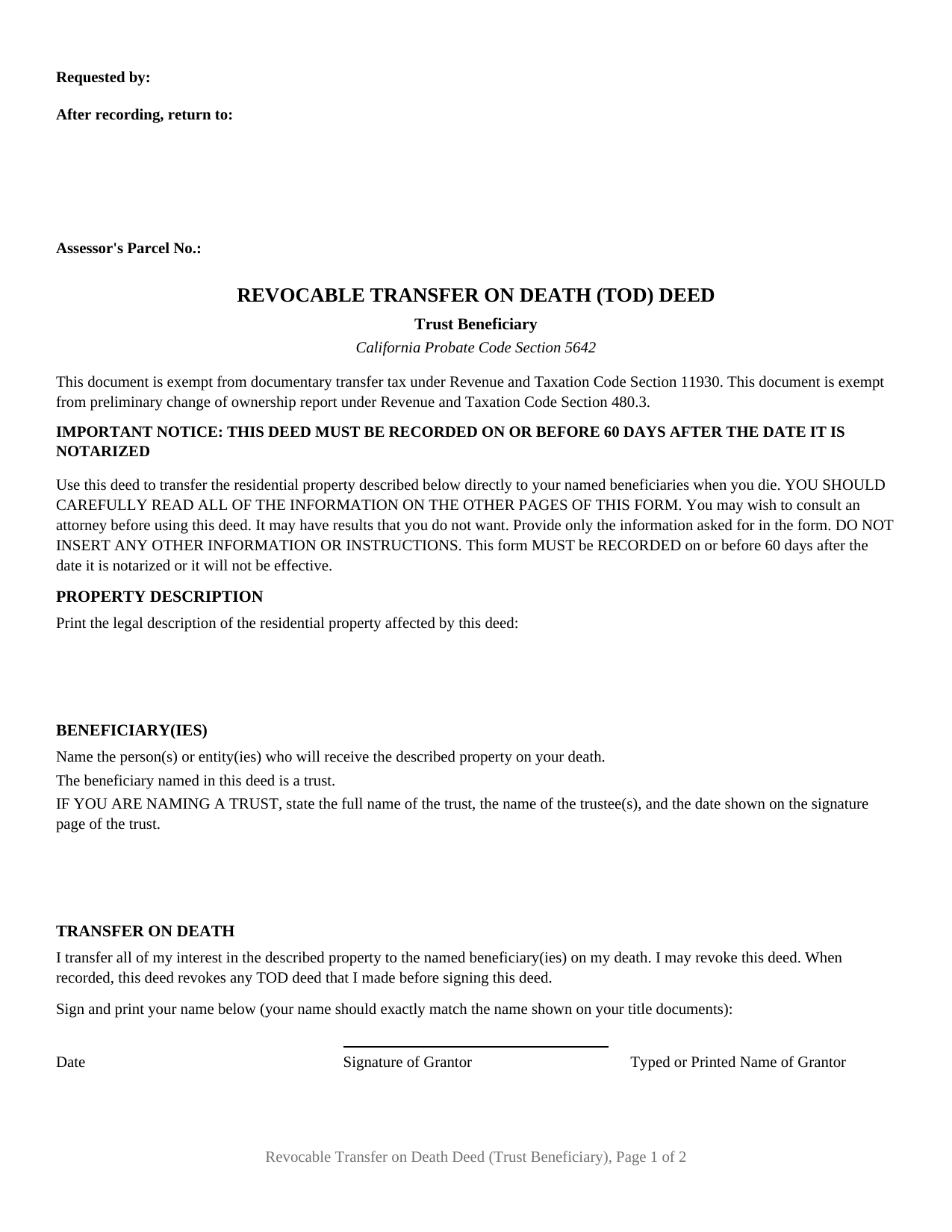
Alameda County Revocable Transfer on Death Deed (Trust Beneficiary) Form
Fill in the blank Revocable Transfer on Death Deed (Trust Beneficiary) form formatted to comply with all California recording and content requirements.
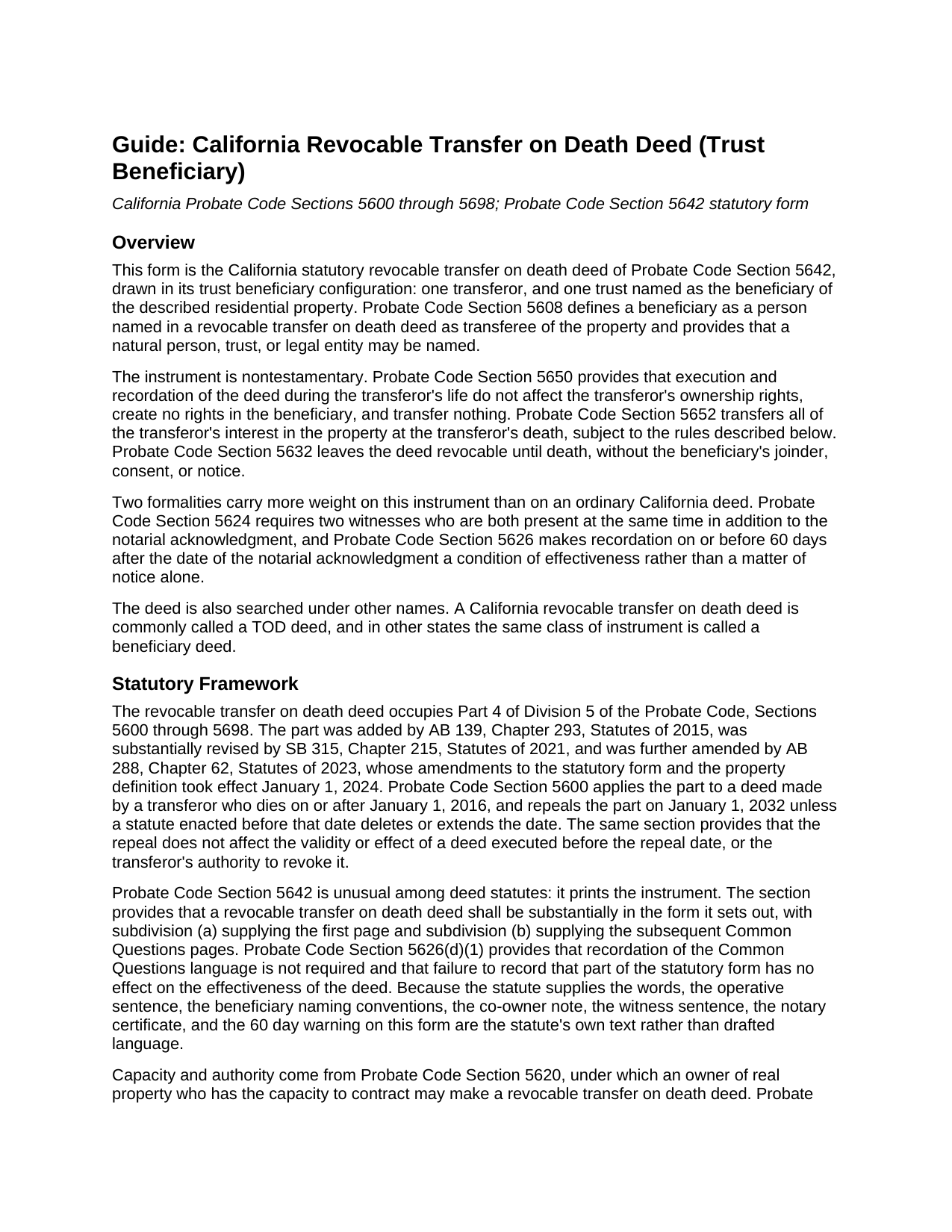
Alameda County Revocable Transfer on Death Deed (Trust Beneficiary) Guide
Line by line guide explaining every blank on the Revocable Transfer on Death Deed (Trust Beneficiary) form.
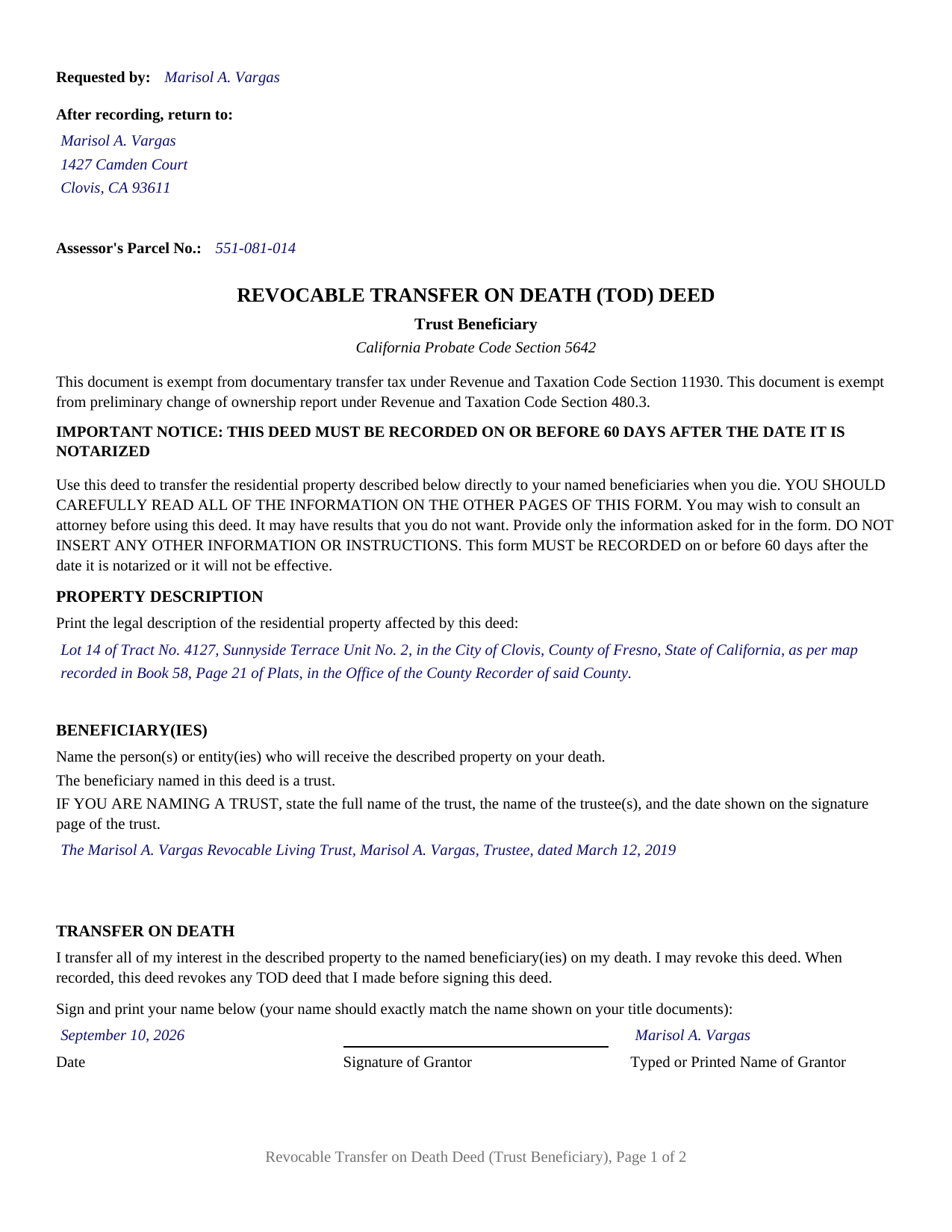
Alameda County Completed Example of the Revocable Transfer on Death Deed (Trust Beneficiary) Document
Example of a properly completed California Revocable Transfer on Death Deed (Trust Beneficiary) document for reference.
All 3 documents above included • One-time purchase • No recurring fees
Immediate Download • Secure Checkout
Additional California and Alameda County documents included at no extra charge:
Where to Record Your Documents
Alameda County Clerk-Recorder
Oakland, California 94607
Hours: Mon-Fri 8:30 to 4:30 (avoid 12:00 to 2:00)
Phone: 510-272-6362 or 888-280-7708
Dublin Office
Dublin, California 94568
Hours: Mon-Fri 8:30 to 4:30
Phone: as above
Recording Tips for Alameda County:
- Bring your driver's license or state-issued photo ID
- Ensure all signatures are in blue or black ink
- Check that your notary's commission hasn't expired
- Documents must be on 8.5 x 11 inch white paper
- Double-check legal descriptions match your existing deed
Cities and Jurisdictions in Alameda County
Properties in any of these areas use Alameda County forms:
- Alameda
- Albany
- Berkeley
- Castro Valley
- Dublin
- Emeryville
- Fremont
- Hayward
- Livermore
- Newark
- Oakland
- Piedmont
- Pleasanton
- San Leandro
- San Lorenzo
- Sunol
- Union City
Hours, fees, requirements, and more for Alameda County
How do I get my forms?
Forms are available for immediate download after payment. The Alameda County forms will be in your account ready to download to your computer. An account is created for you during checkout if you don't have one. Forms are NOT emailed.
Are these forms guaranteed to be recordable in Alameda County?
Yes. Our form blanks are guaranteed to meet or exceed the applicable formatting requirements used for recording in Alameda County, including margin requirements, font requirements, and other layout standards. This guarantee applies to formatting, not to the legal sufficiency of information entered by the user or the suitability of a form for a particular transaction.
Can I reuse these forms?
Yes. You can reuse the forms for your personal use. For example, if you have multiple properties in Alameda County you only need to order once.
What do I need to use these forms?
The forms are PDFs that you fill out on your computer. The free Adobe Acrobat Reader is recommended, and most PDF apps also work. You do NOT enter your property information online - you download the blank forms and complete them privately on your own computer.
Are there any recurring fees?
No. This is a one-time purchase. Nothing to cancel, no memberships, no recurring fees.
How much does it cost to record in Alameda County?
Recording fees in Alameda County vary. Contact the recorder's office at 510-272-6362 or 888-280-7708 for current fees.
Questions answered? Let's get started!
A trust can be the transferee of California real property at death, and this deed names one. The form is the statutory instrument of Probate Code Section 5642 in its trust beneficiary configuration: one transferor signs, and the beneficiary entry holds a trust, identified as the statute identifies one. Probate Code Section 5608 makes that possible: a natural person, trust, or legal entity may be named as transferee. Californians searching for a TOD deed or a beneficiary deed land here.
A trust is identified by three things
The statutory convention for a trust is short and exact: the trust's full name, the trustee or trustees, and the date printed on the trust instrument's signature page. Those three items are what the beneficiary entry takes, and the form's instruction against inserting other information keeps the rest out, a trust address included. The date works as identification, not as a deadline, because a family may have restated a trust more than once. Section 5659 covers a designation that still goes wrong, leaving an ambiguity in designating a beneficiary open to judicial construction where the transferor's intention can be determined.
The deed names the trust; the trust does the dividing
A designation running to a trust moves the sharing question off the deed. Probate Code Section 5652 transfers the interest in accordance with the deed, subject to the right to disclaim, and with one beneficiary there are no equal shares to allocate and no cotenancy to describe. What follows is the trust instrument's work, under its own terms and trustee, none of it on the deed. Two provisions still reach the designation: Section 5652 conditions the interest on surviving the transferor, and Section 5658 lets a court reform a charitable designation.
One signature row, one certificate, one trust
The instrument carries one transferor. Section 5642 prints the signing area as a captioned row of date, signature, and printed name, one acknowledgment certificate follows, and the note under the row confines the deed to the signer's ownership share, a co-owner who wants a beneficiary executing and recording a separate deed. The beneficiary entry is set up for the trust convention alone; a designation naming an individual, or a public or private entity, follows the statute's other conventions. A transferor naming a long standing revocable living trust so the residence joins the rest of the trust estate, and one naming a trust created for a relative, present the designation this deed recites.
Two witnesses, then sixty days
California puts formalities on this instrument that its grant and quitclaim deeds never carry. Section 5624 calls for two witnesses, together at one time, watching the transferor sign or acknowledge that signature, and no notary touches what they sign. Section 5626 makes recordation an effectiveness condition and starts the sixty day window at the notarial acknowledgment, not at signing, hence the capitalized warning on page one. Under Section 5650, while the transferor lives the recorded deed transfers nothing and gives the trust no interest.
What the trust would take
Title arrives as it stands under Section 5652, without covenant or warranty and subject to each limitation of record at the transferor's death, a deed of trust among them. Section 5664 is the harder boundary: where title is held at death in joint tenancy or as community property with right of survivorship, the deed is void and survivorship governs. Section 5610 confines the chapter to one to four unit residential property or a residential unit in a common interest development, excluding agricultural parcels over 40 acres. Unsecured debts follow as well: Section 5672 makes a beneficiary personally liable for them, Section 5674 caps the exposure at the death value of the property net of liens, and Section 5674(a) drops the liability once administration of the transferor's estate begins and the beneficiary meets Section 5677 or Section 5678.
The deed goes to the recorder for the county holding the property, page one left clear at the top for the recording stamp under Government Code Section 27361.6, with Section 27324 placing the title just under that space for indexing. Probate Code Section 5656 spares the filing a documentary transfer tax, a tax declaration, and a preliminary change of ownership report. County fee schedules differ. Included are the blank fillable deed, a completed example built on a Fresno County fact pattern naming one living trust, and the guide that walks each part of the form. Both speak about the form and California law in general terms, and neither is legal advice.
Important: Your property must be located in Alameda County to use these forms. Documents should be recorded at the county recording office listed above.
This Revocable Transfer on Death Deed (Trust Beneficiary) meets all recording requirements specific to Alameda County.
Our Promise
The documents you receive here are guaranteed to meet or exceed the applicable Alameda County recording format requirements. If there is a rejection caused by our formatting, we will correct the issue or refund your payment. This guarantee applies to document formatting only and does not extend to information entered by the user, the selection of the form, or the legal effect of the completed document.
Save Time and Money
Get your Alameda County Revocable Transfer on Death Deed (Trust Beneficiary) form done right the first time with Deeds.com Uniform Conveyancing Blanks. At Deeds.com, we understand that your time and money are valuable resources, and we don't want you to face a penalty fee or rejection imposed by a county recorder for submitting nonstandard documents. We constantly review and update our forms to meet rapidly changing state and county recording requirements for roughly 3,500 counties and local jurisdictions.
4.8 out of 5 - ( 4,818 Reviews )
John M. 5 out of 5 stars
Easy to use site with a good selection of documents
Thank you!
Sterling H. 4 out of 5 stars
I liked being able to drill down to state and county. Just simply the search for all property records
We welcome your positive feedback and are thrilled to have met your expectations. Thank you for choosing our services.
Tonia H. 5 out of 5 stars
Could not be happier with the forms received. Everything went smooth from completing them to getting them recorded. No easy feat with our recorder, always seems to be an issue but not this time... Very Happy!
We appreciate your business and value your feedback. Thank you. Have a wonderful day!
Melody P. 5 out of 5 stars
Great service continues! Thanks again!
Thank you!
John D. 5 out of 5 stars
Very helpful and easy to use.
Thank you for your feedback. We really appreciate it. Have a great day!
GERALD P. 5 out of 5 stars
Product is as advertised. Most beneficial is including detailed instructions and examples. Most other options did not include instructions.
Thank you for your feedback. We really appreciate it. Have a great day!
Scott P. 5 out of 5 stars
The site was easy to use and find what I needed. The purchase and download were very easy.
Thank you!
JOHN S. 5 out of 5 stars
They had everything for a living trust but the form to transfer your house into the living trust
We appreciate your business and value your feedback. Thank you. Have a wonderful day!
SHERRILL B. 5 out of 5 stars
I received prompt attention to the package I submitted. It was submitted promptly the recorders office with a quick turn around for the recorded document. Overall a very pleasant experience.
We are sincerely grateful for your feedback and are committed to providing the highest quality service. Thank you for your trust in us.
Luz G. 5 out of 5 stars
very user friendly
Thank you for taking a moment to share your thoughts.
constance t. 5 out of 5 stars
Excellent service!
We appreciate your business and value your feedback. Thank you. Have a wonderful day!
Alfred M. 5 out of 5 stars
It was a simple process and easily understood the process was seamless and I would highly recommend this to anyone looking to do this.
Thank you for your feedback. We really appreciate it. Have a great day!
Kristen R. 5 out of 5 stars
wonderful experience. highly recommend. will use again.
We deeply appreciate the trust you have placed in our services. Thank you for your valuable feedback and for choosing us.
Michael W. 5 out of 5 stars
I thought it was fine, but I would like to have the option to download Word versions of each form, for easier preparation on my end.
We appreciate your business and value your feedback. Thank you. Have a wonderful day!
Misty M. 5 out of 5 stars
I appreciate the Guide and the Sample pages.
Thank you!