California Revocable Transfer on Death Deed (Trust Beneficiary)
County Specific Legal Forms Validated as recently as September 16, 2026 by our Forms Development Team
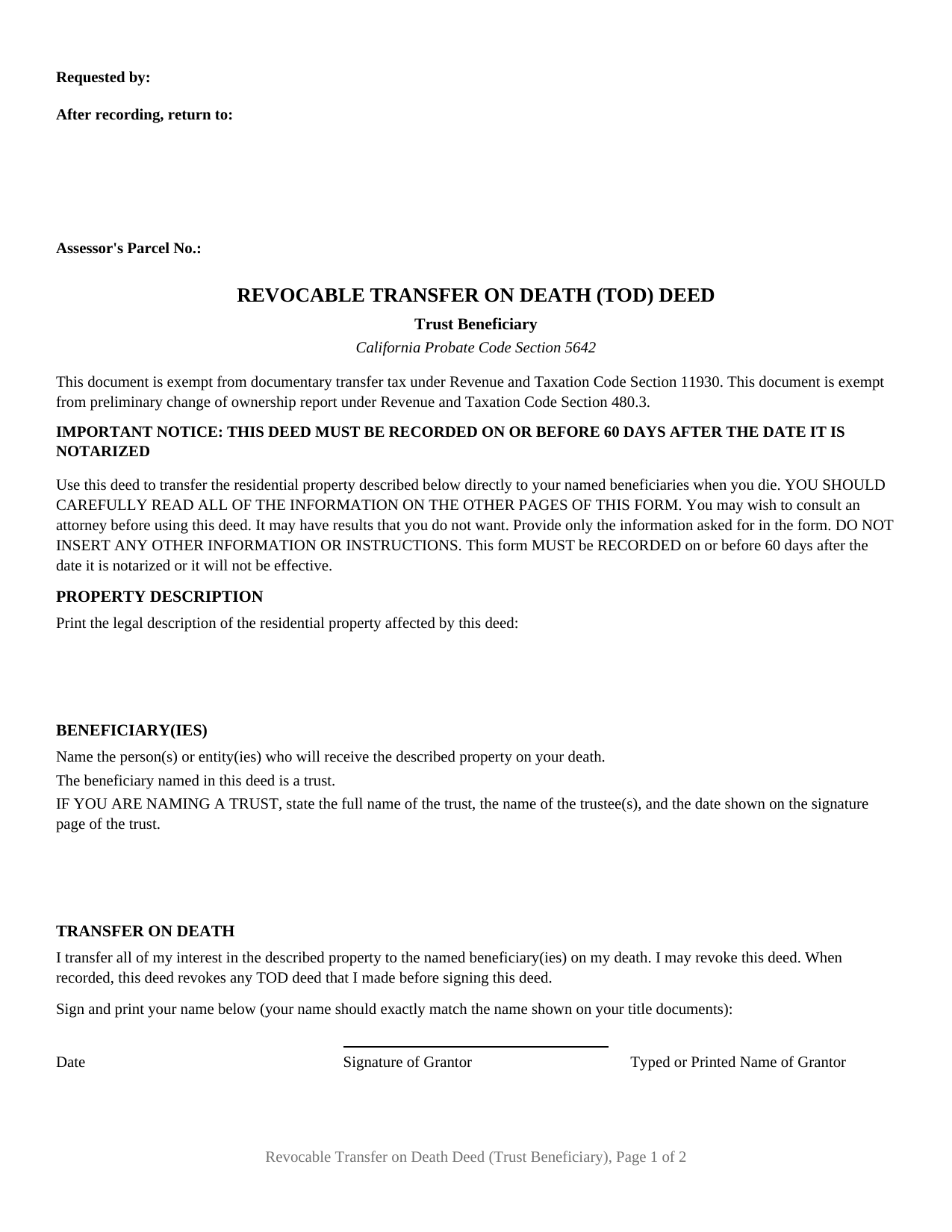
About the California Revocable Transfer on Death Deed (Trust Beneficiary)
How to Use This Form
- Select your county from the list
- Download the county-specific form
- Fill in the required information
- Have the document notarized if required
- Record with your county recorder's office
What Others Like You Are Saying
"You have made this process so simple - I can see it would have been complicated and frustrating with…"
"Excellent instructions to guide one through the warranty deed."
"So far so good!"
"Easy to download. Hopefully easy to fill in. Just wish there was wording for a Beneficiary Deed for …"
"I was very pleased with the entire package we received. It will certainly make my job easier."
4.8/5 from 4,815 reviews. Read all
A trust can be the transferee of California real property at death, and this deed names one. The form is the statutory instrument of Probate Code Section 5642 in its trust beneficiary configuration: one transferor signs, and the beneficiary entry holds a trust, identified as the statute identifies one. Probate Code Section 5608 makes that possible: a natural person, trust, or legal entity may be named as transferee. Californians searching for a TOD deed or a beneficiary deed land here.
A trust is identified by three things
The statutory convention for a trust is short and exact: the trust's full name, the trustee or trustees, and the date printed on the trust instrument's signature page. Those three items are what the beneficiary entry takes, and the form's instruction against inserting other information keeps the rest out, a trust address included. The date works as identification, not as a deadline, because a family may have restated a trust more than once. Section 5659 covers a designation that still goes wrong, leaving an ambiguity in designating a beneficiary open to judicial construction where the transferor's intention can be determined.
The deed names the trust; the trust does the dividing
A designation running to a trust moves the sharing question off the deed. Probate Code Section 5652 transfers the interest in accordance with the deed, subject to the right to disclaim, and with one beneficiary there are no equal shares to allocate and no cotenancy to describe. What follows is the trust instrument's work, under its own terms and trustee, none of it on the deed. Two provisions still reach the designation: Section 5652 conditions the interest on surviving the transferor, and Section 5658 lets a court reform a charitable designation.
One signature row, one certificate, one trust
The instrument carries one transferor. Section 5642 prints the signing area as a captioned row of date, signature, and printed name, one acknowledgment certificate follows, and the note under the row confines the deed to the signer's ownership share, a co-owner who wants a beneficiary executing and recording a separate deed. The beneficiary entry is set up for the trust convention alone; a designation naming an individual, or a public or private entity, follows the statute's other conventions. A transferor naming a long standing revocable living trust so the residence joins the rest of the trust estate, and one naming a trust created for a relative, present the designation this deed recites.
Two witnesses, then sixty days
California puts formalities on this instrument that its grant and quitclaim deeds never carry. Section 5624 calls for two witnesses, together at one time, watching the transferor sign or acknowledge that signature, and no notary touches what they sign. Section 5626 makes recordation an effectiveness condition and starts the sixty day window at the notarial acknowledgment, not at signing, hence the capitalized warning on page one. Under Section 5650, while the transferor lives the recorded deed transfers nothing and gives the trust no interest.
What the trust would take
Title arrives as it stands under Section 5652, without covenant or warranty and subject to each limitation of record at the transferor's death, a deed of trust among them. Section 5664 is the harder boundary: where title is held at death in joint tenancy or as community property with right of survivorship, the deed is void and survivorship governs. Section 5610 confines the chapter to one to four unit residential property or a residential unit in a common interest development, excluding agricultural parcels over 40 acres. Unsecured debts follow as well: Section 5672 makes a beneficiary personally liable for them, Section 5674 caps the exposure at the death value of the property net of liens, and Section 5674(a) drops the liability once administration of the transferor's estate begins and the beneficiary meets Section 5677 or Section 5678.
The deed goes to the recorder for the county holding the property, page one left clear at the top for the recording stamp under Government Code Section 27361.6, with Section 27324 placing the title just under that space for indexing. Probate Code Section 5656 spares the filing a documentary transfer tax, a tax declaration, and a preliminary change of ownership report. County fee schedules differ. Included are the blank fillable deed, a completed example built on a Fresno County fact pattern naming one living trust, and the guide that walks each part of the form. Both speak about the form and California law in general terms, and neither is legal advice.
Important: County-Specific Forms
Our revocable transfer on death deed (trust beneficiary) forms are specifically formatted for each of the 58 counties in California.
After selecting your county, you'll receive forms that meet all local recording requirements, ensuring your documents will be accepted without delays or rejection fees.