Colorado Quitclaim Deed (Trustee Grantee)
County Specific Legal Forms Validated as recently as October 12, 2026 by our Forms Development Team
About the Colorado Quitclaim Deed (Trustee Grantee)
How to Use This Form
- Select your county from the list
- Download the county-specific form
- Fill in the required information
- Have the document notarized if required
- Record with your county recorder's office
What Others Like You Are Saying
"Easy to use service to download all needed forms"
"Prompt review and submission of documents could be an appropriate tagline for this business. The att…"
"I was very pleased. It was the form I needed. I was getting discouraged by companies that wanted me …"
"My experience could not have been better. Easy to communicate with, even though I'm largely ignorant…"
"The information provided is quite thorough.I recommend this Site to anyone, in need of Material for …"
4.8/5 from 4,830 reviews. Read all
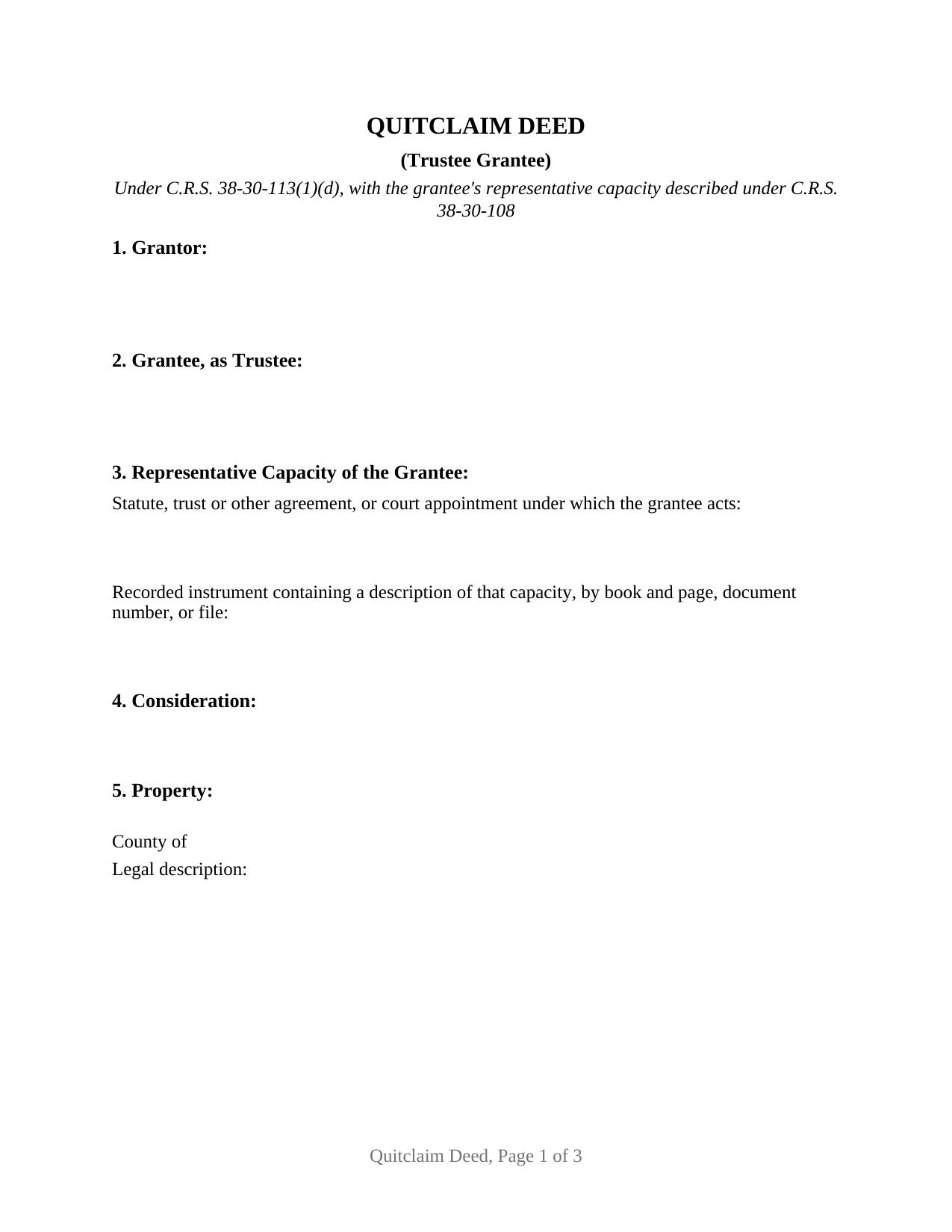
Colorado reads the grantee line of a deed closely when a trustee is on it. Where the grantee is described as trustee, C.R.S. 38-30-108(1) calls for the instrument to describe that representative capacity as well, and a deed that leaves the description out records as a conveyance to the named person alone. This fillable quitclaim deed is configured for that posture: one individual grantor releasing the interest that grantor holds, one grantee taking as trustee, and a numbered section carrying the capacity description the statute looks for.
The statutory test the grantee line has to pass
Section 38-30-108(1) reaches a grantee described as trustee, agent, conservator, executor, administrator, attorney-in-fact, personal representative, nominee, custodian, or a person acting in any other representative capacity. The instrument describes that capacity by one or more statutory means, among them identifying the statute, the trust or other agreement, or the court appointment under which the grantee acts, or pointing by book and page, document number, or file to a recorded writing that already contains the description. Subsection (2) supplies the consequence of silence: the grantee description is then held a description of the person only, and it is not notice of the representative capacity. Subsection (3) leaves a later route open, an affidavit recorded against the earlier conveyance, prepared and recorded on its own and not part of this package. Section 3 of this form exists so the first route is available at the moment the deed is drafted.
A release, not a promise
The conveyance itself is Colorado's statutory quitclaim, the form at C.R.S. 38-30-113(1)(d): words of warranty omitted, quitclaim standing where convey would stand. The grantor sells and quitclaims the described property with all its appurtenances, and the deed states its own character on its face, no covenants of warranty of any kind and no after-acquired title. A trustee grantee therefore receives exactly what the grantor held at delivery, which is why the trust side of the transaction usually rests on the title record and the trust instrument rather than on promises in the deed.
One grantor, one trustee, one certificate
The form recites exactly one grantor, a natural person conveying in an individual capacity, with one signature line and one acknowledgment certificate on the individual short form at C.R.S. 24-21-516(1)(a). The grantee entry recites a single trustee and asks for that trustee's legal address, because C.R.S. 38-35-109(2) sends a deed back unrecorded when the grantee's legal address is missing. An owner releasing a parcel to the trustee of a trust drawn by someone else, a co-owner releasing an undivided share to a trustee who already holds the balance of the record title, and a conveyance to a person acting under a court appointment rather than a trust agreement all present the trustee grantee pattern this deed recites. The form is not set up for two grantors, for an entity or trustee grantor, for a signature through an attorney-in-fact, or for co-trustees as grantees: C.R.S. 38-31-101(3) presumes joint tenancy for a conveyance to two or more trustees, which is the reverse of the tenancy in common default, and this single-trustee form never reaches that presumption. A conveyance naming the trust itself as grantee travels C.R.S. 38-30-108.5 instead, which lets a trust hold property in the name of the trust and lets a trustee record a statement of authority to evidence the trust and the trustee's authority.
What travels to the recorder
The deed is recorded with the clerk and recorder of the county holding the land, where C.R.S. 38-35-109 rewards the first party to record without notice. Colorado's statewide charge on a conveyance is the documentary fee rather than a transfer tax, and it attaches only above five hundred dollars of total consideration, at a penny per hundred dollars, so a trust funding conveyance recited at nominal consideration commonly carries none; Section 6 holds the fee figure or the exemption claimed at the counter. A Real Property Transfer Declaration goes in with the deed, and the property section keeps the street address next to the legal description the way C.R.S. 38-35-122 contemplates, with a line for the assessor schedule or parcel number.
The purchase delivers this deed as a fillable PDF, a completed example filled in for a Douglas County conveyance to a family trust trustee with the acknowledgment completed, and a guide covering every numbered section, the capacity description, the notarization, and the recording steps. The materials are informational and are not legal advice.
Important: County-Specific Forms
Our quitclaim deed (trustee grantee) forms are specifically formatted for each of the 64 counties in Colorado.
After selecting your county, you'll receive forms that meet all local recording requirements, ensuring your documents will be accepted without delays or rejection fees.