Colorado Quitclaim Deed (Interspousal)
County Specific Legal Forms Validated as recently as September 3, 2026 by our Forms Development Team
About the Colorado Quitclaim Deed (Interspousal)
How to Use This Form
- Select your county from the list
- Download the county-specific form
- Fill in the required information
- Have the document notarized if required
- Record with your county recorder's office
What Others Like You Are Saying
"Great service! Super easy to use! I used the service to download a deed notice to do a TOD on a prop…"
"I was quite impressed by the quality of your documents and the ease of the download."
"You made this so easy to process the Executor Deed. THANK YOU a thousand times. Appreciate that all …"
"Professional, simple. Very good."
"Excellent! Follow the prompts for easy access. Forms readily available. Thanks!"
4.8/5 from 4,828 reviews. Read all
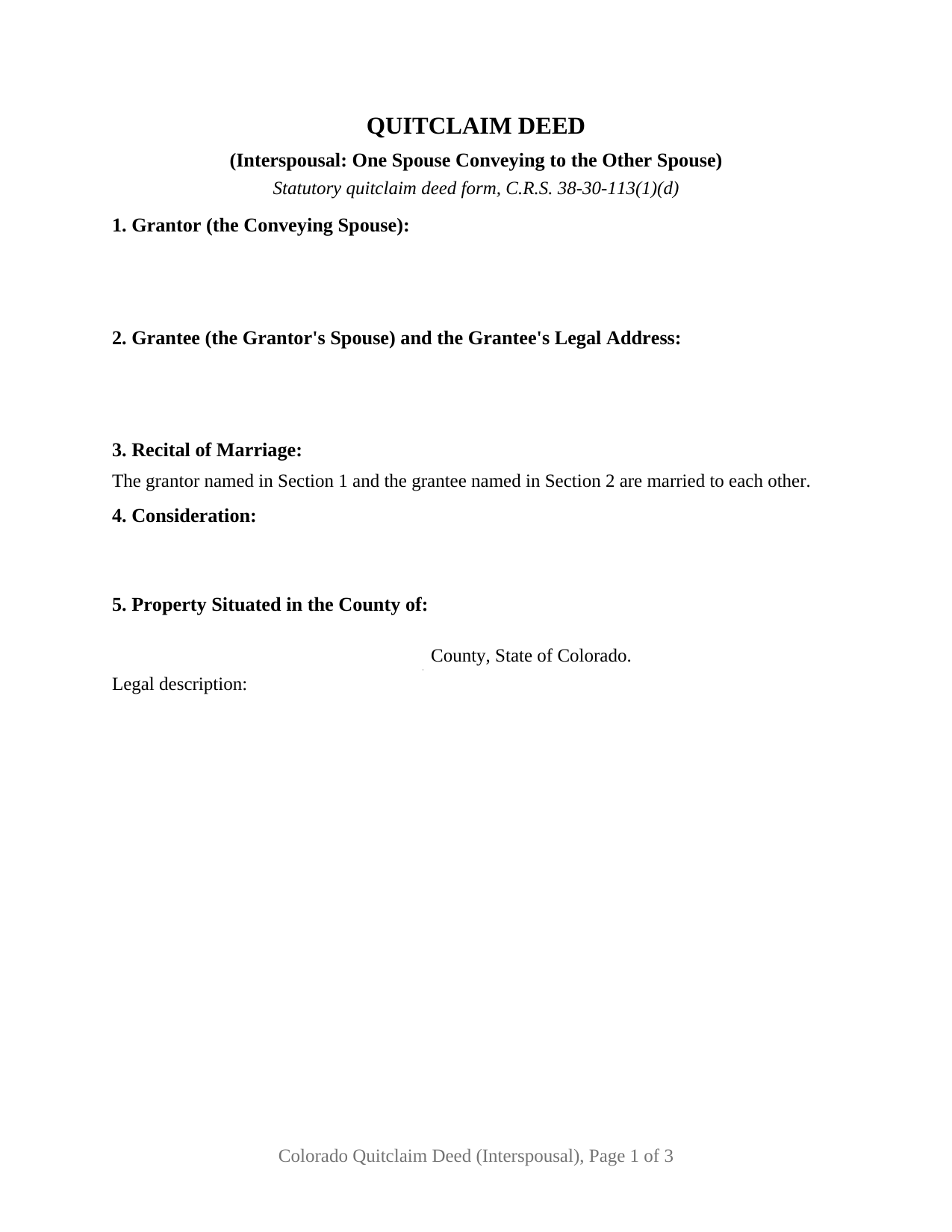
An interspousal quitclaim deed puts the same marriage on both sides of the instrument: one spouse is the grantor, the other spouse is the grantee, and the deed states that on its face. This Colorado form is configured for that single movement of record title between spouses, carrying one grantor entry, one grantee entry, a printed marriage recital, one signature line, and one acknowledgment certificate, in the statutory quitclaim wording at C.R.S. 38-30-113(1)(d).
Why the marriage appears in the deed itself
Colorado recognizes no community property for spouses acquiring Colorado land, no tenancy by the entirety, and neither dower nor curtesy, so title moving between spouses travels the ordinary conveyancing rules. Marriage changes two things: evidence and homestead. Section 3 prints the statement that the grantor and the grantee are married to each other, and C.R.S. 38-35-118(1) gives that kind of statement evidentiary weight, treating a marital status recital in a recorded conveyance as prima facie evidence of what it says, rebuttable, yet read by every examiner who later works the chain of title. Homestead is the second point: C.R.S. 38-41-202(3) lets an owner convey free and clear of the automatic homestead with the owner's signature alone, while a recorded homestead statement under C.R.S. 38-41-202(4) calls for the signature of both spouses, and the guide sets out what that subsection says, and where its text stops, on a deed whose grantee is the other spouse.
Sells and quitclaims, with nothing promised
The conveyance is Colorado's statutory quitclaim: words of warranty left out, quitclaim standing where convey would stand. The grantee spouse receives whatever the grantor spouse holds at delivery, a whole record title, an undivided share, or nothing, and the deed promises none of it. That character is printed in the instrument's own text, no covenant of warranty of any kind and no title acquired after delivery, which is the line C.R.S. 38-30-113(1)(d) draws between a quit claim deed and the bargain and sale form in the same statute. Between spouses the missing covenants tend to matter less than in a sale, because both parties already know the title they are moving, one reason the interspousal transfer deed so often takes quitclaim form.
One signer, one certificate
The form recites exactly one grantor, a married natural person conveying in an individual capacity, and exactly one grantee, that grantor's spouse. The grantee signs nothing, since a grantee takes under a deed rather than executing it, and a single acknowledgment certificate follows the single signature on the individual short form at C.R.S. 24-21-516(1)(a). A spouse whose name alone stands on the vesting instrument passing it to the other spouse, spouses who took title together where one releases an undivided interest so the other holds the whole, and a conveyance carrying out a written agreement between spouses present the posture this deed recites. The form is not set up for a grantee other than the grantor's spouse, for two people signing as grantors, or for an entity, trustee, or attorney-in-fact signature.
The gift exemption on the face of the deed
Spouses frequently exchange nothing for the conveyance, and Colorado's documentary fee statute meets that in two places: nothing is payable where consideration is absent or reaches no more than 500 dollars, and C.R.S. 39-13-104(1)(b) separately exempts a deed conveying title in consequence of a gift. Because C.R.S. 39-13-104(2) has an exemption claimed at the moment the deed is offered for recording, this spouse to spouse deed carries a numbered entry for the fee or the exemption, which the completed example fills in with the gift exemption. Beside it sit the entries Colorado recording law watches for, the grantee's legal address and a street address next to the legal description.
Recording puts the transfer on the record
The executed deed goes to the clerk and recorder of the county where the property sits, at the flat statutory document charge quoted at 43 dollars on county fee schedules since July 1, 2025, with a Real Property Transfer Declaration alongside. Recording is what fixes the grantee spouse's position under C.R.S. 38-35-109, which protects whoever records first without notice; a deed signed and left in a drawer leaves the public record reading as it did before.
The purchase delivers this interspousal quitclaim deed as a fillable PDF, a completed example filled in for a Boulder County conveyance between spouses with the acknowledgment completed, and a guide covering every numbered section, the notarization, and the recording steps. The materials are informational and are not legal advice.
Important: County-Specific Forms
Our quitclaim deed (interspousal) forms are specifically formatted for each of the 64 counties in Colorado.
After selecting your county, you'll receive forms that meet all local recording requirements, ensuring your documents will be accepted without delays or rejection fees.