Colorado Quitclaim Deed
County Specific Legal Forms Validated as recently as August 29, 2026 by our Forms Development Team
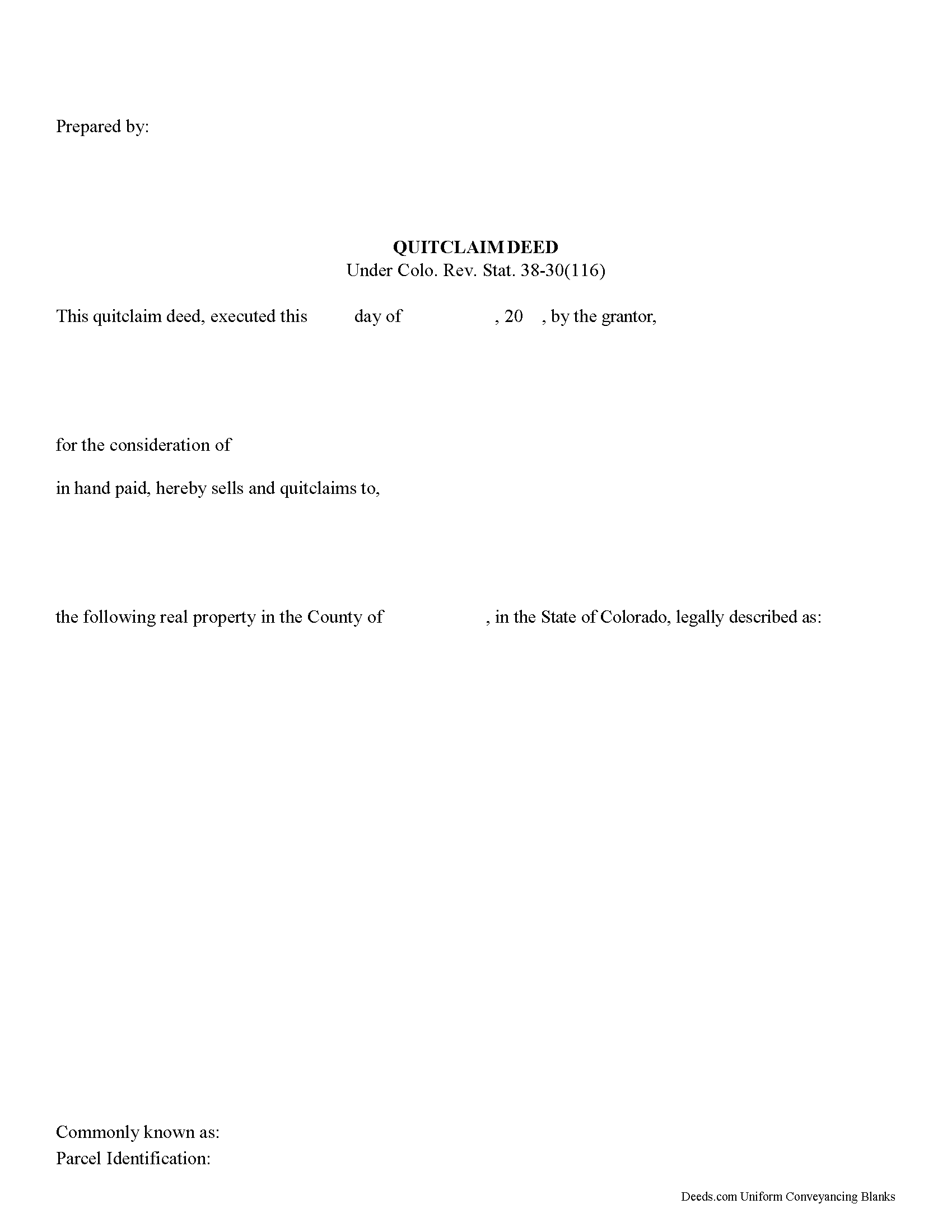
About the Colorado Quitclaim Deed
How to Use This Form
- Select your county from the list
- Download the county-specific form
- Fill in the required information
- Have the document notarized if required
- Record with your county recorder's office
What Others Like You Are Saying
"Excellent service, great feedback and recommendations by the deed preparer, and I really appreciate …"
"Thank you! You made the process of filing something unusual very easy and efficiently. I will defini…"
"Even for a novice like me, this site was easy to use, with very clear & simple options and instr…"
"Deeds.com was simple to use and had a quick turnaround. Saved me so much time hunting around on the …"
"This form really helped me out a lot could be a little more explanatory in some areas but all and al…"
4.8/5 from 4,828 reviews. Read all
Colorado keeps its deed forms in a single statute, and since 2019 that one statute has carried all four. Section 38-30-113 of the Colorado Revised Statutes prints one conveyancing paragraph, and which deed results depends on what is added to it and what is struck out. Remove the words of warranty, put quitclaim where convey stands, and what is left is the instrument this fillable form prepares.
One paragraph, four deeds, one substituted word
The paragraph reads the same whichever deed is being made: a named grantor, for a consideration in hand paid, sell(s) and convey(s) described real property to a named grantee. Subsection (1)(a) adds warranty words. Subsection (1)(b) narrows them to persons claiming under the grantor. Subsection (1)(c) leaves them out, yielding a bargain and sale deed. Subsection (1)(d) leaves them out and changes one word, quitclaim(s) for convey(s). The result warrants nothing and leaves behind any interest its grantor later acquires, which is the whole distance between a quit claim deed and the bargain and sale form one subsection above.
The section number that left the books in 2019
Until March of that year the quitclaim had a section of its own. Section 38-30-116 described a deed executed on the Section 38-30-113 form with quitclaim put in for convey and the warranty phrase dropped. House Bill 19-1098 repealed it outright and rewrote Section 38-30-113 to hold every form in one place, reaching deeds executed on or after March 7, 2019. County recorder pages and title company reference sheets still point readers at the repealed number, describing the mechanics accurately while citing law that no longer exists. This deed cites the subsection in force.
Blanks that carry the parties' own words
This is the base configuration of the Colorado quitclaim deed, and what defines it is what the instrument declines to print. The party entries in Sections 1 and 2 are free form, four lines apiece, and each takes one natural person or two, signing in their own capacity. No status, capacity, or co-ownership wording appears anywhere on the printed deed, so a grantor stating a marital status, or grantees taking as joint tenants with right of survivorship rather than as tenants in common, write those words into the block holding their names. Section 7 provides that a designation of the manner in which the grantees take title, stated in Section 2, is part of the deed, which is what carries into the operative text the joint tenancy declaration C.R.S. 38-31-101 asks for. Two grantor signature blocks and two acknowledgment certificates follow, on the individual capacity short form at C.R.S. 24-21-516(1)(a); where a single grantor conveys, the second block and certificate stay empty. One person releasing an undivided share, two people conveying a parcel they hold together, and two grantors passing title to two grantees taking with survivorship all present count patterns this deed recites. The form is not set up for a corporation, limited liability company, partnership, or trustee on the giving side, for a signature given through an attorney-in-fact, or for three or more people on either side.
Two addresses, and what the counter costs
Colorado polices one entry on the face of a deed and forgives another. C.R.S. 38-35-109(2) has a deed dated after January 1, 1977 that omits the grantee's legal address returned instead of recorded, so the grantee entry collects a complete one, while C.R.S. 38-30-113(3), inside the deed forms statute itself, provides that failure to state the address of the grantor or the grantee does not affect the deed's validity. Recordability and validity answer different questions. Beside the legal description sits the street address entry C.R.S. 38-35-122 asks for, with a line for the assessor's schedule number. The per-document recording charge has been a flat statutory figure since July 1, 2025, quoted at 43 dollars on county fee pages with surcharges. The statewide charge on the conveyance is the documentary fee, not a transfer tax: a cent per 100 dollars, owed only above 500 dollars of consideration, or 24 dollars and 50 cents against the example's 245,000 dollar transfer.
Three files arrive with the purchase: the quitclaim deed as a fillable PDF, a completed example set in Weld County where two grantors pass a platted lot to two grantees taking with survivorship, and a guide walking the numbered sections, the ways Colorado lets grantees hold title, the notarization, and the recording steps. The materials are informational and are not legal advice.
Important: County-Specific Forms
Our quitclaim deed forms are specifically formatted for each of the 64 counties in Colorado.
After selecting your county, you'll receive forms that meet all local recording requirements, ensuring your documents will be accepted without delays or rejection fees.