Colorado Quitclaim Deed (Married Couple as Grantors)
County Specific Legal Forms Validated as recently as September 16, 2026 by our Forms Development Team
About the Colorado Quitclaim Deed (Married Couple as Grantors)
How to Use This Form
- Select your county from the list
- Download the county-specific form
- Fill in the required information
- Have the document notarized if required
- Record with your county recorder's office
What Others Like You Are Saying
"Loved my experience with deeds.com! Easy and simple to fill in the form, plus the extra instructions…"
"I truly appreciate you and you service for all you do to help me ThankYou kathrynchertock"
"Very good forms and the online recording was a blessing."
"Deeds.com was a great experience in helping me get some important documents recorded.I would recomme…"
"Simply to use. Excellent communication."
4.8/5 from 4,828 reviews. Read all
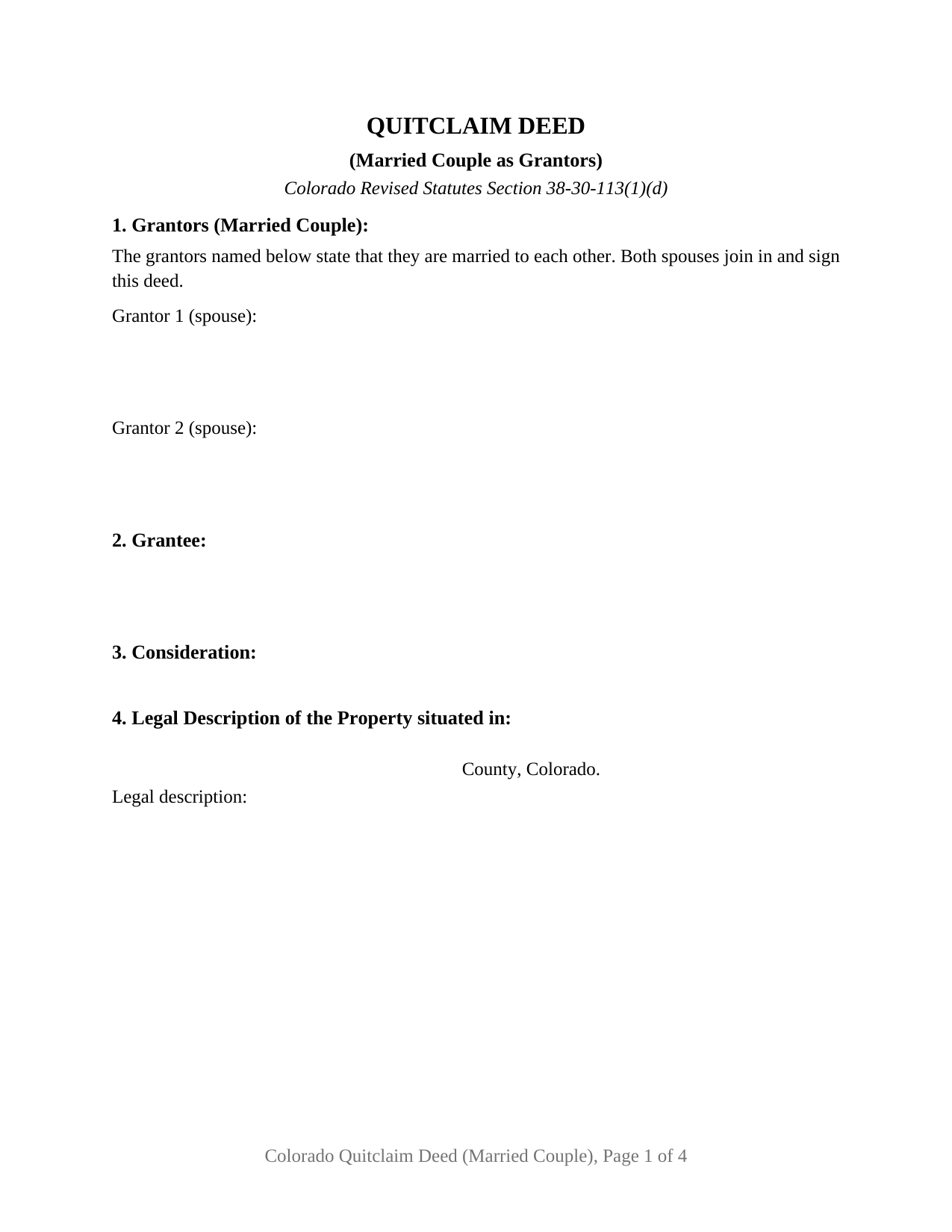
A married couple can release their Colorado real property in one recorded instrument, and this quitclaim deed is built for exactly that signing pattern: two spouses, each conveying as a grantor, on a single deed. It prepares the deed on Colorado's statutory quitclaim wording, C.R.S. 38-30-113(1)(d), with a numbered entry for each spouse, a printed statement that the grantors are married to each other, a signature and date line for each, and an acknowledgment certificate for each signer.
Marriage on the face of the deed
Colorado ties one conveyance rule directly to marriage. Property that is homesteaded automatically may be conveyed by the owner free and clear of homestead rights without another person's signature, but once a homestead declaration has been recorded under C.R.S. 38-41-202(4), a conveyance of the declared homestead takes the signatures of both spouses. A deed that already carries both spouses' signatures answers that requirement on its face, whichever homestead posture the property is in. The rest of Colorado marital property law stays out of the way: dower and curtesy are abolished, and tenancy by the entirety does not exist in Colorado real property, so the couple's title moves through the ordinary co-ownership rules rather than any marital estate.
A release without promises
Like every Colorado quitclaim deed, often typed quit claim deed in searches, this instrument works by the statutory substitution in Section 38-30-113(1)(d): the words of warranty come out and quitclaim takes the place of convey. The spouses, and each of them, sell and quitclaim to the grantee everything they hold in the described property at delivery, with all its appurtenances. The deed states on its face that it carries no covenants of title of any kind and passes no after-acquired title, so an interest either spouse later picks up stays with that spouse. What the grantee receives is precisely what the couple held when the deed was delivered, whether that is the entire record title or something less.
Two spouses, one instrument, two certificates
The form recites exactly two grantors, natural persons who state that they are married to each other and convey in their individual capacities. Each spouse signs and dates a separate line, and the deed carries an acknowledgment certificate for each signer on Colorado's statutory short form under C.R.S. 24-21-516, so the spouses are free to acknowledge together before one notary or separately, on different dates and in different places. A couple passing the family home to an adult child, and spouses who took title together conveying a parcel they no longer keep, present the married-couple pattern this deed recites. The form is not set up for a sole owner, for co-owners who are not married to each other, or for an entity, trustee, or attorney-in-fact signature; each of those follows a different execution pattern than this deed's two-spouse architecture.
From signing table to the recording index
The signed deed goes to the clerk and recorder of the county where the land lies, because Colorado's race-notice statute rewards the first to record without notice. Colorado's statewide charge on conveyances is the documentary fee rather than a transfer tax, and it reaches only transactions whose total consideration exceeds five hundred dollars, at one cent per hundred dollars; a Real Property Transfer Declaration also travels with a conveyance presented for recording. The guide walks through those items, the county recording fee, and the deed-face details Colorado recording law watches for, from the grantee's legal address to the street address entry that sits beside the legal description.
The purchase delivers this married-couple quitclaim deed as a fillable PDF, a completed example showing the form filled in for an El Paso County fact pattern with both spouses' signatures and certificates completed, and a guide covering every numbered section, the notarization, and the recording steps. The materials are informational and are not legal advice.
Important: County-Specific Forms
Our quitclaim deed (married couple as grantors) forms are specifically formatted for each of the 64 counties in Colorado.
After selecting your county, you'll receive forms that meet all local recording requirements, ensuring your documents will be accepted without delays or rejection fees.