Colorado Quitclaim Deed (Married Grantor with Non-Owner Spouse Joinder)
County Specific Legal Forms Validated as recently as October 14, 2026 by our Forms Development Team
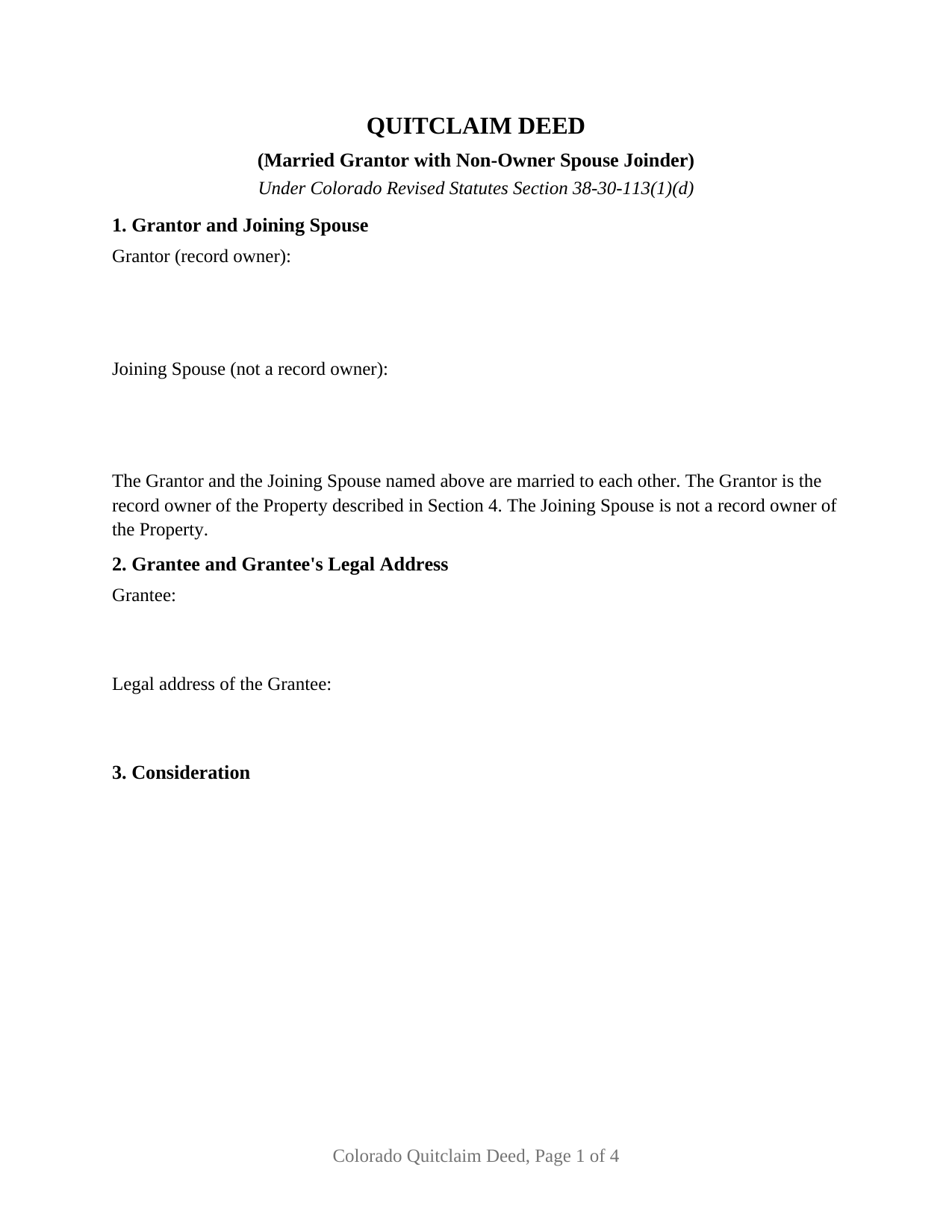
About the Colorado Quitclaim Deed (Married Grantor with Non-Owner Spouse Joinder)
How to Use This Form
- Select your county from the list
- Download the county-specific form
- Fill in the required information
- Have the document notarized if required
- Record with your county recorder's office
What Others Like You Are Saying
"Perfect! Recorded my completed deed today with no problems."
"I found just what I needed at a very good price."
"Smooth, simple, and complete. A great forms service."
"Quick, easy, thorough, reasonable price. Much better than trying to contact a paralegal (who do not …"
"Forms & Guide easy to use. It would have been helpful if the counties with identical form packag…"
4.8/5 from 4,828 reviews. Read all
When a Colorado home stands in one spouse's name alone and a homestead statement has been recorded against it, the deed stops being a one-signature document: the statute calls for both spouses to execute the instrument that conveys the property. This fillable quitclaim deed is configured for that posture. One married grantor holds the record title and releases it, the other spouse owns nothing of record and signs anyway on a separately labeled joinder line, and the deed prints a recital of the marriage that ties the two together.
Why a spouse who owns nothing has a signature line
Colorado hands every qualifying homestead its exemption automatically, with no filing at all, and while the homestead rests on those provisions alone, C.R.S. 38-41-202(3) lets the owner convey free and clear of all homestead rights with no signature but the owner's. Recording a homestead statement changes that. Under C.R.S. 38-41-202(4), once the owner or the owner's spouse records an instrument describing the property, naming the owner, setting out the nature and source of that interest, and stating that it is being homesteaded, the signature of both spouses becomes necessary to convey or encumber it. C.R.S. 38-35-118(1) states the rule from the conveyancing side and adds that the signatures may arrive on one instrument or on separate ones. This deed is the one-instrument version.
What the joinder releases, and where it stops
Section 6 performs the joinder in operative words rather than by implication. The joining spouse joins in the deed, consents to the conveyance so that both spouses have executed it, and releases and quitclaims every homestead right arising under C.R.S. 38-41-201 and 38-41-202. The same section draws the line: the joining spouse conveys no other right, title, or interest, gives no covenant of warranty, and passes no after-acquired title. A blank follows for the recording reference of the homestead statement, and an entry reading that none is of record answers it equally well.
Statutory release wording, and a recital that carries evidentiary weight
The conveyance runs on C.R.S. 38-30-113(1)(d): a deed in substantially the statutory form, warranty words omitted and quitclaim(s) put in the place of convey(s), is a quitclaim deed without covenants of warranty that passes no after-acquired title. The grantee takes the interest the grantor holds at delivery with nothing promised about it, which is what separates a quit claim deed from the warranty forms in the same statute. The marriage recital in Section 1 is doing real work too: under C.R.S. 38-35-118(1) a recital of the marital status of the party executing a recorded conveyance stands as prima facie evidence of the fact stated, rebuttable, but sitting in the chain of title where a later examiner reads it.
One owner, one joining spouse, two certificates
The form recites exactly one grantor, a married natural person holding record title in an individual capacity, and exactly one joining spouse who is not a record owner. Each gets a signature and date block, the joinder block labeled so no reader takes the spouse for a co-grantor, and each gets its own acknowledgment certificate. Separate certificates let the two appear before different notarial officers on different dates in different counties, which the completed example demonstrates. A spouse who is the only name on the vesting deed releasing that property while married, and a conveyance of land against which a homestead statement stands recorded, present the record posture this deed recites. The form is not built for two record owners, for a sole owner conveying alone, or for an entity, trustee, or attorney-in-fact signer.
Recording the deed and the paper beside it
The finished deed goes to the clerk and recorder in the county holding the land, and C.R.S. 38-35-109 is why prompt recording counts in a race-notice state. Since July 1, 2025 the recording charge has been a flat statutory amount per document, quoted as 43 dollars on county fee schedules. The state documentary fee is separate, attaching at a penny per hundred dollars once total consideration passes 500 dollars. A Real Property Transfer Declaration is handed in alongside the deed, and the deed face needs the grantee's legal address and a street address next to the legal description.
The package delivers this deed as a fillable PDF, a completed example filled in for a Larimer County fact pattern with both signatures and both certificates finished, and a guide covering every numbered section, the joinder, the notarization, and the recording steps. The materials are informational and are not legal advice.
Important: County-Specific Forms
Our quitclaim deed (married grantor with non-owner spouse joinder) forms are specifically formatted for each of the 64 counties in Colorado.
After selecting your county, you'll receive forms that meet all local recording requirements, ensuring your documents will be accepted without delays or rejection fees.