Colorado Quitclaim Deed (Divorce)
County Specific Legal Forms Validated as recently as October 19, 2026 by our Forms Development Team
About the Colorado Quitclaim Deed (Divorce)
How to Use This Form
- Select your county from the list
- Download the county-specific form
- Fill in the required information
- Have the document notarized if required
- Record with your county recorder's office
What Others Like You Are Saying
"This was crazy easy to do...such a fantastic service! Thank you!"
"So helpful and extremely responsive. Such a convenient way to record deeds."
"Great follow up and consideration"
"I'm very happy with your service! It saved me, at least, hundreds of dollars vs. going through a law…"
"Loved every step of the process, from the detail explanation of the services/products provided, to t…"
4.8/5 from 4,831 reviews. Read all
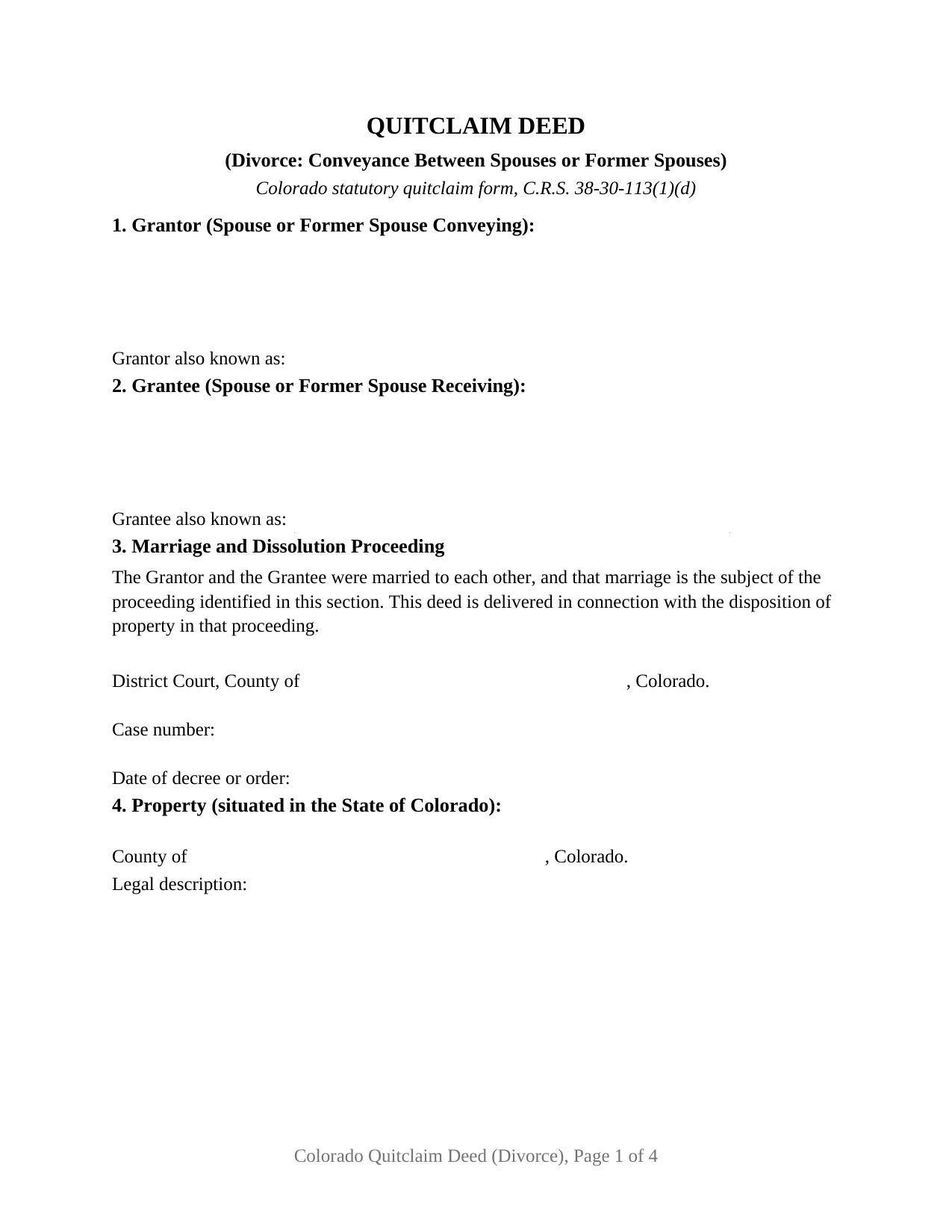
A Colorado dissolution decree can order one party to sign a deed, and Colorado case law describes an order of that kind as acting on the person rather than on the title. The signed instrument is what the county records read. This fillable quitclaim deed prepares it: one spouse or former spouse signs as Grantor, the other is named as Grantee, and a numbered section carries the court, the case number, and the date of the decree or order.
Why a decree usually arrives with a deed behind it
C.R.S. 14-10-113 hands the district court the division of property in a dissolution of marriage or legal separation, and moving that division into the grantor and grantee index is a separate act. In Larrabee v. Larrabee, 31 Colo. App. 493, 504 P.2d 358 (1972), the court described a decree that did not itself operate as a conveyance but was an in personam decree requiring a party under the court's jurisdiction to execute it. Colorado Rule of Civil Procedure 70 covers the signature that never comes, letting the court appoint someone to sign at the disobedient party's cost, or enter a judgment divesting title and vesting it in others with the effect of a conveyance executed in due form of law.
The injunction that runs while the case is open
Every Colorado dissolution and legal separation case carries an automatic temporary injunction under C.R.S. 14-10-107(4)(b)(I)(A), restraining both parties from transferring, encumbering, or in any way disposing of marital property without the consent of the other party or an order of the court, except in the usual course of business or for the necessities of life. It runs until the final decree, a dismissal, or a further order. Section 3 records the case and the decree or order the conveyance answers to.
A release, and a boundary printed on its face
C.R.S. 38-30-113(1)(d) reaches the quitclaim by subtraction: the warranty words come out, quitclaim replaces convey, and what remains is a deed with no covenant of title that picks up nothing the grantor acquires afterward. The Grantee takes what the Grantor holds at delivery, an undivided half, the entire record title, or nothing. A printed sentence marks the line the deed cannot cross: it conveys the Grantor's interest and does not release, assume, or alter an obligation under a promissory note or deed of trust. Title and debt travel on separate tracks.
One signer, one certificate, and two names for one person
The form recites exactly one Grantor, a natural person signing in an individual capacity, and exactly one Grantee, the other party to the marriage, who signs nothing. One signature and date line and one acknowledgment certificate follow, on the individual short form at C.R.S. 24-21-516(1)(a). Both party entries carry an also known as line, which earns its place here: C.R.S. 14-10-120.2 lets a party ask the court at any time after the decree to restore a prior full name, while C.R.S. 38-35-116, the section that keeps two instruments reading to the same person across a name variance, lists first name and middle name variances rather than a changed surname. A joint tenant releasing that interest after the decree, a departing party signing in performance of a numbered paragraph of a separation agreement, and a conveyance signed while the case is open with the other party's consent all present the record posture this deed recites. The form is not set up for two grantors, for an entity or trustee grantor, for an attorney-in-fact signature, or for a grantee who is not the other party to the marriage.
The fee the deed pays, and the exemption that belongs to the court
Colorado's statewide charge on a conveyance is the documentary fee rather than a transfer tax. C.R.S. 39-13-104(1)(l) exempts any decree or order of a court of record determining or vesting title, the court's own instrument; a deed signed by a party is that party's instrument, and Section 6 holds either the computed figure or an exemption claimed at the counter under C.R.S. 39-13-104(2). The fee runs at a penny per hundred dollars of consideration above 500 dollars, or 3 dollars and 75 cents against the example's 37,500 dollar equity payment.
The purchase delivers this divorce quitclaim deed as a fillable PDF, a completed example filled in for a Jefferson County conveyance between former spouses after a decree, and a guide covering the numbered sections, the notarization, and the recording steps. The materials are informational and are not legal advice.
Important: County-Specific Forms
Our quitclaim deed (divorce) forms are specifically formatted for each of the 64 counties in Colorado.
After selecting your county, you'll receive forms that meet all local recording requirements, ensuring your documents will be accepted without delays or rejection fees.