Colorado Quitclaim Deed (Corrective)
County Specific Legal Forms Validated as recently as October 20, 2026 by our Forms Development Team
About the Colorado Quitclaim Deed (Corrective)
How to Use This Form
- Select your county from the list
- Download the county-specific form
- Fill in the required information
- Have the document notarized if required
- Record with your county recorder's office
What Others Like You Are Saying
"I VERY MUCH APPRECIATE THE PROMPT RESPONSE & HELPFULNESS. I WILL DEFINITELY USE THIS SERVICE IN …"
"I found exactly what I needed and the download system allowed me to use the files immediately. Will …"
"No review provided."
". Easy to use."
"I never could even think to solve an important issue involving even overseas individuals without eve…"
4.8/5 from 4,830 reviews. Read all
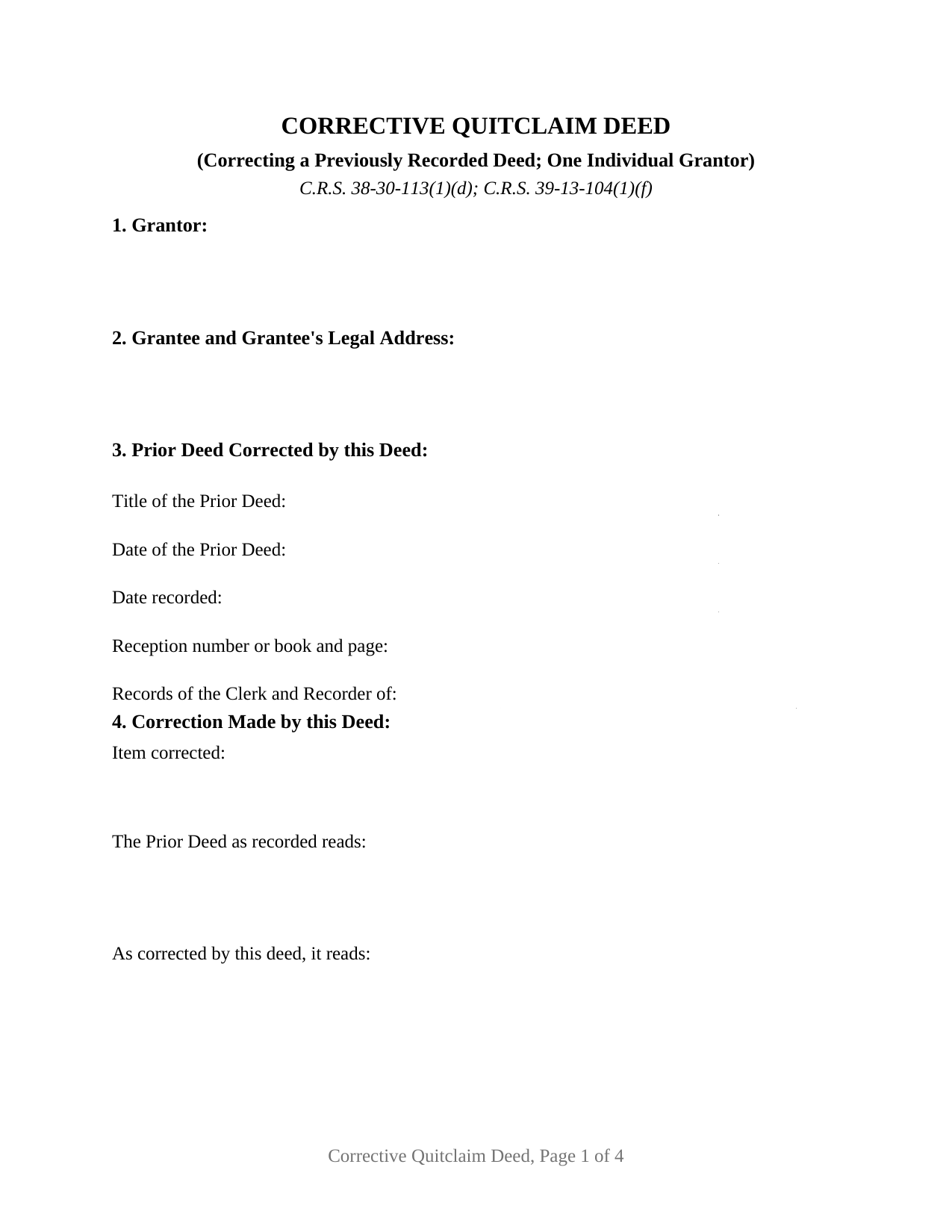
A recorded Colorado deed cannot be edited. The clerk and recorder keeps the image as filed, so an error in a deed already on the record is answered by a second deed recorded beside it, naming the first instrument, stating the correction in the deed's own words, and quitclaiming the same property to the same grantee. This fillable corrective quitclaim deed prepares that second instrument for the individual who signed the deed being corrected.
A record that adds rather than edits
Colorado's real property records accumulate. An endorsed deed keeps its own date and its own rank in the priority order C.R.S. 38-35-109 sets for whoever records first without notice. A corrective deed, often written correction deed, works inside that structure: a later deed from the same grantor to the same grantee over the same land, placing accurate wording where a title examiner reading forward will meet it.
The correction, printed in three parts
Section 3 ties the two filings together with the earlier deed's title, its signing date, its recording date, its reception number or book and page, and the office of record. That reference does real work, because under C.R.S. 38-35-108 a reference in a recorded deed to another instrument is not notice to a stranger to it unless that instrument is itself recorded in the county. Section 4 then prints the correction in three entries: the item corrected, the wording the recorded deed carries, and the wording this deed states. A misspelled subdivision name, a miskeyed plat reception number, an omitted signing date, a defective acknowledgment: a scrivener's error of that scale is what the arrangement exists to place on the record.
Statutory quitclaim wording doing corrective work
The conveyance is Colorado's statutory quitclaim, reached under C.R.S. 38-30-113(1)(d) by leaving the warranty words out and putting quitclaim where convey would stand, yielding a deed with no covenant of title and no interest the grantor picks up later. Section 8 performs it for a stated purpose, correcting the deed identified in Section 3 and confirming the conveyance that deed made, then draws its boundary: the correction stated in Section 4 and nothing further, every other term standing as recorded, no new consideration.
How far one grantor's signature reaches
The Colorado Real Estate Title Standards mark the instrument's outer edge, and the guide walks them with citations. Standard 3.5.5 takes up a second deed executed and acknowledged by the grantor alone, answering that title is not rendered marketable where a grantee's name has been added or deleted, where survivorship language has entered or left the habendum clause, or where part of the property already conveyed has been deleted, since a grantor may not unilaterally alter the effect of a delivered instrument. It answers the other way where the description takes in additional property, citing Friend v. Stancato.
One grantor, one grantee, one certificate
The form recites exactly one grantor, a natural person signing in an individual capacity who is named as grantor on the deed being corrected, and exactly one grantee, that deed's own grantee. The grantee entry takes a complete legal address, an omission C.R.S. 38-35-109(2) answers by sending the deed back unrecorded. One signature line and one acknowledgment certificate follow, on the individual short form at C.R.S. 24-21-516(1)(a). A release carrying a misspelled subdivision name, a description pointing at the wrong plat reception number, and a deed whose acknowledgment came back defective present the posture this deed addresses. The form is not set up for two grantors on the earlier deed, for a joinder signature by the grantee, for an entity or trustee grantor, or for an attorney-in-fact signature.
No documentary fee on a correction
Recording happens with the clerk and recorder of the county holding the land, at the flat statutory charge quoted as 43 dollars on county fee schedules since July 2025. C.R.S. 39-13-104(1)(f) exempts any instrument which confirms or corrects a deed previously recorded, and C.R.S. 39-13-104(2) has an exemption claimed as the instrument reaches the counter, which Section 6 holds. The transfer declaration accompanies a conveyance document, defined at C.R.S. 39-14-101(2) as a document on which the fee is imposed, so county practice on exempt corrective filings varies.
Three files arrive with the purchase: the corrective quitclaim deed as a fillable PDF, a worked Garfield County example correcting a misspelled subdivision name, and a guide covering the numbered sections, the title standard limits, the notarization, and the trip to the recorder. The materials are informational and are not legal advice.
Important: County-Specific Forms
Our quitclaim deed (corrective) forms are specifically formatted for each of the 64 counties in Colorado.
After selecting your county, you'll receive forms that meet all local recording requirements, ensuring your documents will be accepted without delays or rejection fees.