Connecticut Warranty Deed
County Specific Legal Forms Validated as recently as October 16, 2026 by our Forms Development Team
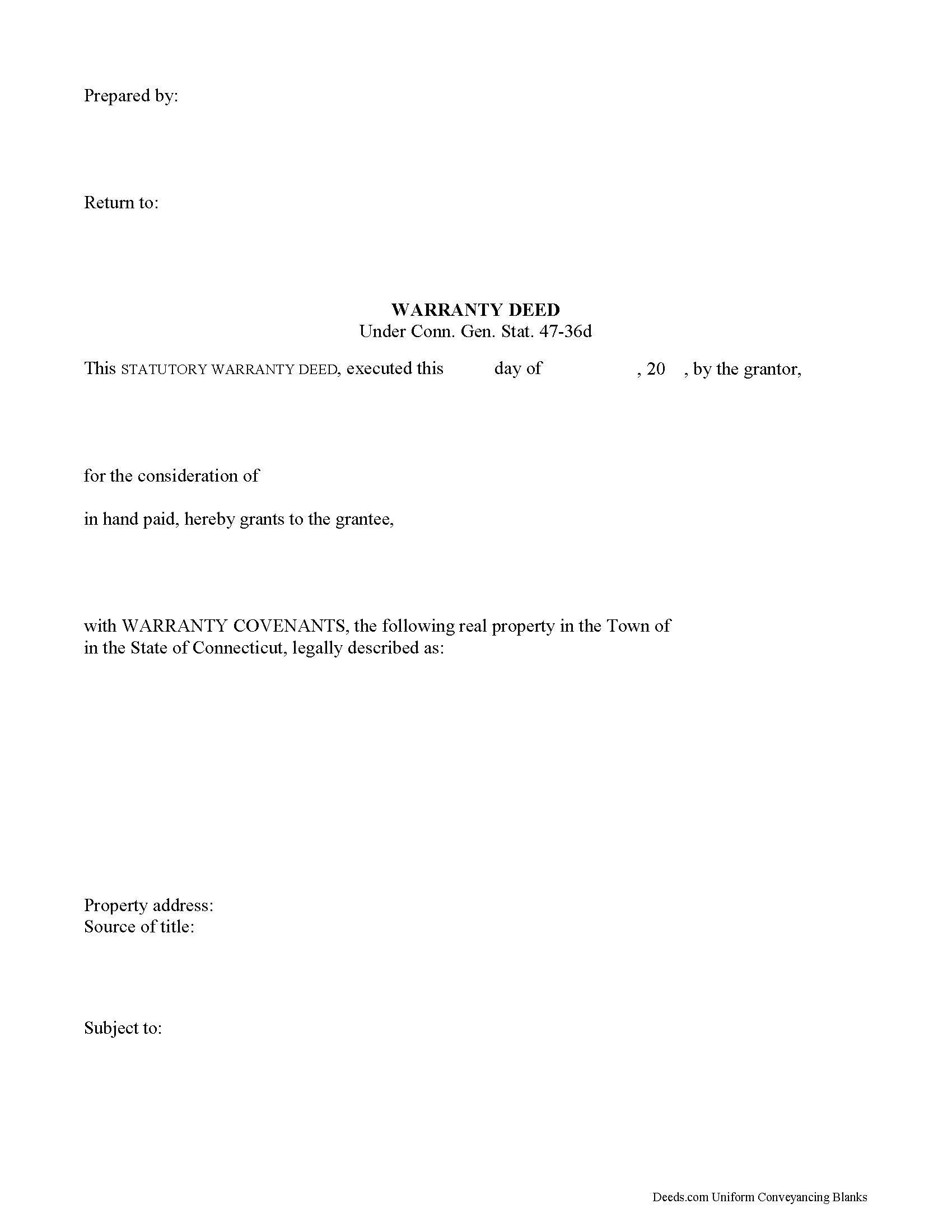
About the Connecticut Warranty Deed
How to Use This Form
- Select your county from the list
- Download the county-specific form
- Fill in the required information
- Have the document notarized if required
- Record with your county recorder's office
What Others Like You Are Saying
"I was very pleased. It was the form I needed. I was getting discouraged by companies that wanted me …"
"I created an account for one particular document. It was very easy to find what I needed for my stat…"
"you guys/girls are the bestest.."
"Good resource. Got what I needed easily"
"Deeds.com worked very well for me. Very Simple packet. And my County uses the same website"
4.8/5 from 4,831 reviews. Read all
A Connecticut deed running to two people is a tenancy in common unless the deed itself says otherwise. Section 47-36a(b)(2) of the General Statutes sets that default and Section 47-14a supplies the words that displace it, which puts a surprising amount of weight on the line that follows the grantee names. This is the general Connecticut warranty deed: one or two individual grantors conveying with the state's full statutory warranty covenants to one or two grantees, on free-form party blocks that carry whatever names, statuses, and vesting words the transaction calls for.
What Follows the Grantee Names
Survivorship in Connecticut is a drafting question, not a status the land records infer. Section 47-14a lists the methods that create a joint tenancy in fee simple with right of survivorship, among them the plain words 'as joint tenants' after the grantees' names and a conveyance to two grantees and their heirs and assigns as tenants by the entirety, which the statute treats as a creation formula whose grantees are known as joint tenants rather than as a separate estate. Absent one of those methods, co-grantees hold undivided shares that pass through each owner's estate. Because this deed preprints no vesting language, the recorded instrument reflects the arrangement the parties chose, and the guide walks through each recognized form with the statutory words that create it.
One or Two Signers on Either Side
The form carries two grantor party lines and two grantee party lines, so it accommodates four count patterns: one grantor to one grantee, one to two, two to one, and two to two. Execution tracks Section 47-5, which asks for a writing subscribed by the grantor, acknowledged, and attested by two witnesses: each grantor signature block sits above two witness blocks, and each grantor has a certificate in the wording of the Section 1-34 short form, so two signers can appear before different officers on different days. When one grantor conveys, the second signature block, its witnesses, and its certificate stay blank. Conveyances by a corporation or limited liability company, by a conservator, executor, administrator, or trustee under Connecticut's separate fiduciary deed forms, by an attorney-in-fact under a power recorded with the deed, and by three or more owners on either side follow patterns this deed is not set up as.
Statutory Words, Statutory Fees
Connecticut priced its own drafting vocabulary into the fee statute: Section 7-34a fixes a rate for documents conforming to, or substantially similar to, Section 47-36c that are clearly entitled statutory form in the heading. The vocabulary those sections share is what does the legal work. 'For consideration paid' and 'with WARRANTY COVENANTS' are the operative words, and Section 47-36e spells out what the second phrase carries: seisin in fee simple; a title clear of every encumbrance the deed does not except; authority in the grantor to make the sale; and a standing obligation, reaching the grantor's heirs, executors, and administrators, to stand behind the grantee's title against anyone who later claims against it. That reach across the entire chain of title is what buyers and lenders look for under the name general warranty deed, and this form prints the covenants in full rather than leaving them to the statute book.
The Town Clerk, and the Tax That Comes First
Connecticut has no county land recorder. Deeds go to the town clerk of the town where the land lies, and Section 7-24(f) puts the return address and addressee at the top of page one, where this form opens. The step that genuinely stands between a sale deed and the land records is the real estate conveyance tax. Under Section 12-497 a taxable deed waits until the town clerk has the OP-236 return in hand and the tax is paid, after which the clerk endorses the tax received on the deed or, on an exempt instrument, stamps in bold letters that none was collected. State rates begin at three-quarters of one percent and step up on higher-value residential consideration, and a municipal share collected at the same counter varies from town to town.
The package delivers the blank deed as a fillable PDF, a completed example filled in at full two-grantor capacity, and a plain-language guide covering every numbered section, the two-witness signing, the certificates, and the recording and conveyance tax steps. The materials are informational and are not legal advice; questions about a particular parcel, a particular chain of title, or a particular family belong with a Connecticut attorney.
Important: County-Specific Forms
Our warranty deed forms are specifically formatted for each of the 8 counties in Connecticut.
After selecting your county, you'll receive forms that meet all local recording requirements, ensuring your documents will be accepted without delays or rejection fees.