Florida Warranty Deed (Partnership Grantor)
County Specific Legal Forms Validated as recently as October 10, 2026 by our Forms Development Team
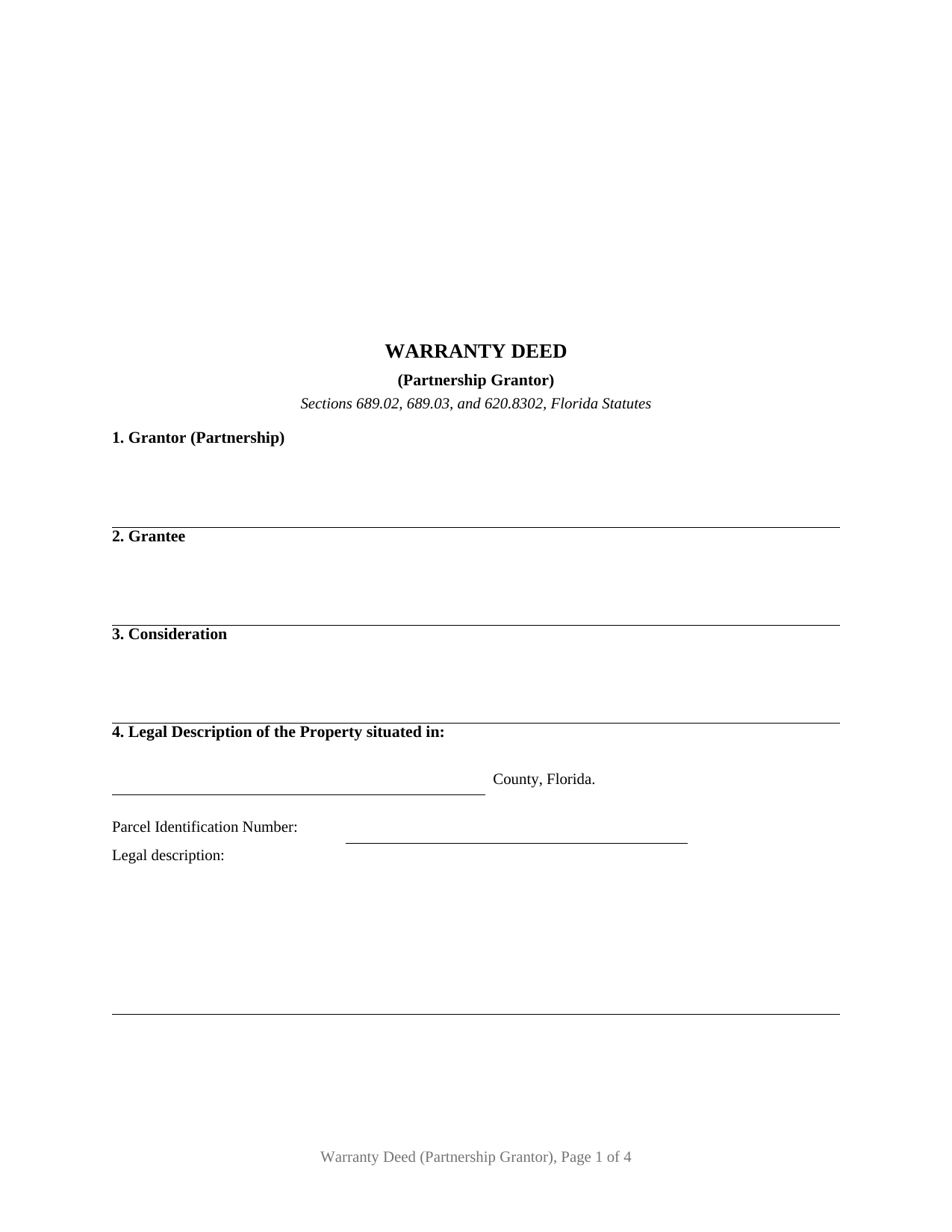
About the Florida Warranty Deed (Partnership Grantor)
How to Use This Form
- Select your county from the list
- Download the county-specific form
- Fill in the required information
- Have the document notarized if required
- Record with your county recorder's office
What Others Like You Are Saying
"I found this site to be very easy to use . I found and printed what I needed in just a few minutes a…"
"Quick and easy"
"The forms worked well for entering information. I have finished without much trouble. Since the form…"
"Wonderful"
"was great!"
4.8/5 from 4,828 reviews. Read all
Florida real estate is often titled in the name of a partnership itself rather than in the names of its partners, and Florida law lets the partnership convey that land the same way it holds it: by a deed executed in the partnership name. This warranty deed prepares that conveyance, with one partner signing on the partnership's behalf and the full statutory warranty of title running to the buyer.
A signature in the partnership name
Under Section 620.8302 of the Florida Statutes, partnership property held in the name of the partnership may be transferred by an instrument of transfer executed by a partner in the partnership name. Section 620.8301 backs that signature with the agency rule of the Revised Uniform Partnership Act: a partner's execution of an instrument in the partnership name, apparently in the ordinary course of its business, binds the partnership unless the partner lacked authority and the other party knew it. For a limited partnership, the signature comes from a general partner under Section 620.1402.
Florida adds a recorded backstop. A partnership may file a statement of partnership authority with the Department of State naming the partners authorized to transfer its real property, and a certified copy of that filed statement, recorded in the county where the land lies, is conclusive in favor of a buyer who gives value without knowledge to the contrary. Partnership closings commonly pair the deed with that certified copy, and the guide explains the statement's five year lapse under Section 620.8303.
One partnership, one partner, one certificate
The deed recites exactly one grantor, a partnership identified by its name, type, state of formation, and post-office address, and exactly one signer, a partner executing in the partnership name, with a single acknowledgment certificate in the partnership short form. The grantee section is free-form, taking one grantee or two or more grantees with the words that describe how they hold title. A Florida general partnership selling a platted lot it holds in its own name, and a limited partnership conveying a parcel through its general partner, present the partnership grantor pattern this deed recites. The form is not set up for partners who hold the land in their own names with a notation of their partner capacity, the pattern Section 620.8302(1)(b) addresses through the record holders' own signatures, nor for a corporation, a limited liability company, a trustee, or an attorney in fact, whose certificates come from other subsections of Section 695.25. No spouse signs: the homestead joinder rule of Article X, Section 4(c) of the Florida Constitution speaks to a married owner of homestead real estate, and a partnership is not one.
Full common-law covenants from a short statutory form
Florida's warranty deed form has been on the books since 1891. Section 689.02 supplies its operative words, has granted, bargained and sold, and its warranty sentence, in which the grantor fully warrants the title and will defend it against the lawful claims of all persons whomsoever. Section 689.03 then does the heavy lifting: a conveyance executed substantially in that form is held to be a warranty deed with full common-law covenants. This form keeps the statutory language, adds the parcel identification number blank Section 689.02(2) requires, and carries an exceptions section so recorded easements, restrictions, and any remaining mortgage stand outside the covenants.
Two witnesses and the partnership acknowledgment
Execution follows Florida's conveyancing rules for any freehold deed: the signing partner signs before two subscribing witnesses, and since January 1, 2024, the recording statute requires each witness's printed name beneath the signature and each witness's post-office address on the instrument. The notary block is the statutory short form partnership acknowledgment of Section 695.25(4), reciting acknowledgment by physical presence or online notarization by the named partner on behalf of the named partnership, with a reserved area for the rubber-stamp seal Section 117.05 places below or beside the notary's signature. The deed also carries the preparer statement and grantee address blanks the clerk checks under Section 695.26 and reserves the clerk's statutory blank space at the top of each page.
The completed deed is recorded with the clerk of the circuit court in the county where the land lies, with documentary stamp tax computed on the full consideration at recording. The package includes the blank deed as a fillable PDF, a completed example worked through an Orange County fact pattern, and a plain language guide that walks the form section by section; the materials are informational and are not legal advice.
Important: County-Specific Forms
Our warranty deed (partnership grantor) forms are specifically formatted for each of the 67 counties in Florida.
After selecting your county, you'll receive forms that meet all local recording requirements, ensuring your documents will be accepted without delays or rejection fees.