Florida Warranty Deed (Trustee Grantor)
County Specific Legal Forms Validated as recently as October 10, 2026 by our Forms Development Team
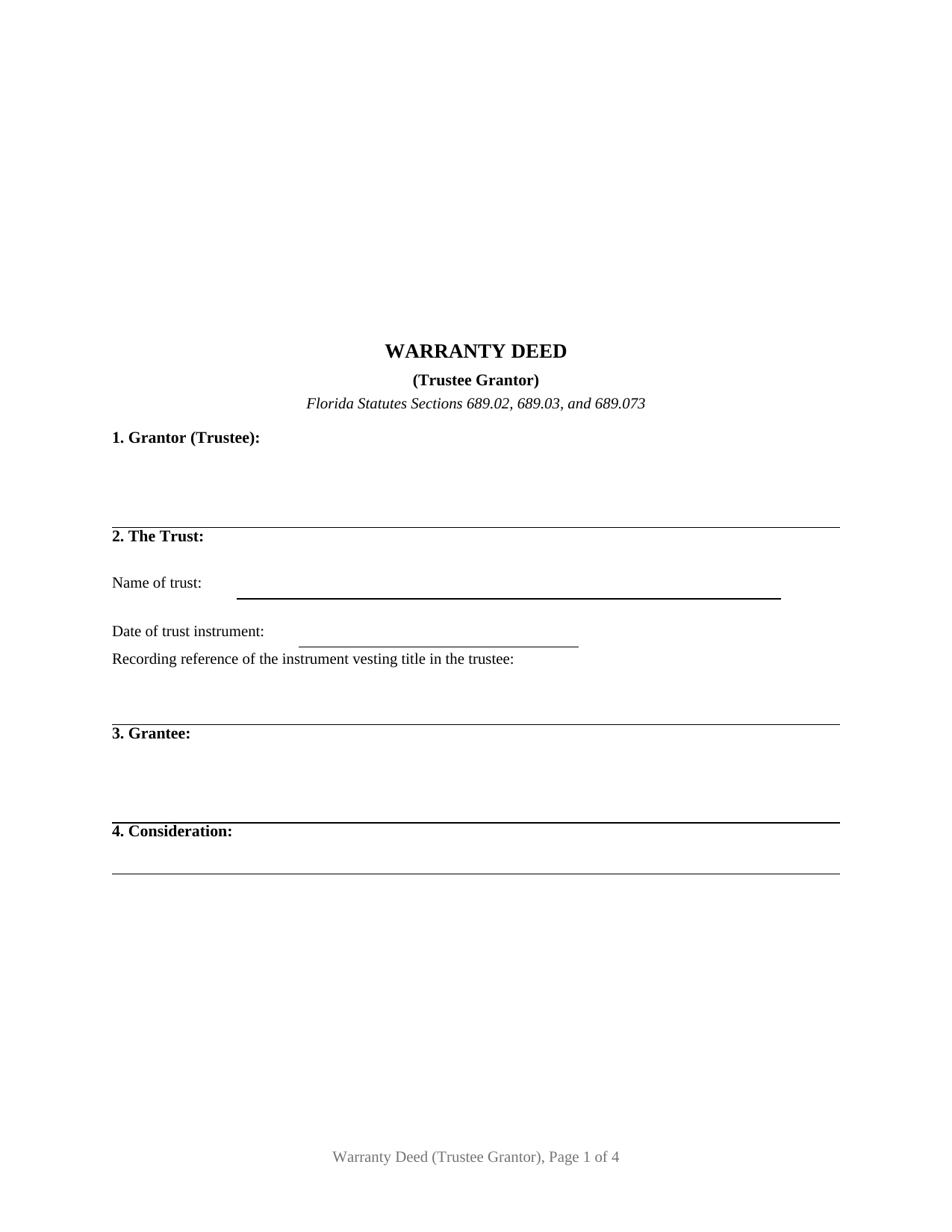
About the Florida Warranty Deed (Trustee Grantor)
How to Use This Form
- Select your county from the list
- Download the county-specific form
- Fill in the required information
- Have the document notarized if required
- Record with your county recorder's office
What Others Like You Are Saying
"So far very good. I will know more when I complete the forms and submit them."
"EVERYTHING WENT WELL, HAD NO PROBLEMS DOWNLOADING MY FORMS. THE ORDER QUICK AND EASY. THANKS IF I EV…"
"Awesome site great paperwork EZ Forms great."
"Works great thank you for saving us driving time!!"
"Top 10 experience, Easy-Fast-Affordable"
4.8/5 from 4,828 reviews. Read all
When a Florida trust sells real property, the deed comes from the trustee, and the covenant that deed carries is a drafting decision with statutory weight. This warranty deed for a trustee grantor pairs the two: the trustee of an identified trust conveys with the full warranty of the Florida statutory form, using the operative words "has granted, bargained and sold" and the covenant to fully warrant the title and defend it against the lawful claims of all persons whomsoever. Under Section 689.03, Florida Statutes, a deed substantially in that form takes effect as a warranty deed with full common-law covenants.
A Statutory Warranty, Signed in Trust Capacity
The warranty here reaches the whole chain of title, not only the period the trustee or the trust has owned the property. That is the difference between this covenant and the narrower conveyances Florida law recognizes: a quitclaim deed passes only whatever interest the grantor holds, with no covenant at all, and a special warranty deed limits the covenant to claims arising by, through, or under the grantor. The trustee signs in a representative capacity, and the deed recites the trustee's power to sell and convey, keyed to Section 689.073, the statute that lets a buyer or title examiner rely on powers conferred in a recorded instrument without inquiring into unrecorded trust terms or the beneficiaries.
Naming the Trust Defeats the Section 689.07 Trap
Florida attaches unusual consequences to the bare word "trustee" on a deed. Under Section 689.07, a conveyance to a grantee described only as trustee, with no named beneficiaries, no statement of the trust's nature and purposes, and no trust title and date, can vest a fee simple with full power to sell and encumber, as if no trust existed. This form is built around that rule from the opposite direction: it identifies the trust by name and by the date of the trust instrument and carries a recording reference for the instrument that vested title in the trustee, so the capacity in which the grantor conveys is plain on the face of the record.
One Trustee, One Signature, One Certificate
The deed recites exactly one grantor, a trustee conveying as trustee of the trust named in its second section, and carries one signature block, GRANTOR / TRUSTEE, paired with two subscribing witness blocks. The grantee section is free-form and receives one grantee or two or more grantees with the words that describe how they hold title. The acknowledgment certificate is the statutory short form of Section 695.25(6) for an acknowledgment by a trustee, reciting the trustee's name and title of position after the words "by means of physical presence or online notarization," and it reserves an area below the notary's signature for the rubber-stamp seal Section 117.05 places there. A successor trustee selling a residence the trust has held since the settlor's death, and the settlor-trustee of a revocable trust selling trust-held land to a buyer, present the trustee-grantor pattern this deed recites. The form is not set up for two co-trustees who both sign, for a natural person conveying in his or her own right, or for a company or an attorney in fact as the conveying party; each of those signs under a different pattern and takes a different certificate.
Two Witnesses and a Representative Acknowledgment
Section 689.01 places two subscribing witnesses on a Florida deed conveying a freehold estate, and since January 1, 2024, the recording statute also asks for each witness name printed beneath the witness signature and a post-office address for each witness. The form carries dedicated witness blocks with those lines built in, followed by the trustee acknowledgment and the identification clause the statute prints after the trustee's name.
Documentary Stamps and the Recording Package
The clerk of the circuit court records the deed in the county where the property sits, and documentary stamp tax is collected at recording: 70 cents per $100 of consideration statewide, with Miami-Dade County on its own rate structure. The first page reserves the blank space the clerk's recording stamp requires, and the parcel identification number blank called for by Section 689.02(2) sits beside the legal description. The download includes the fillable deed with a removable instructions page, a completed example worked through an Orange County fact pattern, and a guide that walks each numbered section in order; the materials describe the form and the statutes behind it and are not legal advice.
Important: County-Specific Forms
Our warranty deed (trustee grantor) forms are specifically formatted for each of the 67 counties in Florida.
After selecting your county, you'll receive forms that meet all local recording requirements, ensuring your documents will be accepted without delays or rejection fees.