Florida Warranty Deed (Married Grantor with Spouse Joinder)
County Specific Legal Forms Validated as recently as October 10, 2026 by our Forms Development Team
About the Florida Warranty Deed (Married Grantor with Spouse Joinder)
How to Use This Form
- Select your county from the list
- Download the county-specific form
- Fill in the required information
- Have the document notarized if required
- Record with your county recorder's office
What Others Like You Are Saying
"this is great because it saves money and gets the job done"
"This was such an easy experience"
"easy to use site, directions well laid out"
"This was a very easy process to find the correct documents and download them. The price was also rea…"
"Ordering, payment, and downloads went without a hitch. I appreciated the guide and examples. Than k …"
4.8/5 from 4,829 reviews. Read all
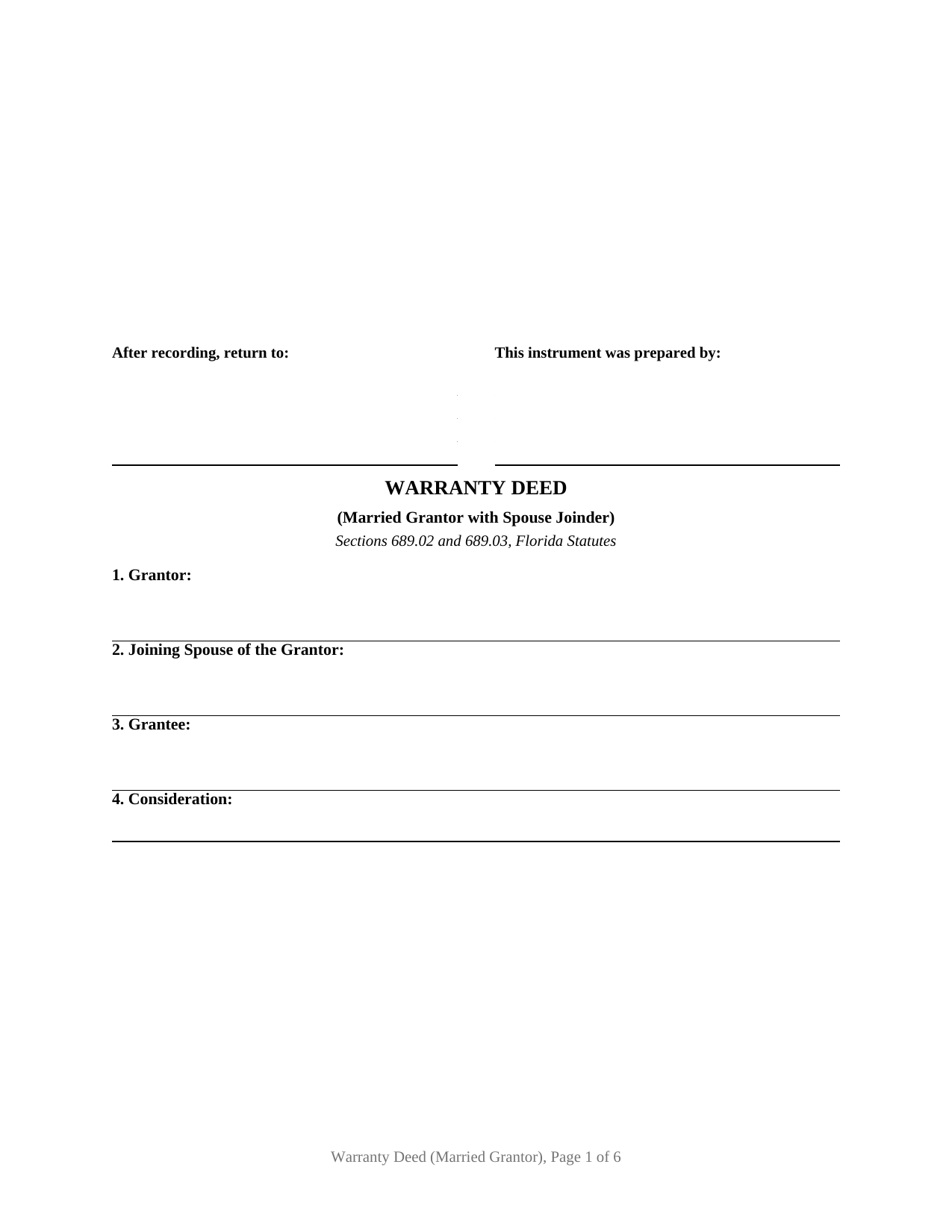
A Florida deed signed by a married owner often carries a second signature: the owner's spouse signs even though the spouse holds no record title. The reason sits in the Florida Constitution. Article X, Section 4(c) provides that the owner of homestead real estate, joined by the spouse if married, may alienate the homestead by mortgage, sale, or gift. This form is a warranty deed built around that rule: one married grantor conveys, and the grantor's spouse joins in the deed with a party section, a joinder recital, and a signature block.
Why the spouse signs a deed that names one owner
The joining spouse is not a grantee and takes nothing under the deed. Section 9 of the form states what the second signature accomplishes: the spouse joins in and consents to the conveyance and releases any interest, including any homestead interest, satisfying the constitutional joinder where the property is the grantor's homestead. Section 689.111, Florida Statutes, allows homestead to be conveyed through a power of attorney but does not dispense with the joinder of both spouses. Dower and curtesy are abolished in Florida, so the second signature answers a homestead question; where the parcel is not the constitutional homestead, the joinder language still releases whatever interest the spouse holds. Each signature carries its own acknowledgment certificate, so the grantor and the joining spouse can sign on different dates or in different states.
One grantor, one joining spouse, two certificates
The deed recites exactly one grantor, a natural person conveying in his or her own right, and exactly one joining spouse, each with a numbered party section. The grantee section is free-form and takes one grantee or two or more grantees with the words that describe how they hold title. Two signature blocks, two pairs of subscribing witness blocks, and two acknowledgment certificates follow, one set for the grantor and one for the joining spouse. A married owner selling a residence titled in that owner's name alone presents the pattern this instrument recites. The form is not set up for two record owners conveying as grantors, for spouses who hold title together as tenants by the entirety, for an unmarried grantor, or for a company, a trustee, or an attorney in fact as the conveying party; each of those signs under a different pattern.
A statutory form with full common-law covenants
Florida has prescribed a warranty deed form since 1891. Section 689.02 supplies the operative words, by which the grantor has granted, bargained and sold the land to the grantee and the grantee's heirs and assigns forever, and the covenant by which the grantor fully warrants the title and will defend it against the lawful claims of all persons whomsoever. Under Section 689.03, a deed made substantially in that form carries the effect of a warranty deed with full common-law covenants. This form uses the statutory language verbatim, includes the parcel identification number blank of Section 689.02(2), and adds a subject-to section so recorded easements, restrictions, and current-year taxes can qualify the warranty. The covenant is the grantor's: Section 8 states it in the grantor's name alone, and the joining spouse's release in Section 9 carries no warranty.
Two witnesses, printed names, and post-office addresses
Execution in Florida takes more than a notary. Section 689.01 requires a deed conveying a freehold estate to be signed in the presence of two subscribing witnesses, and since January 1, 2024, Section 695.26(1)(c) has made each witness's printed name and post-office address a recording requirement. The form pairs each party signature with two witness blocks, and each acknowledgment follows the statutory short form of Section 695.25(1), with its physical presence or online notarization boxes, its identification clause, and a reserved area for the notary's rubber-stamp seal. The first page reserves the 3 inch by 3 inch clerk space at the top right, with the return and preparer blocks beneath it.
Recording and the documentary stamp
The deed is recorded with the clerk of the circuit court of the county where the property is located, and documentary stamp tax under Section 201.02 is collected at recording, at 70 cents per 100 dollars of consideration everywhere but Miami-Dade, which has its own rate and surtax structure. The download includes the blank fillable deed, a completed example on a Sarasota County fact pattern, and a guide covering every section, the signing ceremony, and recording. The materials describe Florida law in general terms and are not legal advice.
Important: County-Specific Forms
Our warranty deed (married grantor with spouse joinder) forms are specifically formatted for each of the 67 counties in Florida.
After selecting your county, you'll receive forms that meet all local recording requirements, ensuring your documents will be accepted without delays or rejection fees.