Florida Warranty Deed
County Specific Legal Forms Validated as recently as October 10, 2026 by our Forms Development Team
About the Florida Warranty Deed
How to Use This Form
- Select your county from the list
- Download the county-specific form
- Fill in the required information
- Have the document notarized if required
- Record with your county recorder's office
What Others Like You Are Saying
"Very satisfied. In the middle of COVID19 I was able to complete important paperwork even though I wa…"
"Very easy to us & thanks for all the info to fill out the form."
"Just what I needed!"
"All downloaded now I just have to fill them out. Will let you know how it does. Thanks for the servi…"
"Quick, easy way to get the forms I needed"
4.8/5 from 4,828 reviews. Read all
Florida decides contests between deeds with a number. Under Section 695.11, Florida Statutes, an instrument counts as recorded the moment the clerk stamps its official register number on it, and the order of those consecutive numbers fixes priority, the lower number prevailing over the higher. A warranty deed hands a buyer both halves of that protection: a promise from the seller about the condition of the title, and a place in the clerk's numbered sequence. This form prepares that deed for Florida real property.
What the 1891 sentence still does
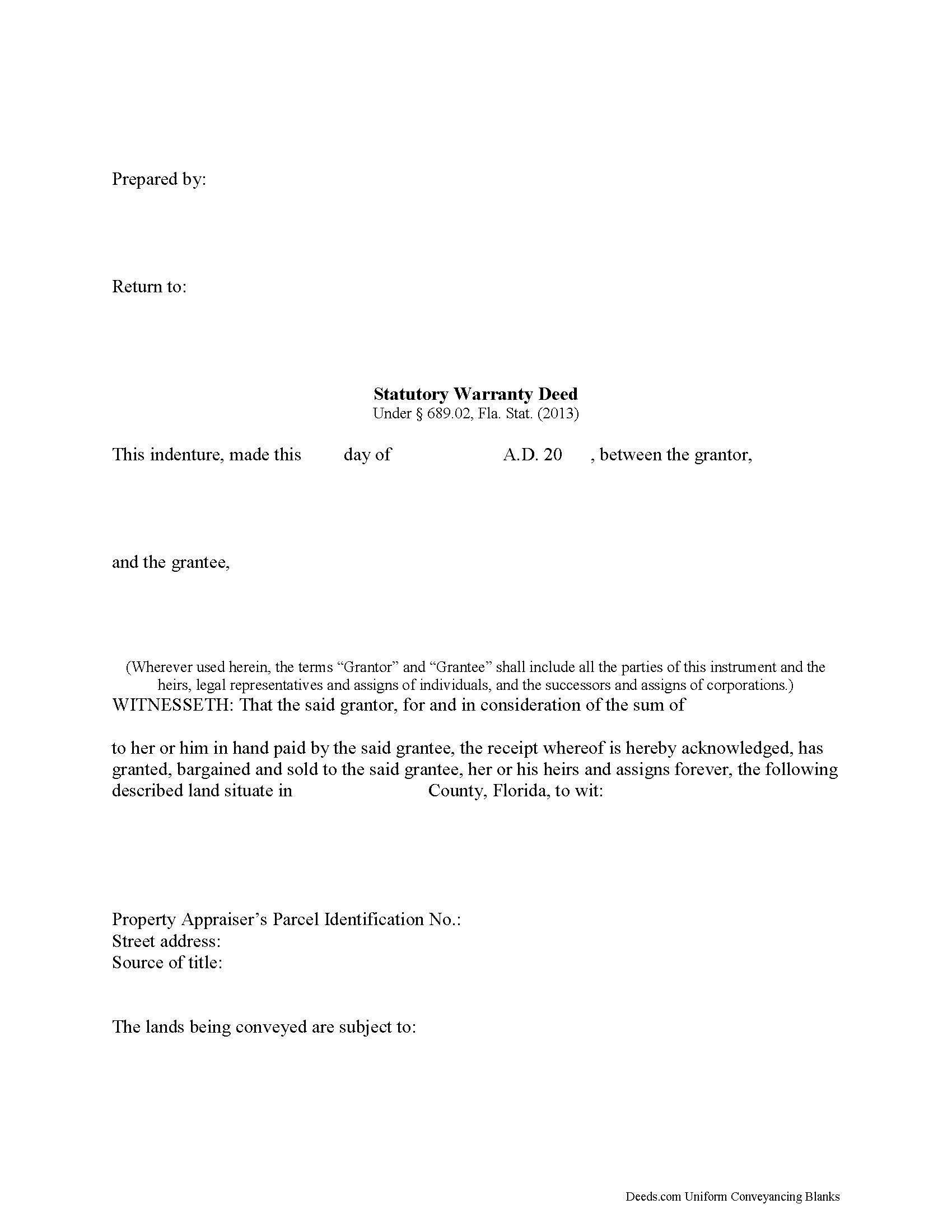
The Florida Legislature put a warranty deed in the statute book in 1891, and Section 689.02 still prints it. The conveyance runs on the phrase "has granted, bargained and sold," and the seller's undertaking arrives in one sentence: to fully warrant the title to said land, and to defend it against the lawful claims of all persons whomsoever. Section 689.03 is where that sentence grows. A conveyance made substantially in the statutory form takes effect as a deed carrying the full set of common-law title covenants, binding on the grantor and the grantor's heirs as though each were spelled out. It looks backward through the entire chain, so a defect created generations before the seller took title is one the seller has promised to defend. One section of the form lists what stands outside that promise, and the parcel identification blank required by Section 689.02(2) sits with the legal description it never replaces.
One or two people on each side of the deed
This is the base configuration of the Florida warranty deed line, and its party blocks are deliberately empty of preprinted labels. The Grantor block takes one or two natural persons signing in their own right, with the status wording the parties enter after each name. The Grantee block takes one or two names followed by whatever ownership wording the grantees choose, which the guide covers form by form: a tenancy in common, the express survivorship language Section 689.15 demands before survivorship exists in a joint tenancy, or the tenancy by the entirety that arises between spouses. Four count patterns therefore appear on this single instrument, from a sole owner selling to one buyer through two owners conveying to two. The execution page follows the same logic, with two grantor signature blocks and a separate acknowledgment certificate for each, so a deed signed by one grantor leaves the second block and certificate blank. The form is not set up for a company, a trustee, an attorney in fact, or a title held by three or more owners, each of which signs under different statutes.
Two witnesses, plus the address rule from 2024
Section 689.01 keeps a signing formality most states abandoned long ago: a deed of a freehold estate is signed in the presence of two subscribing witnesses, who sign it too. The 2023 real property fraud act then added a detail effective January 1, 2024, and Florida clerks check for it. Along with the printed name under every signature, the recording statute now calls for a printed name and a post office address for each witness, and both witness blocks on this form carry a labeled address line. The certificate tracks the statutory short form for an individual acting in his or her own right, indicating physical presence or online notarization and recording the identification the notary relied on.
Stamps, pages, and the square at the top of page one
Documentary stamp tax comes due at the counter. Chapter 201 taxes a deed at 70 cents for each 100 dollars of consideration, counting any mortgage the land remains subject to whether or not the buyer assumes it, and Miami-Dade alone works from its own rate and surtax. Filing charges are largely statutory, with the large county clerks publishing 10 dollars for a first page and 8 dollars and 50 cents for every page after it. Page one of this form leaves its top three inches clear, which covers the three inch square Section 695.26 hands to the clerk at the upper right, and the preparer and return blocks sit just beneath that space.
The download contains the deed as a fillable PDF behind a removable instructions page, a completed example worked through a Duval County sale from the date line to the notary's commission date, and a plain-language guide covering each numbered section, the vesting choices, and the recording steps. The materials describe Florida law in general terms and are not legal advice.
Important: County-Specific Forms
Our warranty deed forms are specifically formatted for each of the 67 counties in Florida.
After selecting your county, you'll receive forms that meet all local recording requirements, ensuring your documents will be accepted without delays or rejection fees.