Hawaii Quitclaim Deed (Corrective)
County Specific Legal Forms Validated as recently as August 27, 2026 by our Forms Development Team
About the Hawaii Quitclaim Deed (Corrective)
How to Use This Form
- Select your county from the list
- Download the county-specific form
- Fill in the required information
- Have the document notarized if required
- Record with your county recorder's office
What Others Like You Are Saying
"This service was a godsend since I am currently disabled."
"Helpful and informative."
"Excellent service! Incorrectly ordered a document and order was immediately canceled when I requeste…"
"Thank you for all your assistance and patience in doing the deed. I can honestly say that DEEDs.com …"
"Forms were very easy to use using the completed form as an example."
4.8/5 from 4,815 reviews. Read all
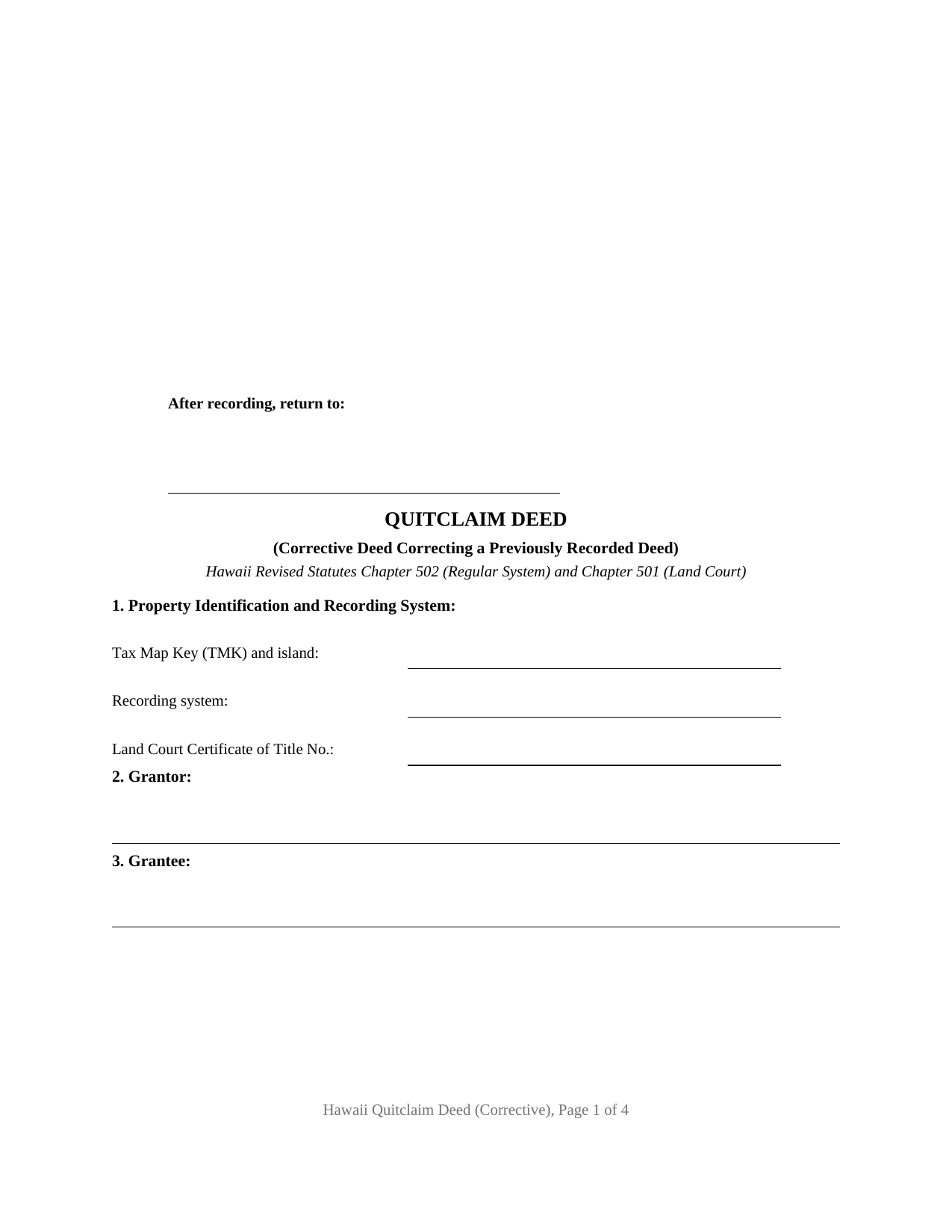
A Hawaii deed that corrects an earlier one carries two jobs at once: change what the record says in a single respect, and leave the rest of the earlier conveyance standing where it was. This Hawaii Quitclaim Deed (Corrective) is a fillable form built for that pairing. One individual grantor identifies a prior recorded deed by title, date, document number, and recording system, sets out the text as it stands in the record and the corrected text, and quitclaims to the same grantee without covenant or warranty of title.
Correcting one line, confirming the rest
The operative section is drafted so the instrument cannot be read as a second, independent transfer. It corrects the prior deed in the one respect the form identifies, then states that it corrects and confirms that deed, is not a new or additional conveyance, and does not enlarge, reduce, or otherwise change the estate, interest, or tenancy the earlier instrument conveyed. The grantee takes subject to the same encumbrances, easements, restrictions, and liens as before, so a later title examiner reading the two documents side by side can see the boundary of the change. Title assurance is absent by design, as in any quit claim deed, and this one says so twice, in the conveyance sentence and again in capital letters.
An exemption that turns on what the document does
Most of Hawaii's conveyance tax exemptions look at who the parties are: spouses, reciprocal beneficiaries, parent and child. Section 247-3(3) of the Hawaii Revised Statutes looks instead at what the paper accomplishes, exempting any document that only confirms or corrects a deed, lease, sublease, assignment, transfer, or conveyance previously recorded or filed. The word carrying the weight is only. A change that adds or drops a grantee, or moves land into or out of the transfer, is a fresh conveyance with its own tax computation rather than a correction. The exemption does not end the paperwork: Section 247-6 conditions recording on a filed certificate, so a Form P-64B rides along with the deed, asking for a detailed statement of the parties' relationship and of the correction. Both P-64 forms belong to the Department of Taxation and are completed separately.
Registered land keeps its corrections in court
Hawaii's two recording systems part company over this instrument. In the Regular System a corrective deed records like any other document and sits in the index beside the deed it corrects. Under the Land Court, Section 501-196 provides that no erasure, alteration, or amendment shall be made upon the registration book after entry of a certificate of title except by order of the court, leaving the registrar one narrow power, to correct a clerical error made by the registrar's own office personnel. A change that would rewrite a certificate or cancel a memorandum reaches the Land Court as a petition in the original registration case. Section 1 of the form collects the tax map key, the recording system, and the certificate of title number a registered land document has to carry.
One grantor, one certificate, and the deed it points back to
The form names exactly one grantor, a natural person signing in an individual capacity, and exactly one grantee, both being the parties the prior deed named, so the correction runs between the same two people as the deed under repair. One signature line follows, and the certificate beneath it collects what Section 502-42 calls for, appearance before the notary and identity, alongside the items Hawaii notary rules add: circuit, document date, document description, page count. Numbered sections hold the prior deed's identifying data, the erroneous text as recorded, and the corrected text, on facing entries. Errors of this shape run through the Hawaii record: a misspelled grantee surname carried forward from a family deed, an omitted marital status, a wrong document number in a source of title line. A prior deed signed by two owners, by an entity through an officer, or by an agent under a power of attorney states signing authority differently, and this form is not drafted as any of those.
The download holds the blank corrective deed, also searched as a correction deed, as a fillable PDF, a completed example worked through a Lanai City fact pattern in which an aunt corrects the spelling of her nephew's name in a deed recorded the year before, and a plain language guide covering every entry, notarization, the conveyance tax certificate, and recording in both of Hawaii's systems. Nothing in these materials is legal advice.
Important: County-Specific Forms
Our quitclaim deed (corrective) forms are specifically formatted for each of the 4 counties in Hawaii.
After selecting your county, you'll receive forms that meet all local recording requirements, ensuring your documents will be accepted without delays or rejection fees.