Hawaii Quitclaim Deed (Two Grantors)
County Specific Legal Forms Validated as recently as September 15, 2026 by our Forms Development Team
About the Hawaii Quitclaim Deed (Two Grantors)
How to Use This Form
- Select your county from the list
- Download the county-specific form
- Fill in the required information
- Have the document notarized if required
- Record with your county recorder's office
What Others Like You Are Saying
"Easy to use and very straight forward. Glad I used Deeds.com"
"Got what I needed"
"An excellent service. Exactly what one would hope for in the 21st century."
"Easy to complete. I would suggest, since it is 2 pages, make a bigger space for land descriptions &a…"
"After a long search this site is the best all inclusive service. Contacting Customer Service receive…"
4.8/5 from 4,815 reviews. Read all
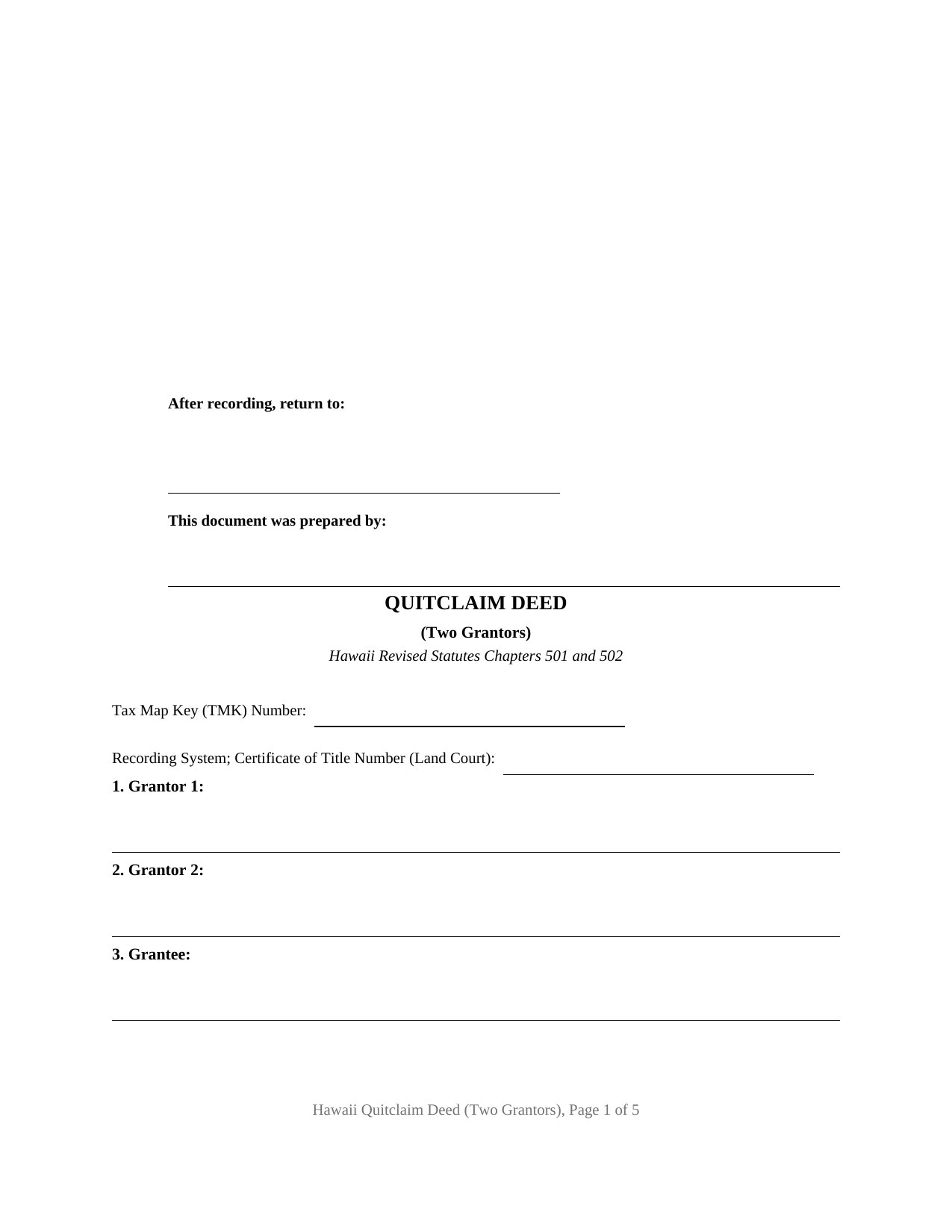
When two record owners give up their interests in the same Hawaii real property, one instrument can carry both releases. This Hawaii Quitclaim Deed (Two Grantors) is a fillable form that joins two individual grantors in a single conveyance: each grantor is recited by name, marital status, and mailing address, each signs above a printed name line, and each acknowledges before a notary under a certificate of that grantor's own. The deed conveys without covenant or warranty of title and is formatted to the recording standards of the Hawaii Bureau of Conveyances.
Two releases, one instrument
The form recites exactly two grantors, each a natural person acting in that person's individual capacity, and its quitclaim clause releases everything both of them hold to the grantee named in the deed. The two-grantor pattern runs through the Hawaii record: co-heirs who took undivided shares under one deed and later pass those shares together to a single relative, joint tenants closing out a co-ownership in one conveyance, and spouses or reciprocal beneficiaries holding as tenants by the entirety, an estate Hawaii law lets only both owners acting together convey, so the two signature lines here are not a convenience but the estate's own requirement. A sole owner's release, a trustee conveyance, and an entity grantor each follow a different recital and signature pattern, and this form is set up as none of them.
Separate acknowledgments for signers who sign apart
Two grantors rarely stand in front of the same notary on the same afternoon. Hawaii law does not require a separate certificate for each signer, and one certificate may name every signer who appears before the officer; this form carries a certificate per grantor anyway, so the two can acknowledge on different dates, on different islands, or in different states, and the deed still records as one instrument. Each certificate prints the full acknowledgment substance Hawaii statute prescribes, together with the certificate items Hawaii notaries complete: the judicial circuit of the commission, the document date, the document description, and the number of pages in the recorded deed. Hawaii also permits remote online notarization, performed by registered Hawaii notaries under the state's 2020 enactment.
The same names in every seat
A two-grantor deed doubles the surface where names can drift, and Hawaii's intake rules police exactly that: no discrepancy may exist between a name as it appears in the body of the instrument, beneath the signature, and in the notary's certificate, with any alias carried in all three places. The form is built around that conformity rule, with a printed name line beneath each signature, as the recording statute directs for natural persons signing individually, and a name blank in each certificate that mirrors the grantor sections. The grantee entry carries the grantee's mailing address, which the registrar's rules make a condition of recording, along with any express co-ownership designation where more than one grantee takes.
One desk, two systems, one first page
Every Hawaii document records at the Bureau of Conveyances in Honolulu, and this deed's first page identifies the parcel the way the Bureau indexes it: the tax map key, a recording system line that states whether the property's records live in the Regular System or the Land Court, and a certificate of title number for registered land. Hawaii bars recording of a taxable conveyance until the conveyance tax is addressed, so a Form P-64A conveyance tax certificate or Form P-64B exemption certificate, state tax forms prepared separately and not included in this package, travels with the deed to the recording desk.
The download delivers three things: the blank two-grantor quitclaim deed as a fillable PDF, a completed example filled in for a realistic Island of Hawaii fact pattern in which two siblings release their inherited shares to a third and acknowledge before different notaries on different dates, and a plain language guide covering every entry, the signing and notarization rules, and recording in both systems. The materials describe Hawaii law and the form in general terms and are not legal advice.
Important: County-Specific Forms
Our quitclaim deed (two grantors) forms are specifically formatted for each of the 4 counties in Hawaii.
After selecting your county, you'll receive forms that meet all local recording requirements, ensuring your documents will be accepted without delays or rejection fees.