Hawaii Quitclaim Deed (Married Grantor with Non-Owner Spouse Joinder)
County Specific Legal Forms Validated as recently as October 5, 2026 by our Forms Development Team
About the Hawaii Quitclaim Deed (Married Grantor with Non-Owner Spouse Joinder)
How to Use This Form
- Select your county from the list
- Download the county-specific form
- Fill in the required information
- Have the document notarized if required
- Record with your county recorder's office
What Others Like You Are Saying
"Seems like this is a very easy process to get what you need."
"Helpful website. Couldn't use the forms for my situation and area"
"Excellent. Timely. Efficient. Smooth. Thank you!"
"You have made this process so simple - I can see it would have been complicated and frustrating with…"
"Excellent and easy to download and use. Love the example page and was so easy to fill out and use im…"
4.8/5 from 4,815 reviews. Read all
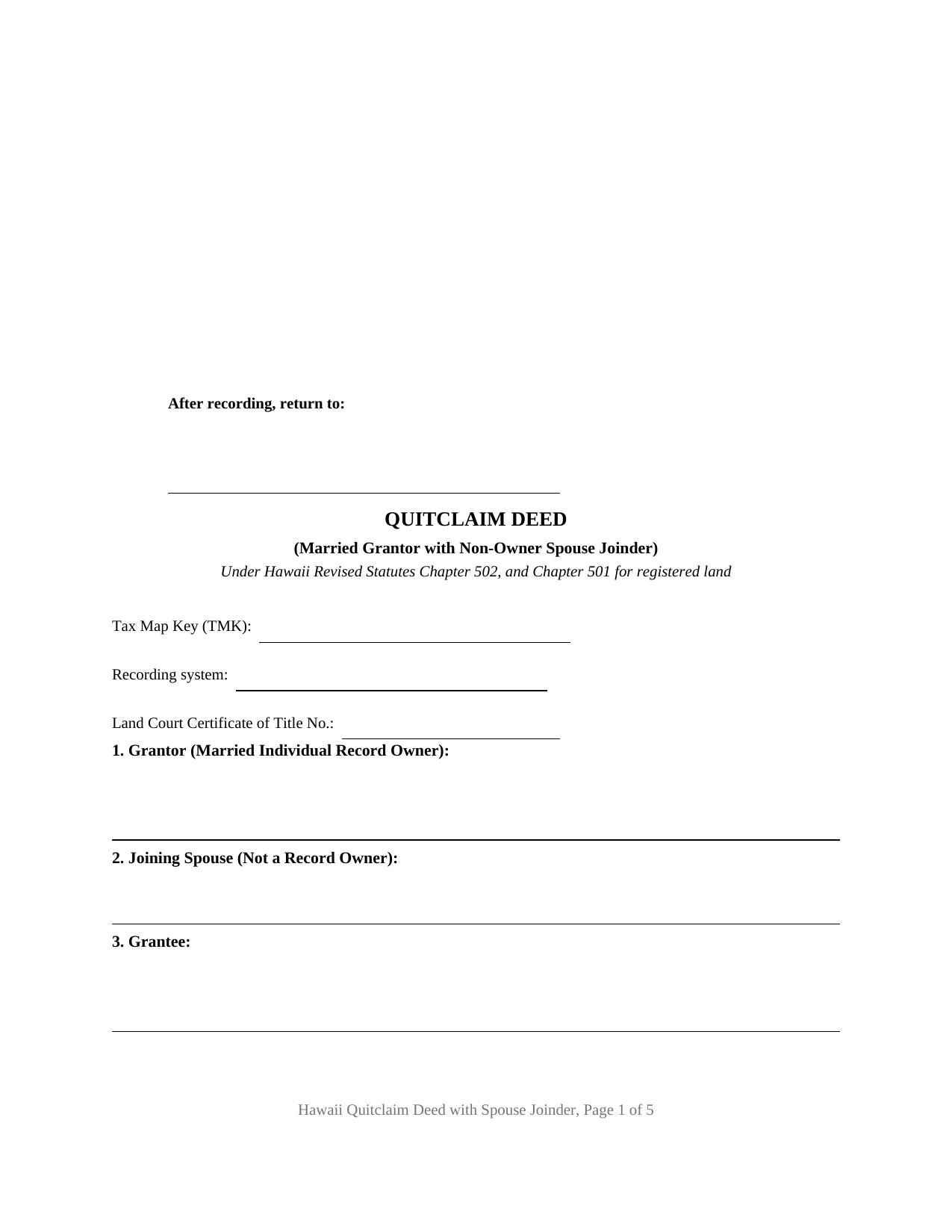
The second signature on this deed conveys nothing, and that is the point of it. When a married Hawaii owner holds record title alone, the spouse whose name never reached the title can sign the same instrument, releasing whatever interest the marriage might be argued to reach. This Hawaii Quitclaim Deed (Married Grantor with Non-Owner Spouse Joinder) is a fillable form built around that pairing: one grantor block, one joinder block, and a notary certificate for each of the two signers.
A release, not a second conveyance
The joinder section repays a close reading. It recites that the joining spouse holds no record title, then remises, releases, and forever quitclaims to the grantee any right, title, interest, claim, and demand that spouse may have in the property, including any interest arising out of the marriage. Three clauses keep the release from doing more: the spouse conveys no record title, takes nothing under the deed, and makes no covenant or warranty. A closing line states that the release operates whether or not the spouse in fact holds an interest, so the deed answers a record question without asserting an interest exists. The owner's own clause quitclaims that interest with no title assurance, the trade every quitclaim deed makes.
Why the release is worth recording in a state with no joinder statute
Hawaii gives this form an unusual footing. The state is not a community property state, dower and curtesy were abolished for estates arising after 1977, and a surviving spouse's protection runs through the Uniform Probate Code elective share, computed at death against an augmented estate. Those are death-time rights against an estate, not signature rules for a lifetime deed, and no Hawaii statute requires a spouse who is off the title to sign a conveyance of the other spouse's solely titled residence. What remains is a title question rather than a statutory one, and a recorded release answers it where searchers look. Title companies and lenders hold underwriting positions that can be stricter than the statute books.
One name on the title, one name off it
The form recites exactly one married individual as the record owner and exactly one spouse who is not a record owner, each signing in an individual capacity, with a printed name line beneath the signature and a certificate of that signer's own. Patterns that present this configuration run through the Hawaii record: an owner who took title before the marriage selling to an unrelated buyer, and an owner passing along a parcel inherited during the marriage. Where both spouses appear on the title, both are owners and both convey, and this form's non-ownership recital does not describe that title.
The page the registrars read first
Every Hawaii instrument records at one office, the Bureau of Conveyances in Honolulu, which also houses the Land Court's assistant registrar. The top three and a half inches of page one belong to the registrars, split down the middle between the two systems, with the inch below held for the return address. Hawaii's recording statute lists what the first page itself has to show, and this form carries all of it there: the grantor's name, the grantee's name and mailing address, the document type, and the tax map key. A recording system line and a certificate of title entry sit beside the key, so registered and unregistered land use one layout.
Reporting the price, or claiming an exemption
No taxable conveyance reaches the Hawaii record book until the conveyance tax is settled. Form P-64A reports the actual and full consideration and computes the tax. Form P-64B claims a statutory exemption, and that list is narrower than family transfers generally: nominal consideration documents between spouses, reciprocal beneficiaries, or parent and child, documents for one hundred dollars or less, and documents that only correct or confirm an earlier recording. A joinder deed sold for value outside those categories files the P-64A. Both are Department of Taxation forms, completed separately, and neither is part of this download.
This download includes the blank deed as a fillable PDF, then a completed example worked through a Kauai fact pattern in which a married Kapaa owner quitclaims her Land Court parcel and her husband signs the joinder four days later before a notary on another island, and a plain language guide covering every entry and the recording process. A quit claim deed, in the older spelling, is the same instrument. These materials describe Hawaii law in general terms and are not legal advice.
Important: County-Specific Forms
Our quitclaim deed (married grantor with non-owner spouse joinder) forms are specifically formatted for each of the 4 counties in Hawaii.
After selecting your county, you'll receive forms that meet all local recording requirements, ensuring your documents will be accepted without delays or rejection fees.