Hawaii Quitclaim Deed (Trustee Grantor)
County Specific Legal Forms Validated as recently as September 29, 2026 by our Forms Development Team
About the Hawaii Quitclaim Deed (Trustee Grantor)
How to Use This Form
- Select your county from the list
- Download the county-specific form
- Fill in the required information
- Have the document notarized if required
- Record with your county recorder's office
What Others Like You Are Saying
"Great templates and very efficient"
"Very easy to use, got everything I needed. Reasonable price."
"Great site makes this procedure easy to do,thanks"
"very easy to use !!!"
"Your site was very informative and I was able to instantly and easily download the documents that I …"
4.8/5 from 4,815 reviews. Read all
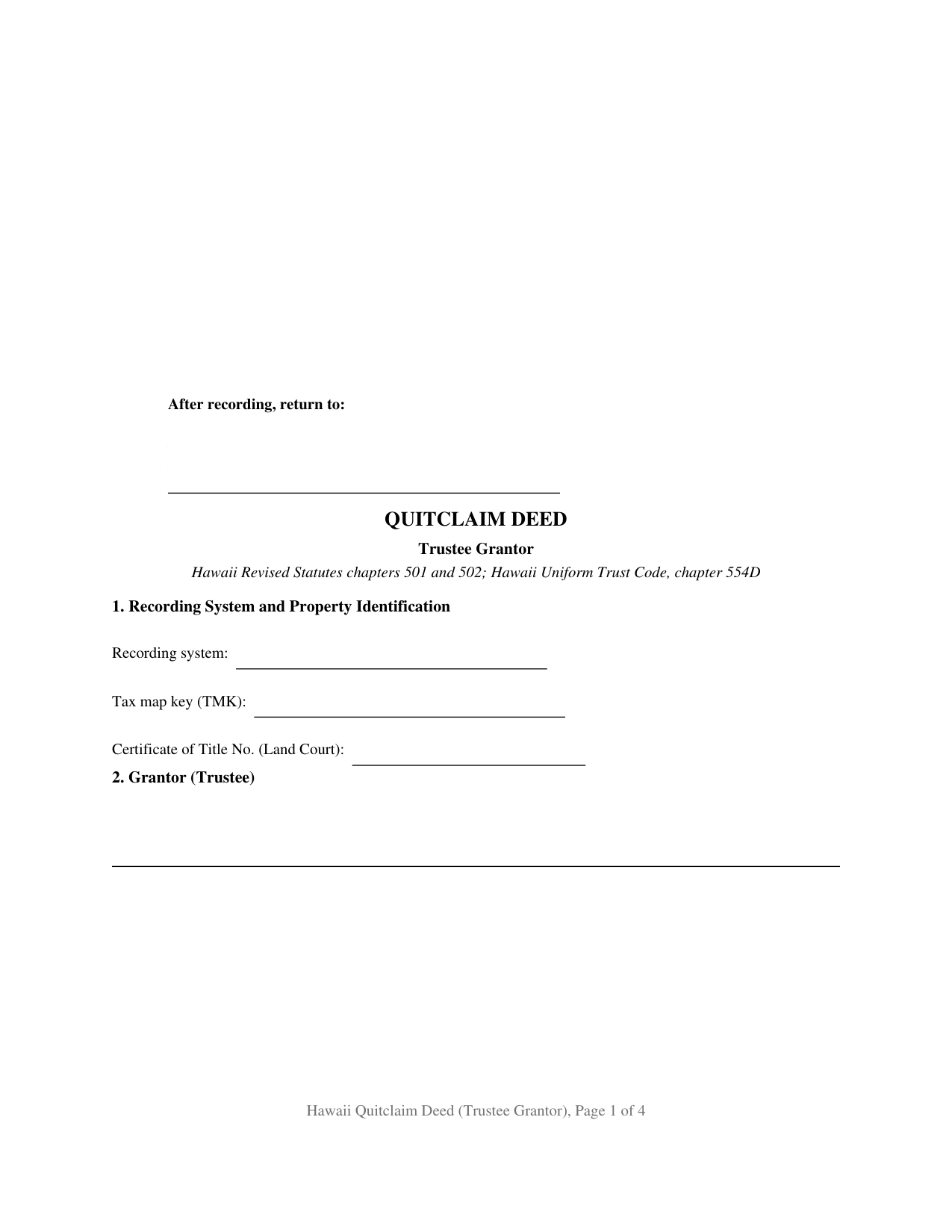
A trustee who signs a deed answers a question an individual owner never faces: where does the power to sign come from? This Hawaii Quitclaim Deed (Trustee Grantor) is a fillable form for the conveyance out of a trust, in which one trustee, signing in that capacity, releases the trust estate's right, title, and interest in a described Hawaii parcel to a named grantee, without covenant or warranty of title.
The power to convey, named on the face of the deed
Section 554D-816 of the Hawaii Revised Statutes, part of the state's Uniform Trust Code, lists what a trustee may do, including selling property for cash or on credit at a public or private sale. The chapter is largely default law, so the trust document governs wherever it speaks, and this deed devotes a section to authority rather than assuming it: the name of the trust, the date of the trust instrument, the article or section of that instrument conferring the power to sell or convey, and the document number of a recorded trust instrument or certification of trust. Section 554D-1012 protects a person other than a beneficiary who deals in good faith and for value with a trustee without knowing that the trustee is exceeding those powers, and a deed pointing to its own authority is how that good faith gets documented.
On registered land, the power is the price of registration
Hawaii keeps two sets of records, and the difference bears hardest on a trustee's conveyance. In the Regular System, recording gives notice and sets priority. Under the Land Court, the assistant registrar applies Section 501-132, which keeps an instrument dealing in any way with registered land held in trust out of the register altogether unless the enabling power is expressly conferred in the instrument of trust, or a court has construed the instrument in favor of the power. A trustee's deed on registered land faces a gate that a deed from an individual owner does not, and the trust entries here are drawn to answer it.
One trustee, one certificate, and one capacity in three places
The form recites a single trustee grantor with one signature line and one acknowledgment certificate. The same capacity appears three times: in the grantor section, beneath the signature on the printed name line the recording statute calls for, and in the notary's by-line, where Hawaii intake permits no discrepancy among the three. The certificate also carries the judicial circuit, document date, description, and page count Hawaii's notary rules add. Ownership patterns presenting this configuration run through the Hawaii record: a successor trustee closing out a family trust by distributing the last parcel, a trustee selling trust land to a buyer, and a settlor serving as sole trustee taking a parcel back out of a revocable living trust. A deed naming a trustee on the receiving side recites the trust in its grantee block instead, and this form is not drafted that way.
A release from the trust estate, and nothing more
What the grantee gets is the trust estate's position at delivery and no assurance about it. A Hawaii quit claim deed, in the older spelling, remises, releases, and forever quitclaims without covenant or warranty, and this one adds the fiduciary limit: the individual signing as trustee makes no personal covenant. Liens, easements, and other matters affecting the title ride through untouched.
The tax certificate a trust deed still files
Hawaii bars recording of a conveyance until its conveyance tax question is answered, and trust transfers answer it in more than one way. Section 247-3(14) exempts the document conveying real property from a grantor's revocable living trust to the grantor as beneficiary, the mirror of the funding transfer, and Form P-64B carries a separate category for a transfer to or from a trust that is not for a business purpose where the actual and full consideration is one hundred dollars or less. A trustee selling for real money reports the price on Form P-64A. Each is a Department of Taxation form, completed on its own and not included here.
The download holds the blank deed as a fillable PDF, a completed example worked through a Hilo fact pattern in which the trustee of a family trust distributes a Waiakea Homesteads lot to a beneficiary, and a plain language guide covering each entry, the forms of ownership a grantee may take, notarization, and both recording systems. These materials describe Hawaii law and this form in general terms and are not legal advice.
Important: County-Specific Forms
Our quitclaim deed (trustee grantor) forms are specifically formatted for each of the 4 counties in Hawaii.
After selecting your county, you'll receive forms that meet all local recording requirements, ensuring your documents will be accepted without delays or rejection fees.