Hawaii Quitclaim Deed (Individual Grantor by Attorney-in-Fact)
County Specific Legal Forms Validated as recently as October 1, 2026 by our Forms Development Team
About the Hawaii Quitclaim Deed (Individual Grantor by Attorney-in-Fact)
How to Use This Form
- Select your county from the list
- Download the county-specific form
- Fill in the required information
- Have the document notarized if required
- Record with your county recorder's office
What Others Like You Are Saying
"A great service, making it fast and easy to prepare warranty deeds for property transfer sales. I re…"
"Love your site. I found just what I needed and it was so easy. Saved me countless time and effort. W…"
"At first glance, explanations and guidance to fill out the grant deed seems quite direct and no too …"
"Forms do not allow enough space for fields and cutoff. Need to expand the fields to allow for more w…"
"Very good thanks."
4.8/5 from 4,815 reviews. Read all
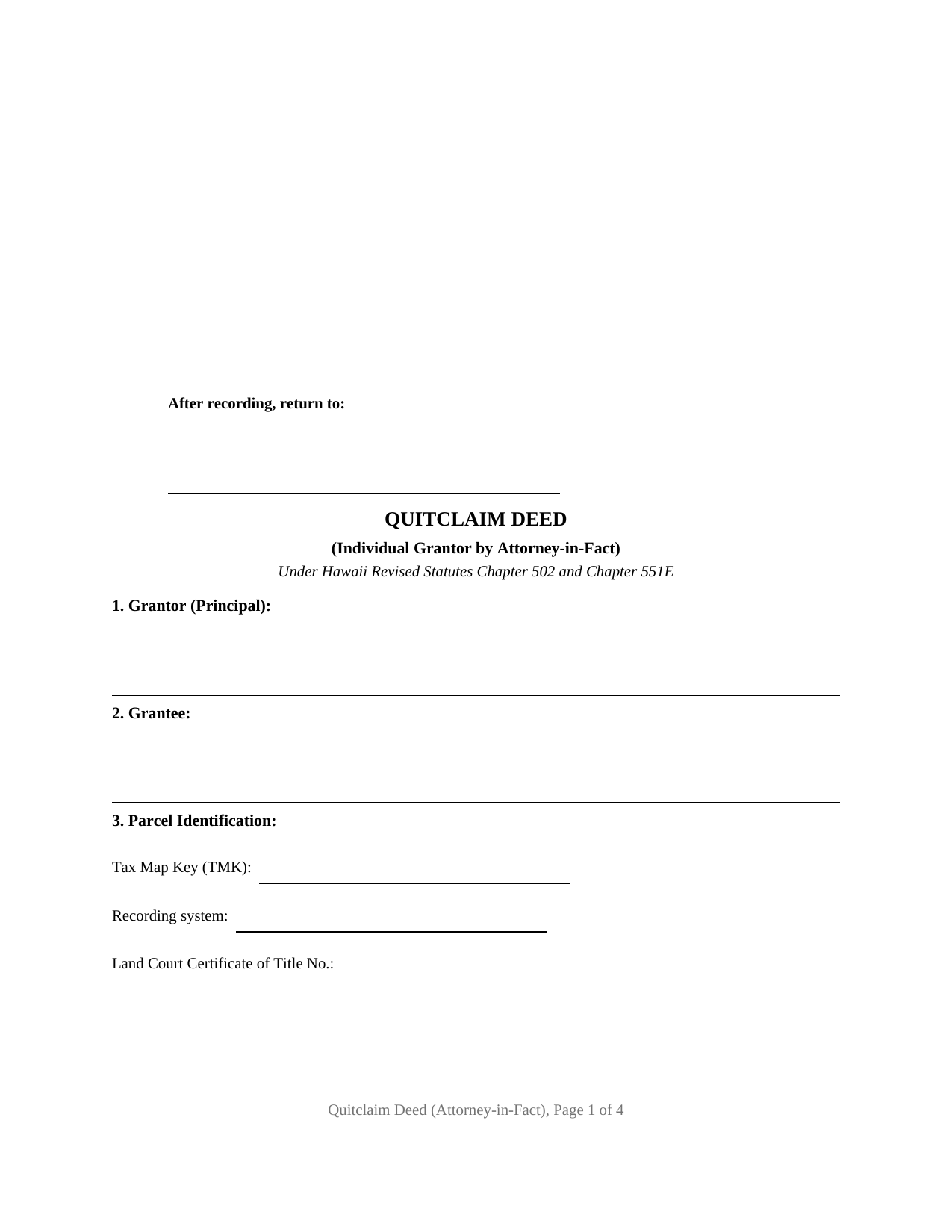
The owner whose interest moves on this Hawaii deed never picks up a pen. One individual is named as grantor, and an attorney-in-fact signs in that grantor's name under a power of attorney the deed identifies by date and recording data. This Hawaii Quitclaim Deed (Individual Grantor by Attorney-in-Fact) is a fillable form built for that split between the party who conveys and the person who signs, releasing whatever right, title, and interest the grantor holds, without covenant or warranty of title.
The authority statute names quitclaim outright
Section 551E-34 of the Hawaii Revised Statutes, part of the Uniform Power of Attorney Act adopted in 2014, sets out what general authority over real property lets an agent do. The list moves through selling, exchanging, and conveying with or without covenants, then names quitclaim by itself. Section 551E-31(g) supplies the consequence: the agent's act under the power of attorney has the same effect as if the principal had performed it. This form's conveyance clause is drafted onto those two provisions.
Two recorded documents, one statewide office
Section 502-84 makes the power of attorney a recorded instrument in its own right: powers of attorney for the transfer of real property within the State are recorded in the bureau of conveyances, and in default of that recording the instrument is not binding to the detriment of third parties. Registered land answers to Section 501-174, under which letters of attorney are acknowledged and filed or recorded with the assistant registrar and registered. Section 5 of the deed carries that document's date and recording reference, the trail a title search follows to the authority behind the deed.
A certificate written for a signer acting by attorney
Hawaii's acknowledgment statute anticipated this signature. Section 502-41 prints certificate forms by signer type, and the second is for natural persons acting by attorney, where the officer certifies the appearer as the person who executed the foregoing instrument in behalf of the named principal. That section also supplies a general form closing with the words this certificate carries, in the capacity shown, having been duly authorized to execute such instrument in such capacity. Around it sit the items Hawaii's notary rules add: judicial circuit, document date, description, page count.
One grantor, one agent, one signature line
The form gives the grantor, the attorney-in-fact, and the grantee separate entries, so the page shows who conveys, who signs, and who receives. Two configurations presenting the pattern: an owner who left the islands after signing a durable power of attorney, and an owner whose agent began acting once the owner's health changed. Where the agent and the grantee are one person, Section 551E-31(b) is the provision a title examiner reads: absent contrary language in the power of attorney, an agent who is not an ancestor, spouse, or descendant of the principal cannot use the authority to create an interest in the principal's property in the agent. An owner signing personally, a trustee, and an entity acting through officers recite authority differently, and this form is none of them.
Nothing warranted, and no promise from the agent
Title assurance is the one thing this deed does not carry: a quitclaim deed, spelled quit claim deed in older documents, passes the grantor's interest and promises nothing behind it. The clause remises, releases, and forever quitclaims that interest, then adds the limits agency calls for: the attorney-in-fact acts in the grantor's name in that capacity alone and not personally, gives no covenant of title individually, and has had no notice of revocation or termination.
Who signs the tax certificate
Hawaii keeps a conveyance out of the record book until Section 247-6 is satisfied, and that paperwork raises its own question here. The Department of Taxation's conveyance tax rules define an authorized representative as a party duly authorized to act for another, naming an attorney-in-fact, so the agent who signed the deed can sign the certificate in that capacity. Form P-64A reports the actual and full consideration and Form P-64B claims an exemption, both state tax forms completed separately and not included here.
The download holds the blank deed as a fillable PDF, a completed example worked through a Molokai fact pattern where a daughter, acting under her father's recorded durable power of attorney, releases his undivided one-half interest in a Kaunakakai parcel to his sister, and a plain language guide covering each entry, notarization, and both recording systems. Nothing here is legal advice; the materials describe Hawaii law and the form in general terms.
Important: County-Specific Forms
Our quitclaim deed (individual grantor by attorney-in-fact) forms are specifically formatted for each of the 4 counties in Hawaii.
After selecting your county, you'll receive forms that meet all local recording requirements, ensuring your documents will be accepted without delays or rejection fees.