Hawaii Quitclaim Deed (Trustee Grantee)
County Specific Legal Forms Validated as recently as September 22, 2026 by our Forms Development Team
About the Hawaii Quitclaim Deed (Trustee Grantee)
How to Use This Form
- Select your county from the list
- Download the county-specific form
- Fill in the required information
- Have the document notarized if required
- Record with your county recorder's office
What Others Like You Are Saying
"Very good experience."
"Great instructions, samples, ease in getting the form I needed, filling it out as a PDF, and having …"
"Excellent site, super fast responses to messages, and great patience with a newbie user. Couldn't be…"
"Thank you, thie was very helpful. I did find the forms I needed.Very easy to use.,"
"Easy to use, I would recommend deeds.com. I would recommend visiting your county recorder before hav…"
4.8/5 from 4,823 reviews. Read all
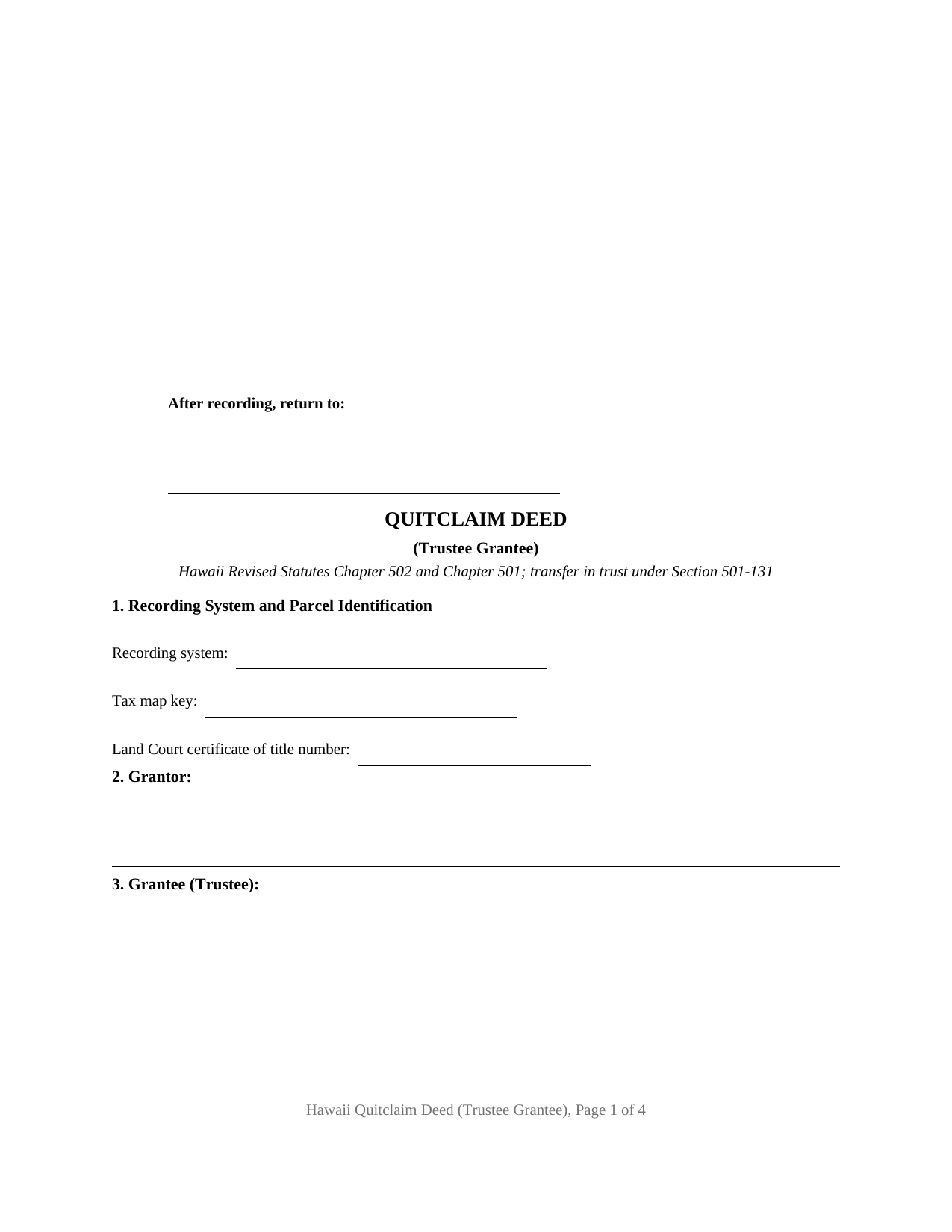
Title cannot be handed to a trust. It is handed to a trustee, and this Hawaii Quitclaim Deed (Trustee Grantee) is a fillable form built on that distinction: one grantor releases whatever right, title, and interest that grantor holds in a described Hawaii parcel, and the grantee is a trustee taking in that capacity under a trust the deed names and dates, with no warranty of title.
Legal title to the trustee, administration to the trust instrument
A quitclaim deed, also written as a quit claim deed, hands over the grantor's interest and promises nothing about the title behind it. What the trustee receives is the grantor's position at delivery, held in a fiduciary capacity and the trust instrument, not the deed, says who benefits and what may be done with the land. This form keeps the two documents in their own lanes: it recites the capacity on the face of the deed, then devotes a section to identifying the trust by name, by the date of its instrument, by the express trust powers over real property, and by the document number of a recorded trust instrument or certification of trust. That certification comes from Chapter 554D of the Hawaii Revised Statutes, the state's Uniform Trust Code, and lets a trustee state the trust's existence, date, name, and revocability, and whether all or fewer than all cotrustees must act, in place of the trust instrument itself.
What a Land Court certificate says about a trust
Registered land makes this pattern visible on the title itself. Section 501-131 keeps the particulars of a trust off the certificate of title: where an instrument transfers registered land in trust, the assistant registrar enters a memorandum reading in trust with a reference by number to the instrument creating it. Section 501-132 adds that an express power to sell or to mortgage is written onto the certificate in those words, and that a later instrument dealing with registered land held in trust is not registered unless the enabling power is expressly conferred in the instrument of trust. Those rules are why this deed asks for the trust powers and a recorded reference on its face.
One grantor, one certificate, and a trust identified four ways
The form recites exactly one grantor, a natural person signing individually above a printed name line, with a single acknowledgment certificate carrying the substance Hawaii's recording chapter prescribes plus the items its notary rules add: judicial circuit, document date, description, and page count. The grantee entry names the trustee, the capacity, and the mailing address the registrar's rules make a condition of recording. Ownership patterns presenting this configuration run through the Hawaii record: an owner funding a revocable living trust drawn up for estate planning, a parent moving one parcel into a family trust that already holds other land, and an owner placing an inherited lot into a trust created years earlier. A deed signed by a trustee as grantor recites authority on the signing side instead, and this form is not drafted as that instrument.
An exemption that still files a certificate
No Hawaii conveyance reaches the record book until the conveyance tax question is answered, and a transfer into the grantor's own revocable living trust answers it with an exemption. Section 247-3 exempts a document conveying real property from a grantor to that grantor's revocable living trust, and from the trust back to the grantor as beneficiary. The exemption is not the end of the paperwork: Section 247-6 still calls for a certificate declaring that the document is that kind of conveyance, so a Form P-64B travels with the deed to the recording desk, while a transfer to a trust for real money reports the consideration on Form P-64A. Both are Department of Taxation forms, filed on their own and not part of this download.
One office takes every Hawaii instrument, the Bureau of Conveyances in Honolulu, and page one is drawn for it: the registrars' reserve across the top, the return strip beneath, and the tax map key, recording system line, and certificate of title entry beside the parties. The package holds the blank deed as a fillable PDF, a completed example worked through a Mililani fact pattern on Oahu where an owner conveys her Land Court parcel to herself as trustee of the trust she created, and a plain language guide covering each entry, notarization, and both recording systems. Nothing here is legal advice; the materials describe the form and the Hawaii law behind it.
Important: County-Specific Forms
Our quitclaim deed (trustee grantee) forms are specifically formatted for each of the 4 counties in Hawaii.
After selecting your county, you'll receive forms that meet all local recording requirements, ensuring your documents will be accepted without delays or rejection fees.