Hawaii Quitclaim Deed (Divorce)
County Specific Legal Forms Validated as recently as September 23, 2026 by our Forms Development Team
About the Hawaii Quitclaim Deed (Divorce)
How to Use This Form
- Select your county from the list
- Download the county-specific form
- Fill in the required information
- Have the document notarized if required
- Record with your county recorder's office
What Others Like You Are Saying
"EVERYTHING WENT WELL, HAD NO PROBLEMS DOWNLOADING MY FORMS. THE ORDER QUICK AND EASY. THANKS IF I EV…"
"Very good information. Easy access and easy to download. All the forms needed for TOD to be notarize…"
"Deeds.com was so easy to use and understand. So fairly priced too in my opinion, worth every penny! …"
"I was very pleased with the document I downloaded. I was able to edit it easily and save a copy both…"
"All Star Support and less than a one day turnaround. Outstanding service. Thank you !"
4.8/5 from 4,815 reviews. Read all
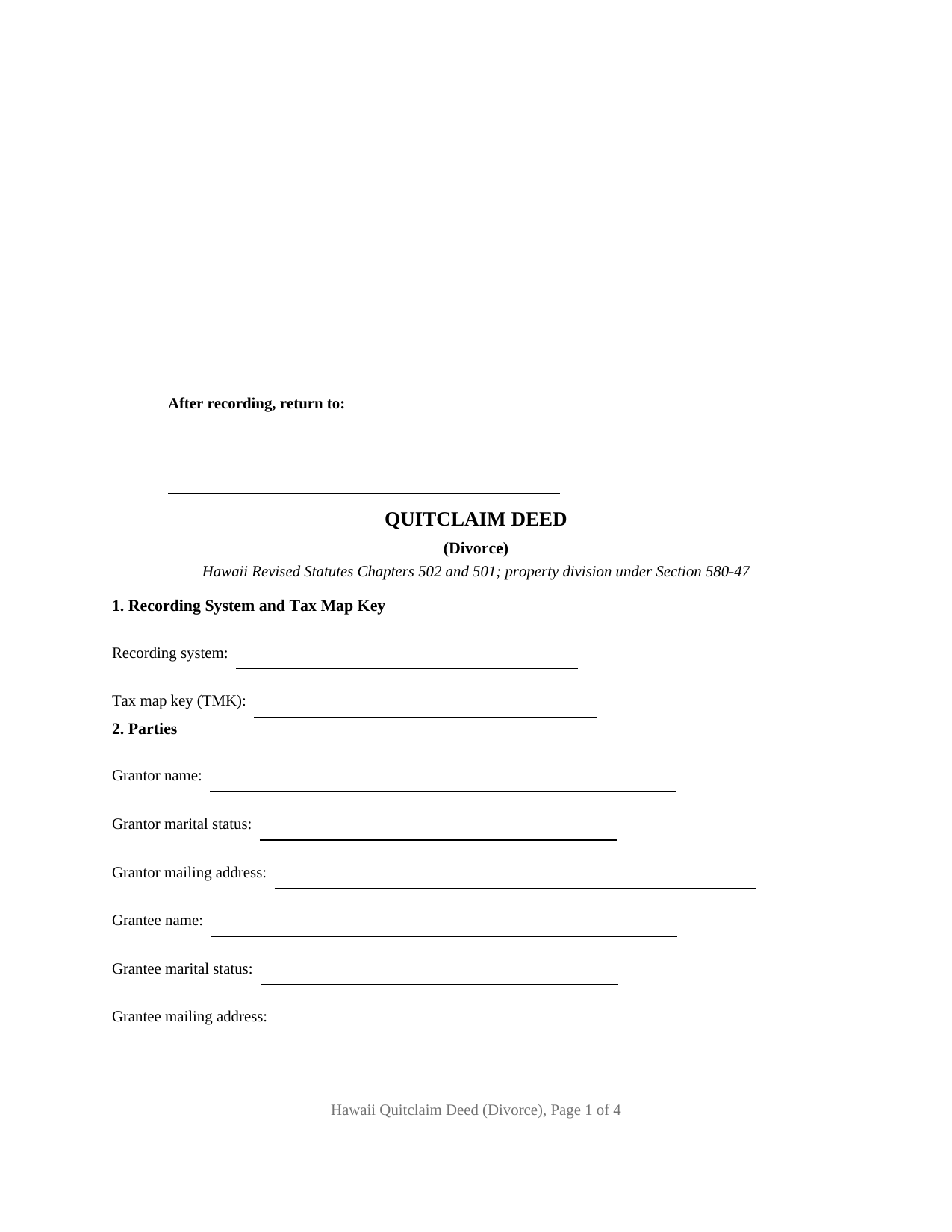
A Hawaii deed drawn for a divorce carries an entry no other conveyance in the state's record carries: a Family Court case number. This Hawaii Quitclaim Deed (Divorce) is a fillable form built around it. One spouse or former spouse signs as grantor, giving up that signer's entire stake in a described Hawaii parcel to the other party, in accordance with a decree or order the deed names by circuit, case number, and date of entry, and with no title warranty of any kind.
A deed that points back at a court file
Section 580-47(a) of the Hawaii Revised Statutes lets the Family Court, upon granting a divorce, make the further orders that appear just and equitable, among them finally dividing and distributing the estate of the parties, real, personal, or mixed, whether community, joint, or separate. Section 580-56(a) adds that every decree of divorce which does not specifically recite that the final division of property is reserved for further hearing shall finally divide that property. What a decree settles between two people and what the land records show remain two different things. Section 3 of this form is where the deed and the court file meet.
What the divorce already did to the title
Hawaii couples hold real property by the entirety, in joint tenancy, in common, or with record title in one name alone. Section 560:2-804 of the Uniform Probate Code reaches the first two on its own: divorce severs the interests of former spouses in property held by the entirety or in joint tenancy with right of survivorship and transforms them into a tenancy in common, subject to the exceptions the section states for a contrary governing instrument, a court order, or a contract dividing the marital estate. That severance is why the quitclaim clause here reaches the grantor's interest whether held by the entirety, jointly, in common, or otherwise.
One grantor, one grantee, one certificate
The form recites exactly one grantor, a natural person signing in an individual capacity, and exactly one grantee, so the interest lands in a single owner and the instrument carries one signature line and one acknowledgment certificate. The grantee signs nothing. Each party entry takes a full legal name, a marital status, and a mailing address, the items Hawaii intake rules ask for. Two configurations presenting this pattern: a decree awarding the marital residence to one party while the other releases the interest, and a release signed years after a decree that was never followed by a recorded deed. A conveyance between spouses whose marriage continues recites the marriage rather than a decree, and two owners conveying together, a trustee, an entity officer, and an agent under a power of attorney each recite authority differently; this form is drafted as none of them.
The exemption certificate reads the decree
Section 247-6 keeps a conveyance out of the record book until its tax question is answered, and the Department of Taxation's Form P-64B carries a category written for this transfer: marital parties in accordance with a divorce decree or the termination of a reciprocal beneficiary relationship. It asks for two things the deed itself carries, the FC-D case number and the nominal consideration figure, and it states its own limit: the conveyance must be between the marital parties, and a transfer not in strict accordance with the decree is taxed on the consideration unless another exemption applies. That category sits in Part IV, which goes directly to the Bureau of Conveyances rather than to the tax department first. Both P-64 forms are state tax forms, prepared on their own and not part of this download.
Two systems, one counter
Every Hawaii instrument is presented at the Bureau of Conveyances in Honolulu, under the Regular System, where recording gives notice and sets priority, or under the Land Court, where registration on a certificate of title is the operative act and Section 501-108(a) conditions acceptance on the certificate number appearing in the body of the instrument. Sections 1 and 4 carry both.
The download holds the blank deed as a fillable PDF, a completed example worked through an Ewa Beach fact pattern in which a former wife releases her interest to her former husband under a First Circuit decree, and a plain language guide covering every entry, notarization, and both recording systems. A quit claim deed, in the older spelling, is the same instrument. These materials describe Hawaii law in general terms; nothing in them is legal advice.
Important: County-Specific Forms
Our quitclaim deed (divorce) forms are specifically formatted for each of the 4 counties in Hawaii.
After selecting your county, you'll receive forms that meet all local recording requirements, ensuring your documents will be accepted without delays or rejection fees.