Idaho Quitclaim Deed (Divorce)
County Specific Legal Forms Validated as recently as October 22, 2026 by our Forms Development Team
About the Idaho Quitclaim Deed (Divorce)
How to Use This Form
- Select your county from the list
- Download the county-specific form
- Fill in the required information
- Have the document notarized if required
- Record with your county recorder's office
What Others Like You Are Saying
"Excellent Service! Please note that form Realty Transfer Tax Statement of Value does not print compl…"
"Excellent service! We surely use again"
"Excellent easy to follow instructions."
"Easy system to use. good information."
"Very helpful."
4.8/5 from 4,832 reviews. Read all
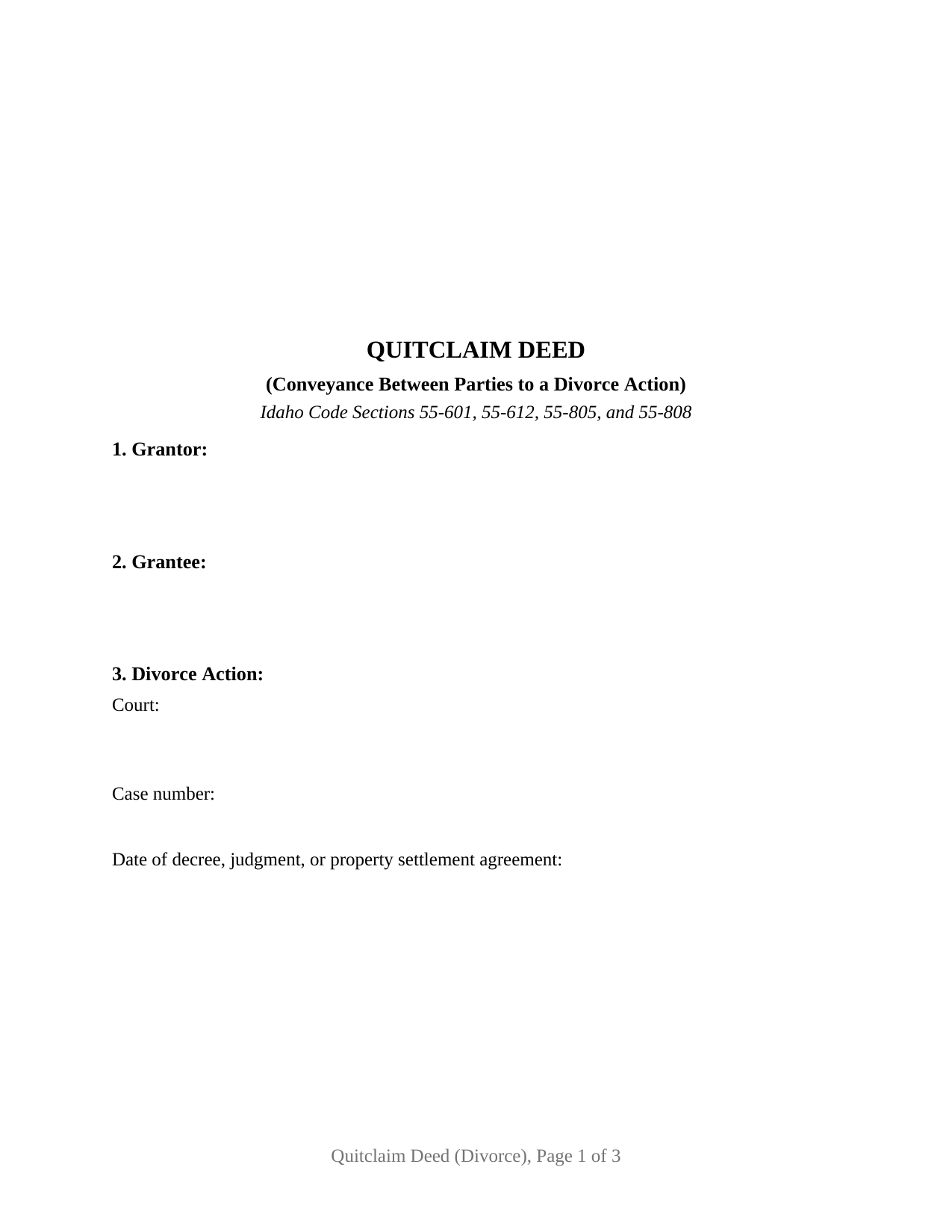
A divorce judgment divides Idaho property between two people. The grantor and grantee indexes at the county recorder do not read judgments. This quitclaim deed is the instrument that carries the division into those indexes: one party signs as Grantor, the other is named as Grantee, and Section 3 pins the conveyance to its case by court, case number, and the date of the decree, judgment, or settlement agreement.
What the decree settles, and what the record still shows
Idaho Code Section 32-712 gives the divorce court the community property and the homestead to assign, directing a substantially equal division in value, considering debts, unless there are compelling reasons otherwise. That assignment binds the parties; what it does not do is put a conveyance in the chain of title under two names. A certified copy of the decree is separately recordable, since Idaho Code Section 55-801 reaches any judgment affecting title and Section 55-802 governs judgments; that copy comes from the clerk of the court and is not part of this package. A recorded decree tells a title examiner what a court ordered; a recorded deed shows a conveyance, indexed under the names of the party who released and the party who took.
Two vestings divorce changes without anyone signing
Idaho law rewrites certain co-ownership when a marriage ends. Idaho Code Section 15-2-804 severs the interests of former spouses in property held in joint tenancy with right of survivorship into equal tenancies in common and revokes revocable dispositions favoring the former spouse. Idaho Code Section 15-6-402 severs community property with right of survivorship into a tenancy in common on divorce or annulment unless a court orders otherwise. Both operate by law, and neither edits the deed on file, which still recites the vesting the couple chose.
One signature, for either of two reasons
Timing decides why one signature block is enough. A deed delivered after entry of the decree runs between two people no longer married, so Idaho Code Section 32-912, requiring a spouse to join in conveying community real estate, and Idaho Code Section 55-1007, requiring a spouse's consent to convey the homestead of a married person, no longer describe the parties. A deed delivered while the case is pending runs between spouses, and Idaho Code Section 32-906(2) provides that only the grantor spouse need execute and acknowledge an instrument conveying property to the other spouse.
A release with the covenant word left out
Idaho reads two covenants into the word grant under Idaho Code Section 55-612 unless a deed restrains them expressly. Section 8 remises, releases, and forever quitclaims instead, restraining both covenants by name, so this quitclaim deed, also spelled quit claim deed and searched as a divorce deed, promises nothing about the title. Deeds of trust, judgment liens, and easements ride through it, and no debt moves: a party who signed the note stays on it until a lender agrees otherwise.
What the divorce configuration carries
The form recites one Grantor and one Grantee, each a party to the case named in Section 3, with the complete mailing address Idaho Code Section 55-601 puts on the face of a conveyance, one signature block, and one certificate on the individual capacity short form of Idaho Code Section 51-116. Section 8 releases every interest the Grantor may hold, community, separate, and homestead alike, and states that the Grantee takes as sole and separate property. A decree awarding the residence to one party and directing the other to convey, a settlement agreement performed by deed, and a former spouse releasing a stale interest years after a case closed present the pattern this deed recites. Two parties conveying together to an outside buyer, and a deed signed by an attorney in fact under a recorded power of attorney, follow different signing patterns.
At the recorder's counter
The acknowledged deed goes to the recorder of the Idaho county holding the land, at the flat fifteen dollars Idaho Code Section 31-3205 sets for a conveyance of thirty pages or fewer, and no transfer tax follows it. Priority answers to recording, so the interval between signing and filing is one a later good faith purchaser can occupy. Page one keeps three inches clear for the stamp or label.
Three files arrive together: the fillable deed, a completed example running a Canyon County conveyance through every entry, and a guide to the sections, the certificate, and recording. These materials are informational, not legal advice; a specific parcel or decree belongs with an Idaho attorney.
Important: County-Specific Forms
Our quitclaim deed (divorce) forms are specifically formatted for each of the 44 counties in Idaho.
After selecting your county, you'll receive forms that meet all local recording requirements, ensuring your documents will be accepted without delays or rejection fees.