Idaho Quitclaim Deed (Married Couple as Grantors)
County Specific Legal Forms Validated as recently as September 16, 2026 by our Forms Development Team
About the Idaho Quitclaim Deed (Married Couple as Grantors)
How to Use This Form
- Select your county from the list
- Download the county-specific form
- Fill in the required information
- Have the document notarized if required
- Record with your county recorder's office
What Others Like You Are Saying
"This was a great site to use. They responded quickly when needed. And with i 24 hours the deed was f…"
"Excellent way to do this kind of transaction."
"I looked around for forms and came to this site. I had to do 15 deeds and this form was very useful …"
"great site for downloading forms"
"I planned to use an attorney for this process but deeds.com made it so easy I was able to do it myse…"
4.8/5 from 4,829 reviews. Read all
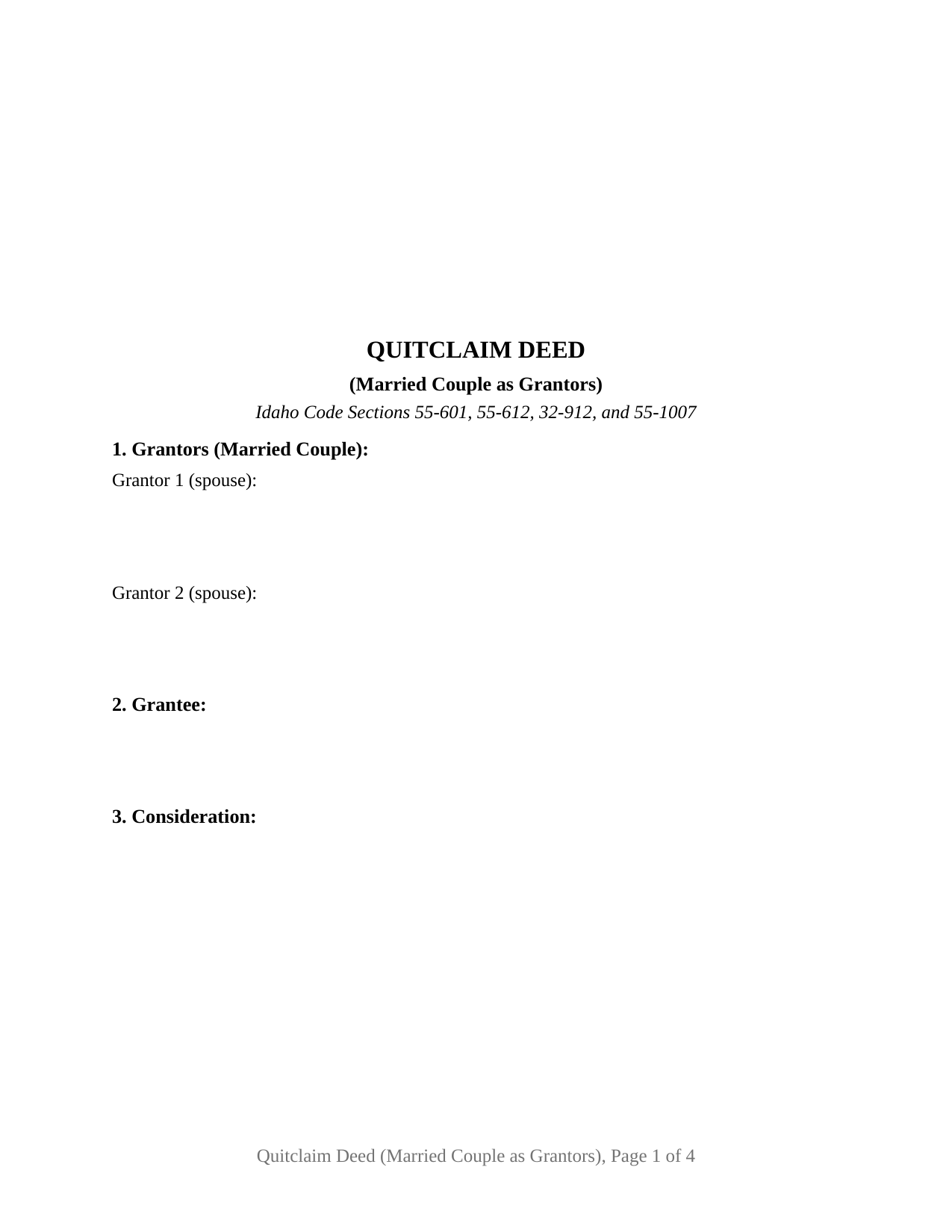
One married couple, one conveyance: this Idaho quitclaim deed carries the signing pattern Idaho law describes when spouses convey together. The form recites two grantors who state that they are married to each other, gives each spouse a signature line and an acknowledgment certificate, and passes to the named grantee every interest the couple holds at delivery, community or separate, without any warranty of title.
Why an Idaho conveyance by spouses takes two signatures
Idaho is a community property state, and its execution rules read marriage directly onto the deed. Idaho Code Section 32-912 gives either spouse management and control of community property while providing that neither spouse may sell, convey, or encumber community real estate unless the other spouse joins in executing the instrument. Idaho Code Section 55-1007, amended effective July 1, 2025, adds a parallel rule for the homestead of a married person: no conveyance or encumbrance without the other spouse's consent, and the statute treats that consent as evidenced by each spouse executing and acknowledging the instrument. This deed is drafted around both rules at once. Its conveyance section states that both spouses join under Section 32-912 and that each spouse's execution and acknowledgment evidences homestead consent under Section 55-1007, so the completed instrument shows the joinder and the consent on its face.
Everything the couple holds, released without covenants
The operative sentence remises, releases, and forever quitclaims all of the grantors' right, title, and interest, and it states expressly that the conveyance includes any community property interest and any separate property interest of either spouse. That breadth is the quiet advantage of the married couple configuration: whether the couple's title is community, separate, or an unexamined mixture of the two, the release reaches all of it. Like every quitclaim deed, often searched as a quit claim deed, the instrument promises nothing about what that interest is. Idaho Code Section 55-612 would imply two covenants from the word grant, so the conveyance section expressly restrains those covenants and states that the deed conveys without covenant or warranty of title.
What the married couple configuration carries
The form recites exactly two grantors, married to each other, with a marital recital in the conveyance section, a grantee section holding the name and complete mailing address Idaho Code Section 55-601 places on the face of the instrument, and a separate acknowledgment certificate for each spouse in the statutory short form of Idaho Code Section 51-116. The two certificates are the form's arrangement, letting the spouses acknowledge on different dates, before different officers, or in different states. Spouses giving a family parcel to an adult child, a couple releasing their interests to resolve a title question with a neighbor, and spouses conveying property whose title mixes community and separate interests present the pattern this deed recites. A sole owner's release, an interspousal deed from one spouse to the other under Idaho Code Section 32-906(2) in which only the grantor spouse executes, and a conveyance by co-owners who are not married to each other follow different signing patterns, and the form is not set up as any of them.
Recording in the property county
The acknowledged deed goes to the county recorder where the land lies, with a statewide fee of fifteen dollars for a deed of thirty pages or fewer and no transfer tax or transfer declaration behind it, since Idaho bars real estate transfer taxes by statute. Idaho's race notice rule makes promptness count: an unrecorded conveyance loses to a later good faith purchaser for value who records first. The first page keeps a full three inch top reserve for the recorder's stamp or label, inside the statutory page size cap and the legibility rule for recorded pages.
Inside this package
Three pieces arrive together: the quitclaim deed as a fillable PDF, a completed example that walks a Kootenai County conveyance by spouses through every section, and a plain language guide to the entries, the two acknowledgments, and the recording step. The materials describe Idaho law in general terms; they are informational only, not legal advice, and an Idaho attorney can address how these statutes operate on a specific title or marriage.
Important: County-Specific Forms
Our quitclaim deed (married couple as grantors) forms are specifically formatted for each of the 44 counties in Idaho.
After selecting your county, you'll receive forms that meet all local recording requirements, ensuring your documents will be accepted without delays or rejection fees.