Idaho Quitclaim Deed (Two Grantors)
County Specific Legal Forms Validated as recently as October 2, 2026 by our Forms Development Team
About the Idaho Quitclaim Deed (Two Grantors)
How to Use This Form
- Select your county from the list
- Download the county-specific form
- Fill in the required information
- Have the document notarized if required
- Record with your county recorder's office
What Others Like You Are Saying
"I purchased the Affidavit of Surviving Joint Tenant document and found the whole package of document…"
"so far appears to meet my needs!"
"The deed is great. However, I do not believe your Statement of Full Consideration is up to date as i…"
"Ordered a 'Gift Deed' form The 'Example' form was most helpful. The actual form was very detailed, a…"
"Purchased and used the quitclaim form. I have no complaints with any aspect. The forms, instructions…"
4.8/5 from 4,828 reviews. Read all
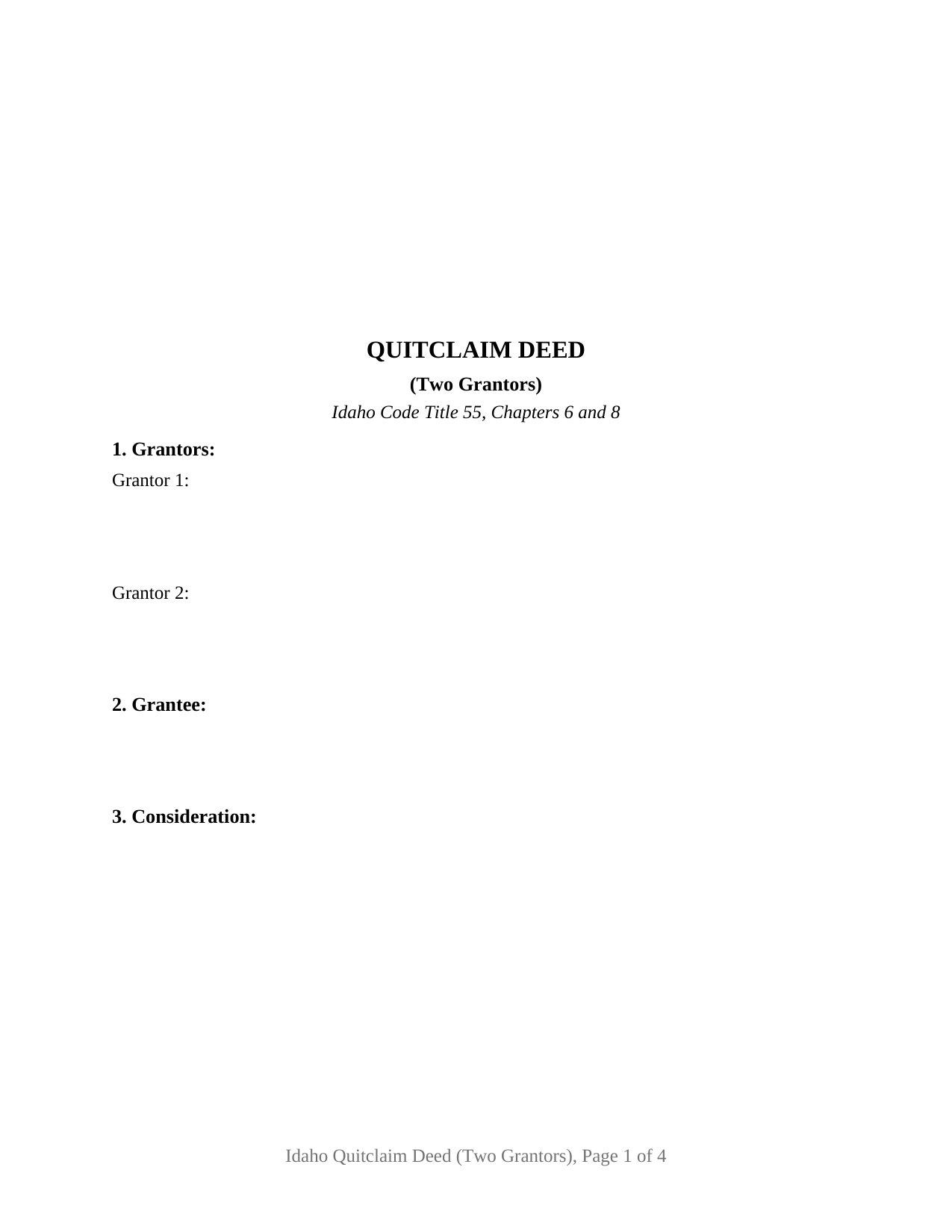
Two grantors, two signature lines, two acknowledgment certificates: this Idaho quitclaim deed is arranged for a pair of owners who release their interests in a single conveyance. The form carries a two-grantor configuration throughout, and it passes to the named grantee whatever right, title, and interest the two grantors together hold at delivery, with no covenant or warranty of title attached.
Why two signatures appear on one Idaho deed
Idaho is a community property state, and Idaho Code Section 32-912 provides that neither spouse may sell, convey, or encumber community real estate unless the other spouse joins in executing the deed. Idaho Code Section 55-1007 runs parallel for the homestead of a married person, with spousal consent evidenced by each spouse executing and acknowledging the instrument. A married couple deeding community real estate therefore signs together, and the two signature blocks on this form carry exactly that joinder. The same pattern appears without a marriage: two heirs passing inherited fractional interests to one relative, two tenants in common consolidating title in a single name, and two co-owners releasing their shares in the same transaction all present the two-grantor configuration this deed recites. The form recites exactly two grantors; a sole owner's conveyance, and a deed from three or more owners, follow different signing patterns.
Each grantor acknowledges separately
Idaho Code Section 55-805 makes acknowledgment the gateway to the record: a deed is entitled to recording once its execution is acknowledged and certified, and no witness signatures enter into it. This form carries a separate certificate for each grantor, so one grantor may acknowledge in Nampa on a Tuesday while the other appears before a different notarial officer, even in another state, days later. The certificates follow the statutory short form in Idaho Code Section 51-116. The separate certificates are an arrangement of the form rather than a command of Idaho law, since the short form names the individual or individuals acknowledging and can cover two signers who appear together; the two-certificate layout simply removes any need for the grantors to coordinate a single appointment.
A conveyance with the covenants switched off
An Idaho deed picks up implied title covenants only from the word grant, and Idaho Code Section 55-612 attaches them unless the conveyance restrains them in express terms. This form does both of the things that keep the transfer covenant free: its operative sentence remises, releases, and forever quitclaims, and its conveyance section expressly restrains every covenant Section 55-612 would otherwise imply. What moves to the grantee is the combined interest of both grantors, exactly as it stands, which is why the two-grantor quitclaim deed, also searched as a quit claim deed, does the work of consolidation and family transfers where the parties already know the state of the title.
From the signing table to the recorder's counter
Idaho Code Section 55-601 puts one content rule on the face of the deed, the grantee's name and complete mailing address, and Section 2 of the form holds it. Delivery to the recorder of the county where the property sits follows, with a statewide fifteen dollar fee for a deed running thirty pages or fewer and nothing else to file, since Idaho bars real estate transfer taxes by statute. Under the state's race notice statutes the first good faith purchaser to record prevails over an unrecorded deed, which is the practical reason a completed deed travels to the recorder promptly. The top of the first page stays blank for the recorder's stamp, and the pages stay within Idaho's statutory size and legibility rules.
What arrives with the download
The download delivers the two-grantor quitclaim deed as a fillable form, a completed example showing a Canyon County conveyance by a married couple to a single grantee, and a plain language guide covering each entry, the two acknowledgments, and the recording step. The materials are informational only, not legal advice; questions about how these statutes operate on a particular title belong with an Idaho attorney.
Important: County-Specific Forms
Our quitclaim deed (two grantors) forms are specifically formatted for each of the 44 counties in Idaho.
After selecting your county, you'll receive forms that meet all local recording requirements, ensuring your documents will be accepted without delays or rejection fees.