Idaho Quitclaim Deed (Trustee Grantee)
County Specific Legal Forms Validated as recently as September 29, 2026 by our Forms Development Team
About the Idaho Quitclaim Deed (Trustee Grantee)
How to Use This Form
- Select your county from the list
- Download the county-specific form
- Fill in the required information
- Have the document notarized if required
- Record with your county recorder's office
What Others Like You Are Saying
"Super efficient, extremely responsive , and above all quick turnaround. Thank you! Will definitely u…"
"The experience was great. It was so easy to get my document recorded and it was done the same day!"
"I had to add a section on the form to accomodate the former Grantor/Grantee informtion before it cou…"
"Very helpful, with blank and sample completed documents. The only thing I was confused about was the…"
"Excellent, invaluable and reasonable!"
4.8/5 from 4,828 reviews. Read all
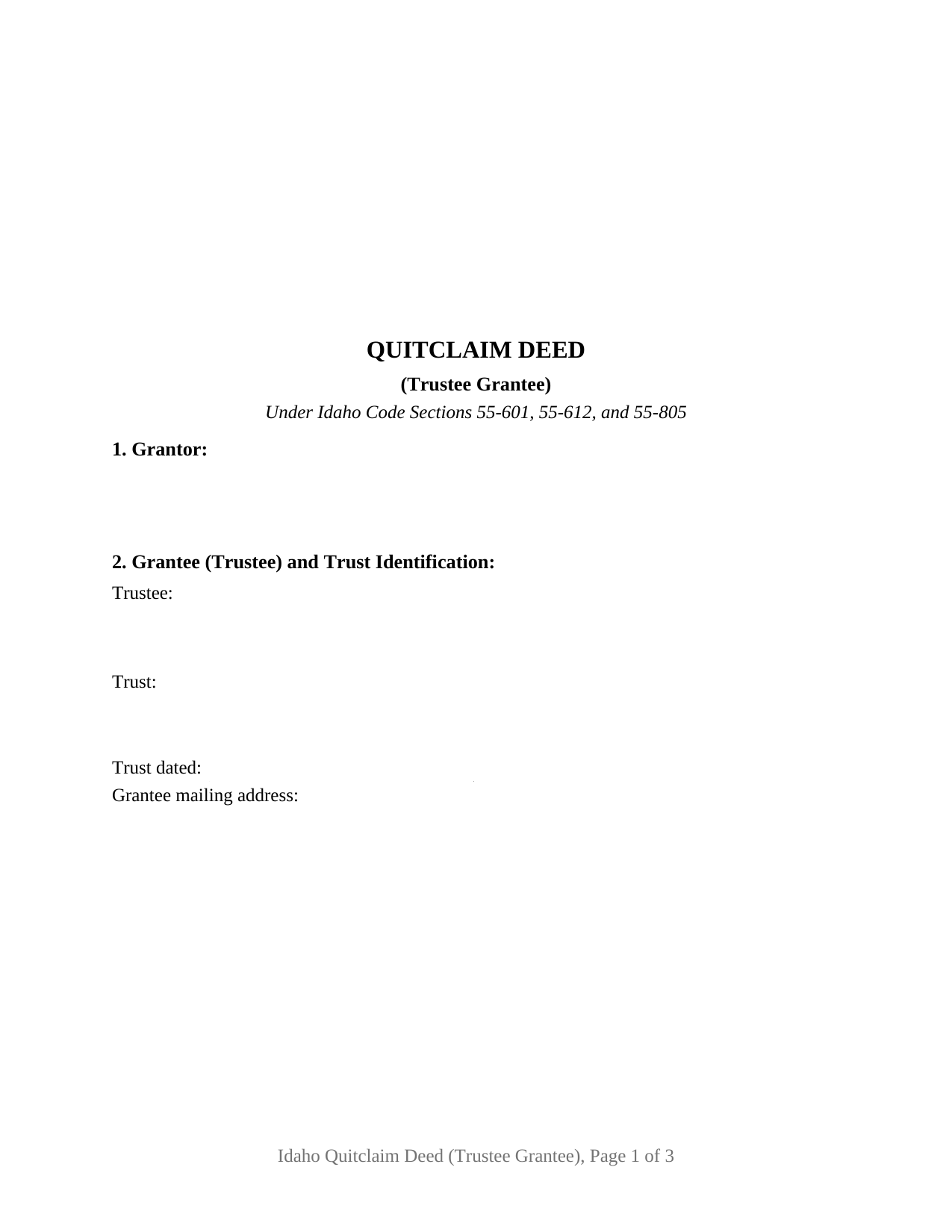
The Grantee on this Idaho quitclaim deed is a trustee, and the conveyance section says what that does to the title it receives: the interest released by the Grantor vests in the named trustee as trustee of the identified trust, not in that person individually. Section 2 gathers what a fiduciary grantee puts on the record: the trustee's name, the trust's name, the trust's date, and the complete mailing address Idaho Code Section 55-601 places on the face of an Idaho conveyance.
Title in a fiduciary name
An Idaho deed to a trustee is deliberately thin on trust detail. Idaho Code Section 68-110 provides that a third person dealing with a trustee may assume the existence of trust powers and their proper exercise without inquiry, and that a third person without actual knowledge that the trustee is exceeding or improperly exercising those powers is fully protected. So the deed names the trust and stops, and the trust's terms stay out of the public record. When a title company or a later buyer wants more, Idaho Code Sections 68-114 and 68-115 supply the certification of trust, an affidavit signed and acknowledged by all currently acting trustees, confirming the trust's existence, its date, the acting trustees, and their powers. That affidavit is prepared and delivered separately and is not part of this package.
What a quitclaim releases
A quitclaim deed, often searched as a quit claim deed, transfers the interest the signer actually holds and promises nothing about its condition. Idaho hangs two implied covenants on the single word grant under Idaho Code Section 55-612, so this deed keeps that word out of its operative sentence and states expressly that both implied covenants are restrained and excluded. Deeds of trust, liens, easements, and subdivision covenants keep burdening the parcel exactly as before, and a loan secured by it is neither released nor assumed. What moves is the Grantor's interest, whatever it turns out to be, into fiduciary hands.
What the trustee grantee configuration carries
The form recites one Grantor and one trustee Grantee. A single signature line and a single certificate follow, the certificate drawn on the statutory short form of Idaho Code Section 51-116, the acknowledgment Idaho Code Section 55-805 makes the condition of recording; no witness signs an Idaho deed. The Grantee signs nothing, because a trustee who takes title under a deed is not an executing party. Three patterns present this configuration in the Idaho records: a parcel bought years after the trust was created and conveyed to the trustee so the trust holds it with everything else; an inherited or fractional interest released to the trustee of a family trust that already holds the rest of the title; and a parcel whose earlier deed named the trust itself, or named a trustee who no longer serves, conveyed to the currently acting trustee so the record runs to someone who can act. A deed signed by a trustee as Grantor runs the opposite direction, and a conveyance of Idaho community real estate or of a married person's homestead brings in the other spouse under Idaho Code Sections 32-912 and 55-1007. The form is not set up as either one.
Recording, and the trust filings it does not replace
The acknowledged deed is delivered to the recorder of the Idaho county holding the parcel, with the statutory fifteen dollar charge for a deed of thirty pages or fewer, and Idaho neither taxes real estate transfers nor asks for a transfer declaration behind the deed. Under Idaho's race notice statutes an unrecorded conveyance loses to a later good faith purchaser for value who records first, though it still binds the parties. Page one holds three inches clear for the stamp or label, covering every space Idaho recorders publish, and the pages stay inside the statutory size and legibility standard. Two trust related filings sit elsewhere: the Section 15-7-101 duty to register a trust administered in Idaho with the court at its principal place of administration, and the affidavit in Idaho Code Section 63-703(4) that proves trust ownership to a county assessor for the homeowner's exemption. Neither one happens at the recorder's counter.
Three files arrive together: the fillable deed, a completed example filled in for a Twin Falls County conveyance to a trustee, and a guide that walks through every entry, the acknowledgment, and the recording step. These materials describe Idaho law generally and are informational, not legal advice; questions about a specific parcel or trust belong with an Idaho attorney.
Important: County-Specific Forms
Our quitclaim deed (trustee grantee) forms are specifically formatted for each of the 44 counties in Idaho.
After selecting your county, you'll receive forms that meet all local recording requirements, ensuring your documents will be accepted without delays or rejection fees.