Idaho Quitclaim Deed (Married Grantor with Non-Owner Spouse Joinder)
County Specific Legal Forms Validated as recently as September 30, 2026 by our Forms Development Team
About the Idaho Quitclaim Deed (Married Grantor with Non-Owner Spouse Joinder)
How to Use This Form
- Select your county from the list
- Download the county-specific form
- Fill in the required information
- Have the document notarized if required
- Record with your county recorder's office
What Others Like You Are Saying
"Was sort of complicated for this phone illiterate 70 year old 😂. Asked my daughter for help. She bre…"
"Easy process. Thanks for making this resource available."
"Very useful and right at your fingers when you need a form. Recommend these forms highly. Thank you!…"
"Site was very easy to use. Lots of information provided...if the deed gets registered without a prob…"
"Easy to follow forms, and the attached go-by and instructions made it easy to complete."
4.8/5 from 4,832 reviews. Read all
Idaho puts a signature line on this deed for a person who owns nothing on the record. One married owner holds title and signs as grantor; that owner's spouse, whose name appears nowhere in the chain, signs to consent to the conveyance and to release whatever interest the spouse may hold. What reaches the grantee is the interest the grantor holds when the deed is delivered, released without covenant or warranty of title.
Consent from a spouse who is not on the title
Two Idaho statutes reach past the record title. Idaho Code Section 55-1004 makes a homestead automatic on owner-occupied residential property, with no declaration to record, and Idaho Code Section 55-1007, re-enacted by 2025 House Bill 150 and effective July 1, 2025, provides that the homestead of a married person shall not be conveyed or encumbered by a spouse without the consent of the other spouse. The statute names the way that consent is shown: each spouse executes and acknowledges the instrument by which the homestead is conveyed. Idaho Code Section 32-912 adds the community property side, calling for the other spouse to join in executing any deed of community real estate. A deed carrying the record owner's signature alone leaves both questions open, and Idaho title practice notices.
One grantor, one consenting spouse, two certificates
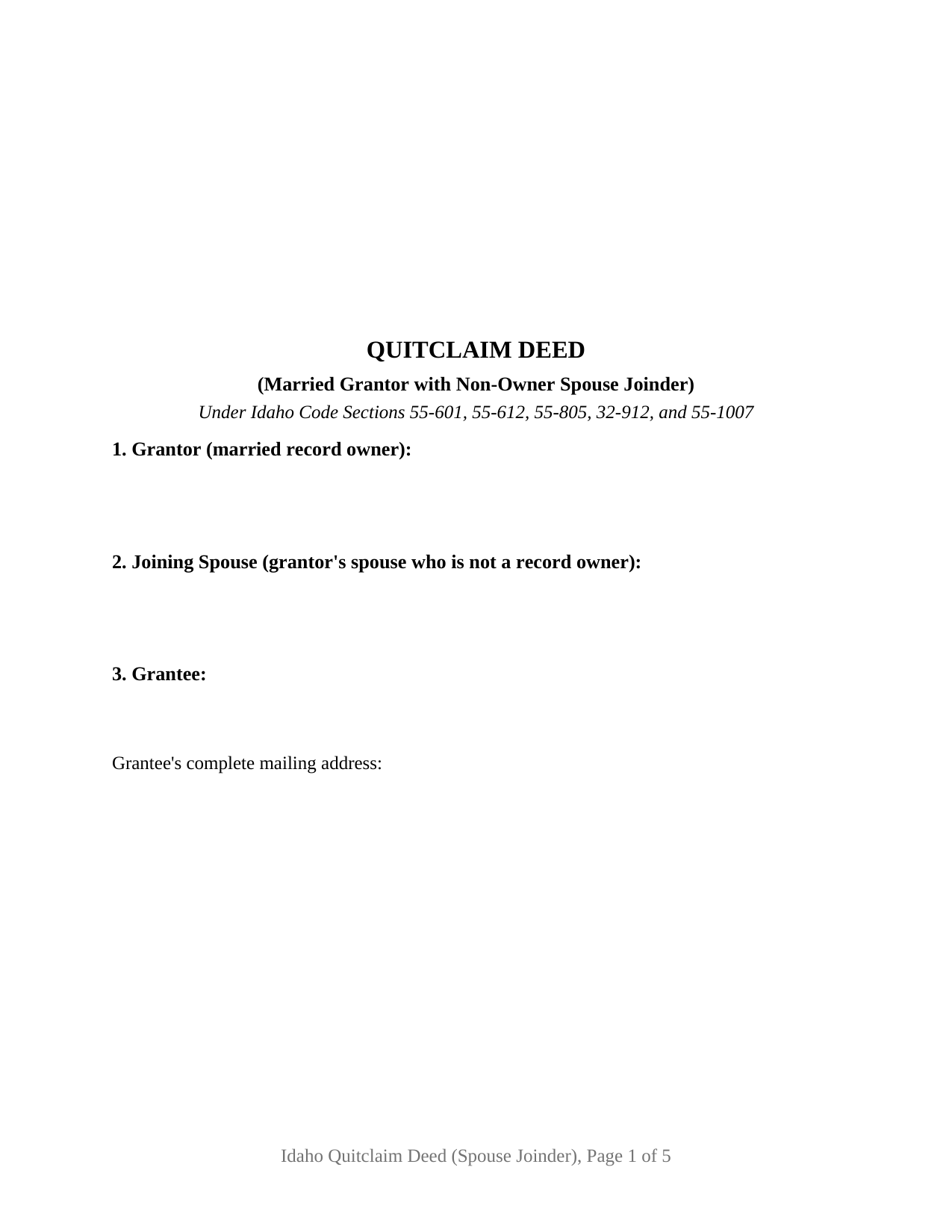
The form recites one grantor, described as a married record owner, and one joining spouse, described as the grantor's spouse who is not a record owner. Section 10 is where the configuration does its work: it states the joining spouse's consent under Section 55-1007, the spouse's joinder under Section 32-912 to the extent the property is community real estate, and the spouse's own release of any interest held in the property, including any community property interest and any homestead right. Each signer has a signature block, a printed name and date entry, and a certificate in the individual capacity short form of Idaho Code Section 51-116, so the two may appear before different notarial officers on different days. Separate property owned before the marriage and lived in as the family home, an inherited parcel that became the couple's residence, and title standing in one spouse's name although it was acquired during the marriage all present the pattern this deed recites. An interspousal deed under Idaho Code Section 32-906(2), in which only the grantor spouse executes, follows a different pattern, and the form is not set up as one.
Nothing here promises a clean title
A quitclaim deed, also spelled quit claim deed, moves an interest without standing behind it. Idaho makes that turn on a single word: Section 55-612 reads two covenants into a conveyance that uses grant, unless express terms restrain them, so Section 9 of this form uses remises, releases, and forever quitclaims and restrains those covenants by name. Both signers convey on the same terms. Mortgages, judgment liens, easements, plat restrictions, and unpaid taxes survive the transfer, and the joining spouse's consent settles the marital signature question without warranting anything about the chain of title.
Fees, format, and the recorder
Idaho Code Section 55-808 sends the acknowledged deed to the recorder of the county holding the land, and Section 31-3205 sets a flat fifteen dollar charge for a conveyance running no more than thirty pages. No transfer tax and no companion declaration follow it, because Section 63-307A bars the taxing of real estate transfers at every level of Idaho government. Recording buys priority: under Section 55-812 a deed left in a drawer loses to a later purchaser in good faith and for value who records first, while Section 55-815 keeps the unrecorded deed good between the parties themselves. Page one leaves the top three inches open, which clears the recording stamp and label spaces published from Ada County to Oneida County.
What the download includes
Three files: the fillable deed, a completed example running a Bonneville County conveyance through every entry, and a guide to the sections, the two acknowledgments, and the recording step. The materials describe Idaho law in general terms, are informational only, and are not legal advice; an Idaho attorney can speak to a specific title or marriage.
Important: County-Specific Forms
Our quitclaim deed (married grantor with non-owner spouse joinder) forms are specifically formatted for each of the 44 counties in Idaho.
After selecting your county, you'll receive forms that meet all local recording requirements, ensuring your documents will be accepted without delays or rejection fees.