Idaho Quitclaim Deed
County Specific Legal Forms Validated as recently as October 14, 2026 by our Forms Development Team
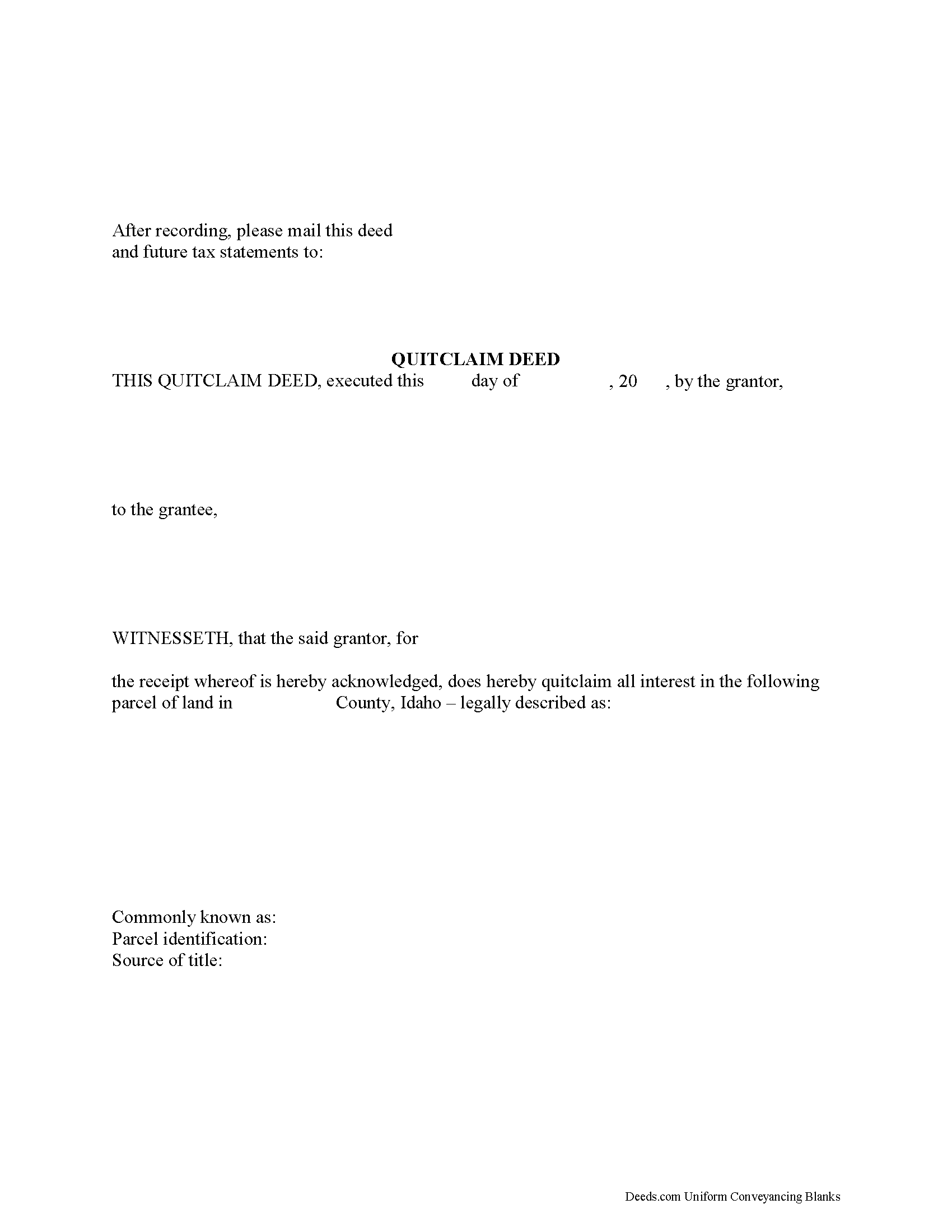
About the Idaho Quitclaim Deed
How to Use This Form
- Select your county from the list
- Download the county-specific form
- Fill in the required information
- Have the document notarized if required
- Record with your county recorder's office
What Others Like You Are Saying
"I love this! I wish there was one for a simple personal will."
"Great service that saved me a lot of time for under 30 bucks."
"Good form with an example and instructions"
"This was such an easy process and even tho you had to pay a $15 - to me it was well worth not having…"
"Very easy to use and I appreciate the fees being charged after the submission."
4.8/5 from 4,832 reviews. Read all
Idaho decides what a deed promises by reading a single word. Under Idaho Code Section 55-612, the word grant in a conveyance implies two covenants unless express terms restrain them: that the grantor has not already conveyed the same estate to anyone else, and that the estate carries no encumbrance the grantor made or suffered. Those covenants may be sued on as if expressly written. This deed is drafted the other way. Its operative sentence keeps the word out and restrains both covenants by name, so what moves to the grantee is the interest the grantor holds at delivery, and nothing is promised about it.
A release, and what a release leaves behind
The operative language remises, releases, and forever quitclaims. A quitclaim deed, also spelled quit claim deed, passes whatever the grantor has, which may be a full fee, a fractional share, or nothing at all. Everything already burdening the parcel keeps burdening it: a deed of trust, a judgment lien, unpaid taxes, a recorded easement, a mineral reservation. No loan moves either, so a grantor who signed a note remains the person the lender looks to.
What Idaho puts on the face of a conveyance
Idaho prescribes no statutory quitclaim form, so the content rules come from the general conveyancing sections. Idaho Code Section 55-601 calls for an instrument in writing subscribed by the party disposing of the estate or by an agent authorized in writing, and it puts the grantee's name and complete mailing address on the instrument itself, a requirement construed in City of Kellogg v. Mission Mountain Interests Ltd. and KEB Enterprises, L.P. v. Smedley. Idaho Code Section 55-805 then makes acknowledgment, certified as Title 51, Chapter 1 prescribes, the condition of recording. No subscribing witness signs an Idaho deed.
A base form with no vesting preprinted
The form recites natural persons signing in their own capacity, one or two on each side, in free-form party blocks carrying no preprinted status, capacity, or form of ownership. One grantor releasing to one grantee, and two co-owners releasing to two people who take together, are the count patterns it recites. Two signature blocks, headed GRANTOR and SECOND GRANTOR, and two certificates in the individual capacity short form of Idaho Code Section 51-116 follow the numbered sections; the second of each stays blank when one person conveys. The form of ownership is typed into the grantee section, because Idaho Code Sections 55-104 and 55-508 make a deed to two or more grantees a tenancy in common unless another form is expressly declared, and the guide sets out each form Idaho recognizes. Marriage reaches the signing side rather than the certificate: Section 32-912 describes community real estate conveyed by both spouses joining, Section 55-1007 describes homestead consent evidenced by each spouse executing and acknowledging, and Section 32-906(2) describes the one conveyance a married person makes alone. A deed signed in a company name, by a trustee, or by an attorney in fact rests on other authority and takes a different certificate, and this form is not set up as any of those.
The clock that decides who wins
Idaho is a race-notice state. Under Idaho Code Section 55-812 an unrecorded conveyance is void against a later purchaser or mortgagee in good faith and for value whose conveyance is first duly recorded, while Section 55-815 keeps an unrecorded deed good between the parties themselves. Recording is constructive notice from the moment of filing under Section 55-811, and the recorder endorses the reception time to the minute under Section 31-2410, so the days between signing and filing belong to whoever files first.
Fifteen dollars, and nothing riding behind it
The deed goes to the recorder of the county where the land sits. Idaho Code Section 31-3205 prices a conveyance of thirty pages or fewer at fifteen dollars, and Section 63-307A states the policy of the state against taxing real estate transfers and bars counties from imposing one, so no transfer declaration travels with the instrument. Page one keeps its top three inches clear, which covers every stamp and label space Idaho recorders publish.
The download delivers the deed as a fillable PDF, a completed example carrying a Latah County conveyance through every blank, and a plain language guide to the sections, the two certificates, and the trip to the recorder. These pages describe Idaho law in general terms and are not legal advice; a question about a particular parcel or chain of title belongs with an Idaho attorney.
Important: County-Specific Forms
Our quitclaim deed forms are specifically formatted for each of the 44 counties in Idaho.
After selecting your county, you'll receive forms that meet all local recording requirements, ensuring your documents will be accepted without delays or rejection fees.