Indiana Transfer on Death Deed (Married Couple Grantors as Joint Tenants with Right of Survivorship)
County Specific Legal Forms Validated as recently as October 12, 2026 by our Forms Development Team
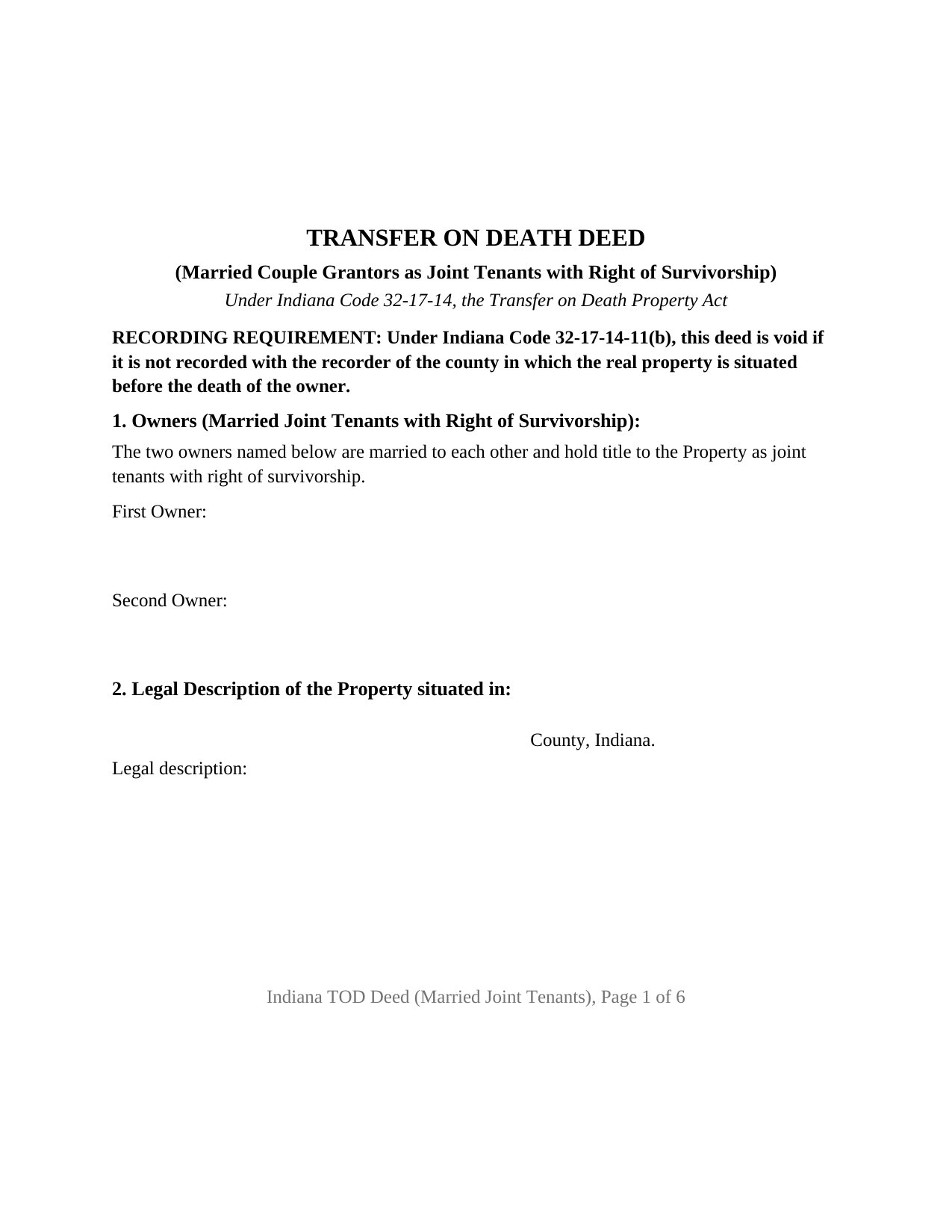
About the Indiana Transfer on Death Deed (Married Couple Grantors as Joint Tenants with Right of Survivorship)
How to Use This Form
- Select your county from the list
- Download the county-specific form
- Fill in the required information
- Have the document notarized if required
- Record with your county recorder's office
What Others Like You Are Saying
"Deeds.com support is very quick and responsive. Would use again and recommend to others in need of e…"
"Very Good Product. Provided a lot of good info to assist people to DIY various Deed"
"Very good so far -- downloading all the forms. So many forms -- I had no idea ...."
"Deeds is extremely helpful and cost effective for small and large businesses. Saves me time to do mo…"
"This is the easiest process ever!"
4.8/5 from 4,824 reviews. Read all
This Indiana transfer on death deed is written for a married couple whose vesting deed made them joint tenants with right of survivorship rather than tenants by the entirety. Both spouses sign one deed under Indiana Code 32-17-14, the Transfer on Death Property Act, and the designation waits: the survivor owns the whole property after the first death, and the named beneficiaries take only when the second spouse dies.
Why the words on the vesting deed matter
Indiana presumes that a deed to a husband and wife creates a tenancy by the entirety unless the instrument expresses a different tenancy. A couple whose deed says joint tenants with right of survivorship holds under those words, and IC 32-17-14-3 defines joint owners as joint tenants with a right of survivorship while excluding entireties spouses, so the chapter's joint owner rules govern this deed. The form recites that configuration as fixed text, and its Source of Title section identifies the vesting deed and its wording.
A deed that waits for the second death
Three sections set the timing. IC 32-17-14-15(b) provides that on the death of one of two joint owners, property subject to a beneficiary designation belongs to the survivor. IC 32-17-14-4(c) treats the death of the last surviving joint owner as the death of the owner, the moment a designation takes effect. IC 32-17-14-16(d) requires the agreement of each living owner to revoke or change the designation, so one spouse cannot quietly replace the beneficiaries while the other lives; after the first death, the survivor controls it alone. The deed states each rule in its operative section, in the IC 32-17-14-11(f) pattern: the owners quitclaim to themselves as joint tenants with right of survivorship, TOD to the named beneficiaries.
Why both spouses sign
Under IC 32-17-14-11(e)(2), a transfer on death deed recorded by one joint tenant severs the joint tenancy into a tenancy in common, after which each half would pass at its owner's own death. This form therefore carries two owner signature blocks and two acknowledgment certificates and has no single-owner configuration. The certificates are separate, so the spouses may acknowledge on different dates or before different notaries, and each carries the IC 32-21-2-7 acknowledgment sentence with the county of commission and expiration date IC 33-42-9-12 requires.
What the beneficiary section carries
The designation names the primary beneficiaries, in equal shares unless a percentage or fraction is stated (IC 32-17-14-26(b)(5)), and any contingent beneficiary marked with those words. The chapter's substitution rules travel with it: a lineal descendant who dies first is replaced by that beneficiary's own descendants per stirpes unless the deed says No LDPS, and a non-descendant is replaced only where LDPS follows the name (IC 32-17-14-22). A beneficiary takes subject to every lien and other matter the owners created during life (IC 32-17-14-19(a)), and the deed carries the insurance warning IC 32-17-14-11(j) permits.
Recording in Indiana
Recording gives this beneficiary deed its life: under IC 32-17-14-11(b) it is void unless recorded with the recorder of the county where the property lies before the death of the owner. The county auditor endorses the deed before the recorder accepts it, the recorder's fee for a deed is $25 under IC 36-2-7-10, and Indiana charges no transfer tax. The form is laid out to IC 36-2-11-16.5 and closes with the statements Indiana recorders look for: the tax statement and grantee mailing addresses under IC 32-21-2-3(e), the Social Security number redaction affirmation, and the preparer statement under IC 36-2-11-15. After the second death, the beneficiary records the affidavit IC 32-17-14-26(b)(20) describes; that affidavit is prepared and recorded separately and is not included in this package.
The configuration this form recites
The deed recites exactly two record owners, married to each other, holding as joint tenants with right of survivorship, each signing personally and acknowledging before a notarial officer. Spouses who took title by a deed naming joint tenancy with survivorship present the pattern this deed recites. An entireties couple, tenants in common, a sole owner, three or more owners, a trustee or entity owner, and an owner signing through an attorney in fact follow patterns this form is not set up as.
The package includes the fillable transfer on death deed, a completed example filled in for a Hamilton County fact pattern, and the guide that explains every section, the signing rules, and the recording steps. This description and the guide describe the form and the governing Indiana statutes in general terms; they are not legal advice.
Important: County-Specific Forms
Our transfer on death deed (married couple grantors as joint tenants with right of survivorship) forms are specifically formatted for each of the 92 counties in Indiana.
After selecting your county, you'll receive forms that meet all local recording requirements, ensuring your documents will be accepted without delays or rejection fees.