Indiana Transfer on Death Deed (Married Couple Grantors Tenants in Common)
County Specific Legal Forms Validated as recently as October 12, 2026 by our Forms Development Team
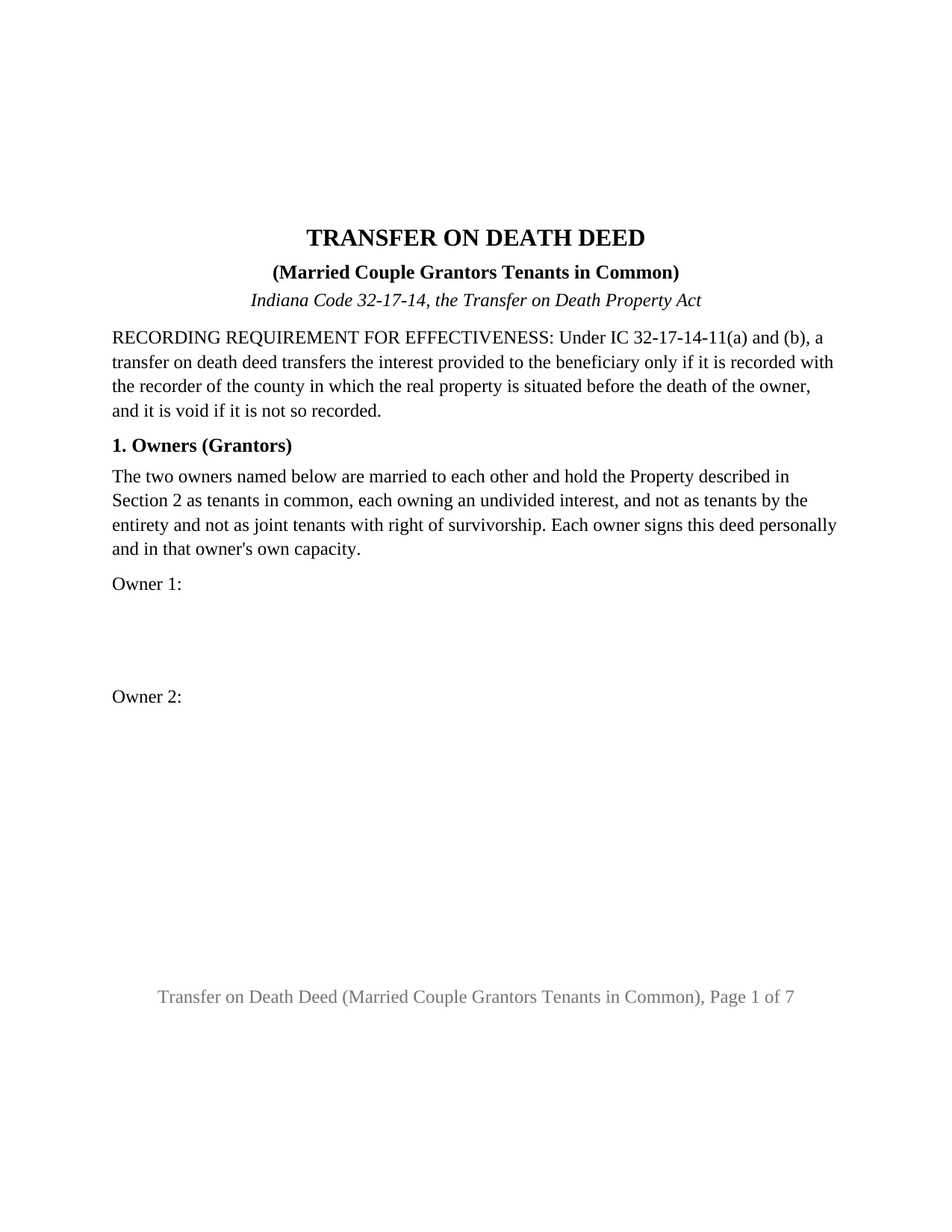
About the Indiana Transfer on Death Deed (Married Couple Grantors Tenants in Common)
How to Use This Form
- Select your county from the list
- Download the county-specific form
- Fill in the required information
- Have the document notarized if required
- Record with your county recorder's office
What Others Like You Are Saying
"The process was very easy and walked you through the entire process step by step. Also, outstanding …"
"The NV Clark County deed upon death was perfect! Our county doesn't offer a template, but rather has…"
"WOW!!! Deeds.com came through with shinning colors. when I needed something recorded in a hurry and …"
"This service gave me the information and guide I needed to file a Quitclaim Deed. I went through the…"
"Very good so far -- downloading all the forms. So many forms -- I had no idea ...."
4.8/5 from 4,824 reviews. Read all
An Indiana transfer on death deed for two spouses who hold their real estate as tenants in common names who receives each spouse's undivided interest at that spouse's death, without probate. This form prepares that deed under Indiana Code 32-17-14, the Transfer on Death Property Act, for exactly two record owners who are married to each other and whose vesting deed placed them in a tenancy in common.
Two undivided interests, two separate transfers
A tenancy in common carries no survivorship, and under IC 32-17-14-11(e)(4), where the owner's interest is held as a tenant in common, the owner's interest passes to the beneficiary as a transfer on death transfer. On this deed both spouses sign one instrument and name one set of beneficiaries. At the first death, the deceased spouse's undivided interest passes to those beneficiaries, who become tenants in common with the surviving spouse. At the second death, the surviving spouse's interest passes under the same deed to the beneficiaries then living. The deed states that timing in its operative section.
Nothing moves during life, and IC 32-17-14-16 keeps the designation revocable until death by a later recorded deed or an acknowledged, recorded affidavit. A beneficiary takes only by surviving the spouse whose interest is transferred, two or more beneficiaries share equally unless the deed states different shares, and a descendant beneficiary who dies first is replaced by that beneficiary's own descendants per stirpes unless the designation says No LDPS, the rule of IC 32-17-14-22.
Why the tenancy in common matters for spouses
Indiana presumes that a deed to a husband and wife creates a tenancy by the entirety, and the Indiana Supreme Court in Underwood v. Bunger held that express words such as all as Tenants-in-Common in the vesting deed rebut it. Entireties property follows a different rule in the Act: a transfer on death deed of it is void unless both spouses join, and the survivor takes the whole at the first death. A tenancy in common has none of that machinery. Spouses who bought with unequal contributions, or whose vesting deed in a later marriage was drawn to keep each half separate, are the couples whose titles carry this pattern, and the vesting deed's grantee clause is what shows it.
What both signatures and one designation accomplish
The deed recites that the two owners are married to each other and hold the property as tenants in common, each owning an undivided interest, as fixed text rather than a blank. Each spouse signs, each as to that spouse's own undivided interest, in the wording IC 32-17-14-11(f) supplies: the owners convey and warrant to themselves as tenants in common, TOD to the named beneficiaries. The form carries a signature block and a separate acknowledgment certificate for each spouse, so the two can acknowledge on different dates or before different notaries, each certificate in the Indiana acknowledgment wording of IC 32-21-2-7. The form is set up for one shared designation covering both interests; two spouses who intend different beneficiaries for their separate halves present a different pattern from the one this deed recites. Optional contingent beneficiaries and the insurance warning IC 32-17-14-11(j) permits on deeds executed after June 30, 2025 also appear on the face of the TOD deed.
Recording before death, with the auditor's endorsement
Recording is what gives this beneficiary deed effect. Under IC 32-17-14-11(a) and (b), the deed transfers an owner's interest only if it is recorded with the recorder of the county where the property is situated before that owner's death, and a deed left unrecorded at death is void; with two owners, recording while both are living places it of record before either death. Under IC 32-17-14-11(i), the county auditor endorses the deed before the recorder accepts it, and the recorder's fee for a deed is a flat $25 with no transfer tax. The deed ends with the mailing address statements of IC 32-21-2-3(e) and the preparer statement and Social Security redaction affirmation of IC 36-2-11-15. After each spouse's death, the beneficiary records the affidavit IC 32-17-14-26(b)(20) describes; that affidavit is prepared separately and is not included in this package.
The package includes the fillable form, a completed example filled in for a realistic Hamilton County fact pattern, and the guide that walks through every section, the acknowledgment, and the recording steps. This description and the guide describe the form and the governing Indiana statutes in general terms; they are not legal advice.
Important: County-Specific Forms
Our transfer on death deed (married couple grantors tenants in common) forms are specifically formatted for each of the 92 counties in Indiana.
After selecting your county, you'll receive forms that meet all local recording requirements, ensuring your documents will be accepted without delays or rejection fees.