Indiana Transfer on Death Deed (Married Couple Grantors as Tenants by the Entirety)
County Specific Legal Forms Validated as recently as October 12, 2026 by our Forms Development Team
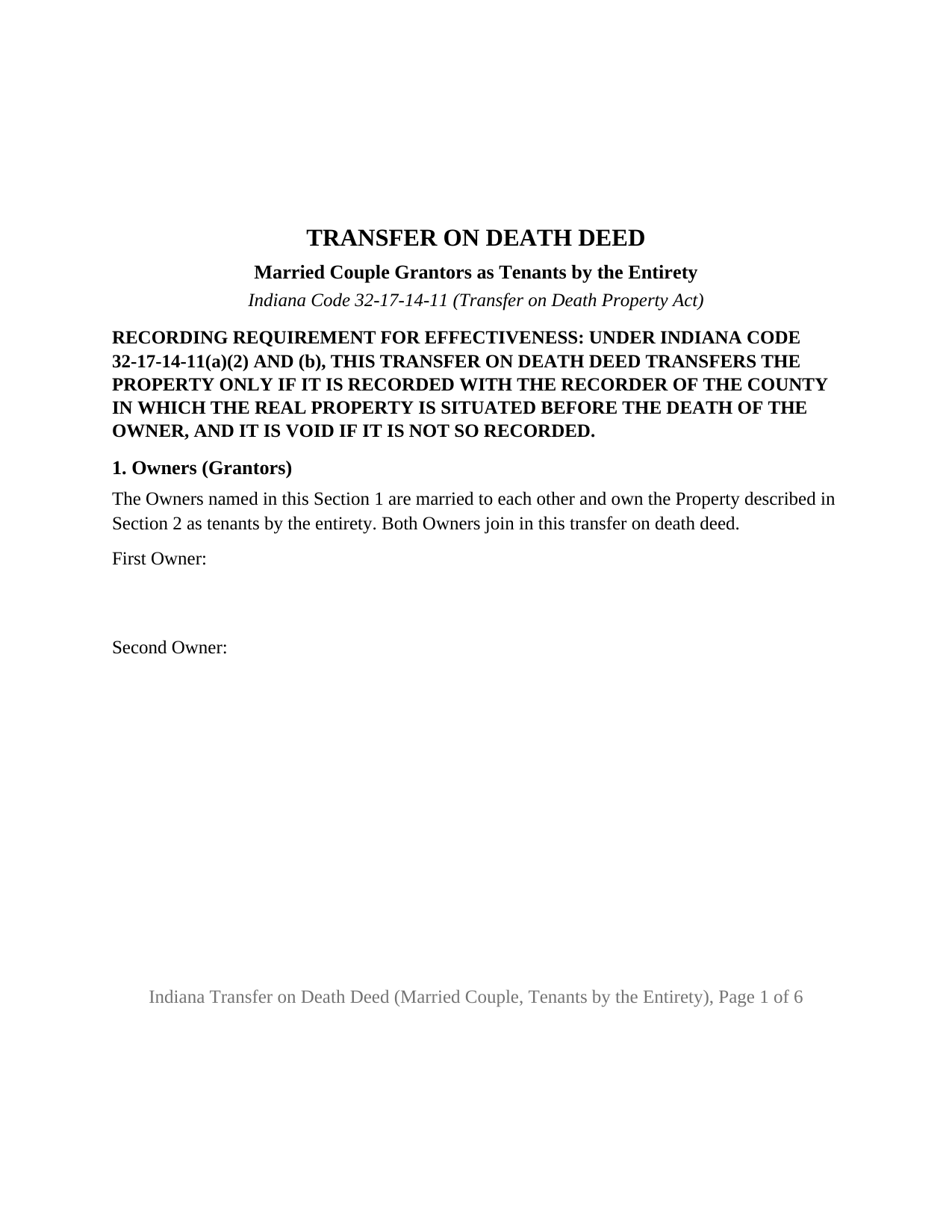
About the Indiana Transfer on Death Deed (Married Couple Grantors as Tenants by the Entirety)
How to Use This Form
- Select your county from the list
- Download the county-specific form
- Fill in the required information
- Have the document notarized if required
- Record with your county recorder's office
What Others Like You Are Saying
"Great Service!"
"Great experience. Rapid service, no unexpected problems, and reasonable pricing. I will definitely u…"
"Excellent service even faster then I expected. Very pleased and a reasonable priced document. I enco…"
"found this site very easy to use"
"easy & convenience .good service"
4.8/5 from 4,824 reviews. Read all
Two Indiana spouses who hold their home as tenants by the entirety can name, in one transfer on death deed signed by both of them, who receives the property after both have died. This form prepares that deed under Indiana Code 32-17-14-11 for exactly two owners married to each other, with a signature line and an acknowledgment certificate for each spouse and a beneficiary designation that waits for the second death.
One deed, both signatures, the second death
Indiana's Transfer on Death Property Act treats entireties property differently from every other form of ownership. Under section 11(e)(1), a transfer on death deed of property held as tenants by the entirety is inoperable and void unless the other spouse joins in the conveyance. A deed signed by one spouse alone accomplishes nothing. This form is built around that rule: Section 1 recites that the owners are married to each other and hold as tenants by the entirety, both owners sign in Section 5, and each has a certificate of acknowledgment.
The deed also fixes when the beneficiary takes. At the first death the surviving spouse owns the whole property by survivorship, which section 4(a)(1) of the chapter says is not a transfer on death transfer, and section 16(b) gives the surviving spouse the power to revoke or change the designation. The transfer to the beneficiary therefore happens at the death of the last surviving owner, and the deed says so in its own words. Until then the beneficiary has no rights in the property under section 15(a).
What the beneficiary designation carries
Section 3 names one or more primary beneficiaries and, where the owners wish, contingent beneficiaries who take if no primary beneficiary survives. Multiple surviving beneficiaries share equally unless the deed states different shares under section 26(b)(5), and a trust may be named under section 11(d). Indiana's lineal descendants per stirpes rule in section 22 works through short notations after a beneficiary's name, which the guide describes. The operative paragraph in Section 4 follows the chapter's own pattern of the owners conveying to themselves, TOD to the named beneficiaries, and closes with the insurance coverage warning that section 11(j) permits on a deed executed after June 30, 2025.
The configuration this form recites
The form recites two record owners, married to each other, who hold the property as tenants by the entirety; both sign, and the form carries two acknowledgment certificates so the spouses may appear on different days or before different notarial officers. A couple whose vesting deed names them together with no qualifying words, which Indiana law reads as a tenancy by the entirety, and a couple whose deed names them expressly as tenants by the entirety, present the pattern this deed recites. The form is not set up as a sole owner's designation, a deed by unmarried co-owners, or a deed signed through a trustee, an entity, or an attorney in fact.
Recording before death, with the auditor first
Recording is what makes an Indiana TOD deed work. Section 11(b) makes the deed void if it is not recorded with the recorder of the county where the property lies before the owner's death, and for a deed signed by two spouses the reading that satisfies the statute for each owner is recording while both are living. Indiana adds a step most states do not have: under section 11(i) and Indiana Code 36-2-11-14, the county auditor endorses the deed before the recorder accepts it. The recorder's fee for a deed is $25, Indiana has no transfer tax, and the end of the deed carries the mailing address statement, the prepared-by line, and the Social Security redaction affirmation that Indiana recorders look for.
Changing or revoking the designation
While both spouses live, a revocation or change takes both of them under section 16(b); after the first death the surviving spouse acts alone. The change is made by a later recorded deed or affidavit under section 16(j); a will does not revoke the deed. After the last surviving owner dies, the beneficiary records the affidavit described in section 26(b)(20), a separate instrument prepared and recorded after death and not included in this package.
The package includes the fillable transfer on death deed, a completed example filled in for a realistic Hamilton County fact pattern, and the guide that walks through every numbered section and the statutes behind it. This description and the guide describe the form and Indiana law in general terms; they are not legal advice.
Important: County-Specific Forms
Our transfer on death deed (married couple grantors as tenants by the entirety) forms are specifically formatted for each of the 92 counties in Indiana.
After selecting your county, you'll receive forms that meet all local recording requirements, ensuring your documents will be accepted without delays or rejection fees.