Indiana Transfer on Death Deed (Individual Owner, Unmarried)
County Specific Legal Forms Validated as recently as October 13, 2026 by our Forms Development Team
About the Indiana Transfer on Death Deed (Individual Owner, Unmarried)
How to Use This Form
- Select your county from the list
- Download the county-specific form
- Fill in the required information
- Have the document notarized if required
- Record with your county recorder's office
What Others Like You Are Saying
"Saved a great deal of time and hassle. THANKS"
"Thx. Easy to research and download. Now proof is in the pudding. :-)"
"Found just the form I was looking for. It was an easy download process. Now just have to complete th…"
"I received what I requested. Then I didn't need it after all."
"Worked well for me to create a deed for a house I inherited. It was very thorough and easy to use. I…"
4.8/5 from 4,824 reviews. Read all
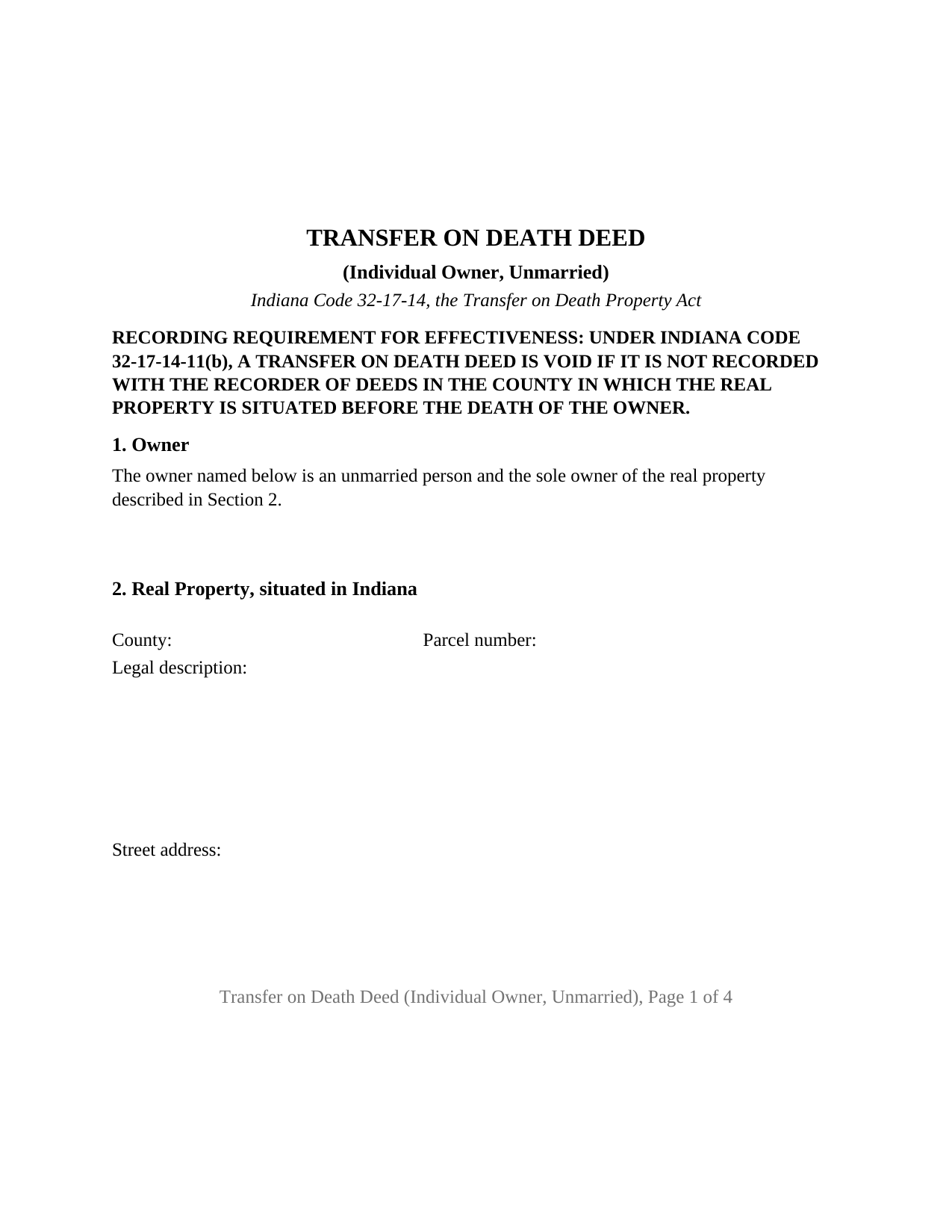
One Indiana owner, holding title alone and not married, names who takes the real estate at death by signing a single transfer on death deed with no second signature line on it. Built on Indiana Code 32-17-14 for exactly that owner, the form recites in fixed text that the owner is an unmarried person and the sole owner of the property, carries one owner signature block and one acknowledgment certificate, and takes the owner's name, the property, and the beneficiaries as its only entries.
A deed with one signature and no joinder question
Indiana attaches spousal joinder to record title, not to marriage. The chapter's own joinder rule, IC 32-17-14-11(e)(1), reaches entireties property and nothing else; dower and curtesy were abolished by IC 29-1-2-11, and Indiana has no community property or homestead joinder statute. A sole record owner signs alone, and this deed has no place for anyone else to sign. The unmarried recital is printed as deed text, not left to a blank or a check box.
What happens upon the death of the owner
During the owner's life the deed changes nothing. Under IC 32-17-14-15 the beneficiary has no rights in the property before the owner's death; the owner sells, mortgages, or leases without the beneficiary's signature and revokes or changes the designation by a later deed or an acknowledged affidavit recorded before death (IC 32-17-14-16(j)), which a will cannot do. Upon the death of the owner, the deed transfers the owner's interest to the beneficiary, subject to every lien, easement, and contract the owner made during life (IC 32-17-14-19). The deed states that trigger in one fixed sentence; a sole owner's deed has no survivorship to wait for.
Conveys and warrants, or quitclaims, by marked box
IC 32-17-14-11(f) phrases the designation as the owner conveying and warranting, or quitclaiming, to the owner, TOD to the beneficiary. Section 5 prints each operative word beside its own box with neither marked; the marked word fixes whether the conveyance carries the title covenants of IC 32-17-1-2 or passes the interest without them under IC 32-21-1-15. The guide describes both words and their covenants without ranking them.
Naming the beneficiaries
The beneficiary section takes one or more primary beneficiaries, individuals, a trust through its trustee, or an entity, and an optional contingent beneficiary marked with those words as IC 32-17-14-26(b)(4) asks. Surviving beneficiaries share equally unless a percentage or fraction follows a name (IC 32-17-14-26(b)(5)). A lineal descendant who dies first is replaced by that descendant's own children per stirpes unless No LDPS follows the name, and a beneficiary outside the owner's line is replaced that way only where LDPS follows it, the mechanism of IC 32-17-14-22.
The configuration this form recites
The deed recites exactly one record owner, an unmarried person and the sole owner, signing personally and acknowledging before a notarial officer. A widowed owner whose spouse's interest passed by survivorship, an owner who took the whole title from a former spouse in a dissolution, and a never-married owner who bought alone present the pattern this deed recites. A married owner, two or more owners on one deed, a trustee or entity owner, an owner holding only a life estate, and an owner signing through an attorney in fact follow patterns this form is not set up as.
Recording before death, through the auditor
The deed is void unless recorded with the recorder of the county where the property is situated before the owner's death (IC 32-17-14-11(b)); a recording-requirement notice in capitals sits under the title so the condition is never buried. Since July 1, 2024 the county auditor's endorsement under IC 36-2-11-14 has been necessary to record a TOD deed, so the signed deed stops at the auditor before the recorder. The form keeps the two inch margins of IC 36-2-11-16.5, carries the address statements of IC 32-21-2-3(e), and closes with the redaction affirmation and prepared-by statement of IC 36-2-11-15; the deed fee is $25 and Indiana has no transfer tax. After the owner's death the beneficiary records the affidavit of IC 32-17-14-26(b)(20), a separate instrument prepared after death and not included in this package.
The package contains the fillable deed, a completed example worked through an Allen County fact pattern, and the guide covering each section, the certificate, and the auditor and recorder steps. Neither this description nor the guide applies Indiana law to a particular owner; both are general in nature and are not legal advice.
Important: County-Specific Forms
Our transfer on death deed (individual owner, unmarried) forms are specifically formatted for each of the 92 counties in Indiana.
After selecting your county, you'll receive forms that meet all local recording requirements, ensuring your documents will be accepted without delays or rejection fees.