Indiana Transfer on Death Deed (Individual Owner, Married)
County Specific Legal Forms Validated as recently as October 13, 2026 by our Forms Development Team
About the Indiana Transfer on Death Deed (Individual Owner, Married)
How to Use This Form
- Select your county from the list
- Download the county-specific form
- Fill in the required information
- Have the document notarized if required
- Record with your county recorder's office
What Others Like You Are Saying
"So convenient."
"Flawless. I ordered the forms needed, along with completed samples. I filled them out, and I was on …"
"Quick, clean, easy. A hat trick."
"Got me all the info I was looking for Thanks you deeds.com"
"Fast and convenient service."
4.8/5 from 4,824 reviews. Read all
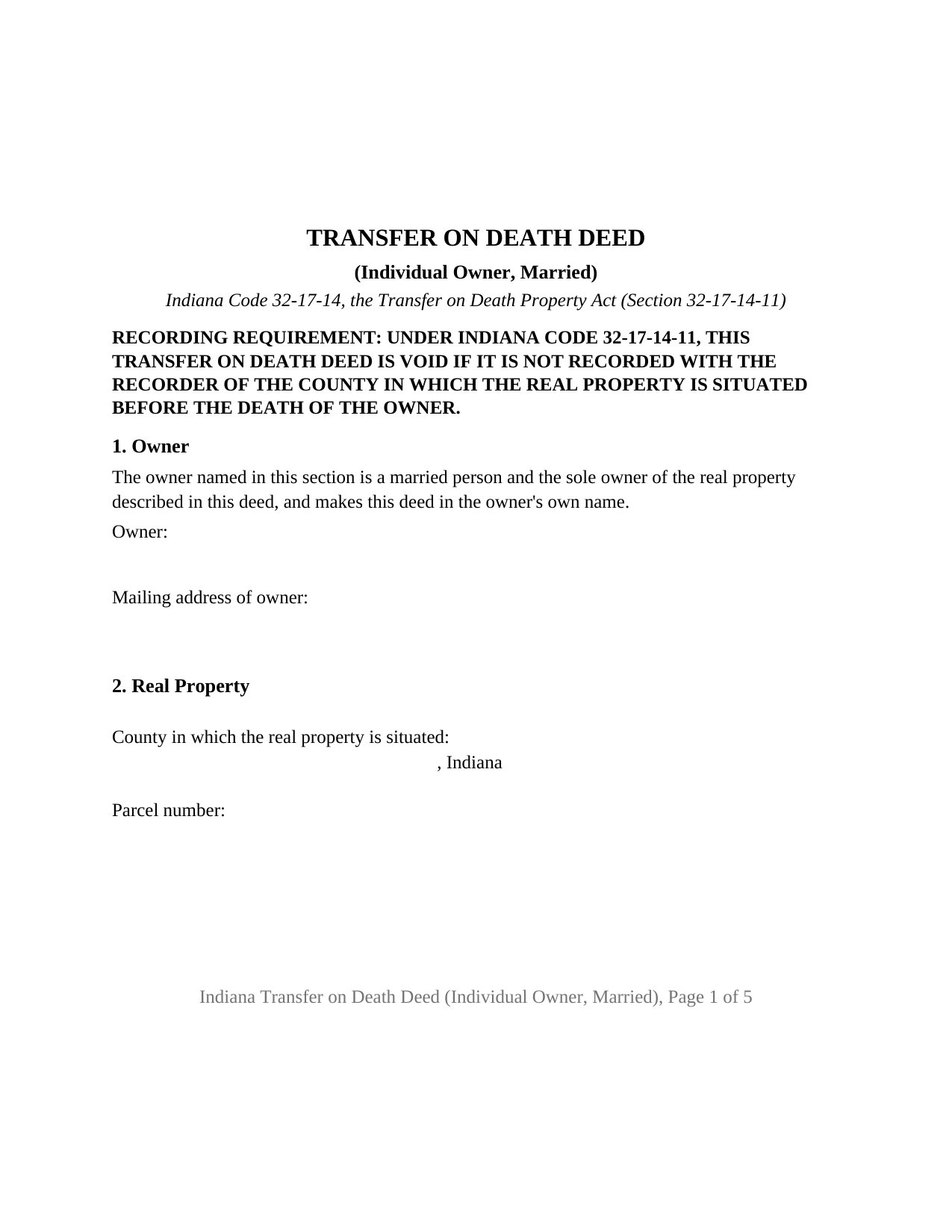
This Indiana transfer on death deed is written for one owner who is married and holds the real estate alone, in that owner's name only. The owner signs alone and names who takes the property at death; the spouse, who holds no record interest, has no signature line. The deed is prepared under Indiana Code 32-17-14-11 for one record owner, recited on its face as a married person and the sole owner of the property.
A married owner who signs alone
Indiana asks no non-owner spouse to join a deed of the other spouse's property. IC 29-1-2-11 abolished dower and curtesy, IC 29-1-2-3.1 gives a married man's instrument executed without his wife's joinder the same effect as if she had joined, and IC 31-11-7-2 gives a married woman the property rights of an unmarried woman. Inside the Transfer on Death Property Act, the one joinder rule, IC 32-17-14-11(e)(1), reaches entireties property and nothing else. A sole owner's TOD deed is the owner's deed alone, and this form carries one signature block, headed OWNER, and one acknowledgment certificate.
What the vesting deed has to show
The pattern turns on the grantee clause of the vesting deed, not on the marriage. Property deeded to one spouse before the wedding, inherited by one spouse, or conveyed to one spouse alone during the marriage carries a vesting deed naming a single grantee. A deed naming both spouses is a different title: Indiana reads a conveyance to a husband and wife as a tenancy by the entirety under IC 32-17-3-1 unless the deed says otherwise, and the Act voids a TOD deed of entireties property that the other spouse does not join.
What a surviving spouse keeps, and what the deed decides
A married owner's beneficiary deed meets the spousal statutes at death, not at signing. IC 32-17-14-25(a) provides that the surviving spouse's election against a will under IC 29-1-3-1 does not apply to a valid transfer on death transfer, while leaving the transfer open to the $25,000 surviving spouse allowance of IC 29-1-4-1 through the nonprobate transferee liability of IC 32-17-13, where the probate estate cannot pay it. A designation naming the spouse is revoked by a later dissolution of the marriage under IC 32-17-14-23.
The designation the owner writes
Section 4 names the primary beneficiaries and any contingent beneficiary marked with those words under IC 32-17-14-26(b)(4); two or more share equally unless the entry states shares, and a child who dies first is replaced by that child's descendants per stirpes under IC 32-17-14-22 unless the entry says No LDPS. Section 5 performs the designation in the chapter's pattern, the owner conveying to the owner, TOD to the beneficiaries, with the two operative words IC 32-17-14-11(f) supplies, conveys and warrants and quitclaims, printed beside boxes with neither marked. Until the owner dies the beneficiary has no rights in the property under IC 32-17-14-15(a), and the designation stays revocable under IC 32-17-14-16.
Void unless recorded in time, after the auditor
Under IC 32-17-14-11(b) the deed is void if it is not recorded with the recorder of the county where the property lies before the owner's death, so the signed deed goes to the county auditor for the endorsement IC 32-17-14-11(i) makes necessary, then to the recorder, whose deed fee is $25 with no transfer tax. The deed ends with the mailing address statement of IC 32-21-2-3(e) and the redaction affirmation and prepared-by statement of IC 36-2-11-15. After the owner's death, the beneficiary records the affidavit IC 32-17-14-26(b)(20) describes, an instrument prepared separately after death and not included in this package.
The configuration this form recites
The deed recites one record owner, a married person and the sole owner of the described property, signing personally and acknowledging before a notarial officer, with no field for a spouse, a second owner, or a witness. A spouse who took title alone, before or during the marriage, presents the pattern this deed recites. Two spouses on one title, an unmarried sole owner, a trustee or entity owner, an owner signing through an attorney in fact, and three or more owners follow patterns this form is not set up as.
Included in the package are the fillable deed, a completed example drawn on an Allen County fact pattern, and the guide covering every section and the auditor to recorder path. This description and the guide describe the form and the governing Indiana statutes in general terms; they are not legal advice.
Important: County-Specific Forms
Our transfer on death deed (individual owner, married) forms are specifically formatted for each of the 92 counties in Indiana.
After selecting your county, you'll receive forms that meet all local recording requirements, ensuring your documents will be accepted without delays or rejection fees.