Maine Quitclaim Deed (Corrective)
County Specific Legal Forms Validated as recently as October 14, 2026 by our Forms Development Team
About the Maine Quitclaim Deed (Corrective)
How to Use This Form
- Select your county from the list
- Download the county-specific form
- Fill in the required information
- Have the document notarized if required
- Record with your county recorder's office
What Others Like You Are Saying
"A great way to access form knowledge"
"Hard to find, obscure, forms were available. I did not think I was going to be able to find them, le…"
"Very easy and nice website to use."
"Deeds.com has saved me quite a bit in attorney fees by making legal forms available on line. Easy to…"
"worked very well"
4.8/5 from 4,833 reviews. Read all
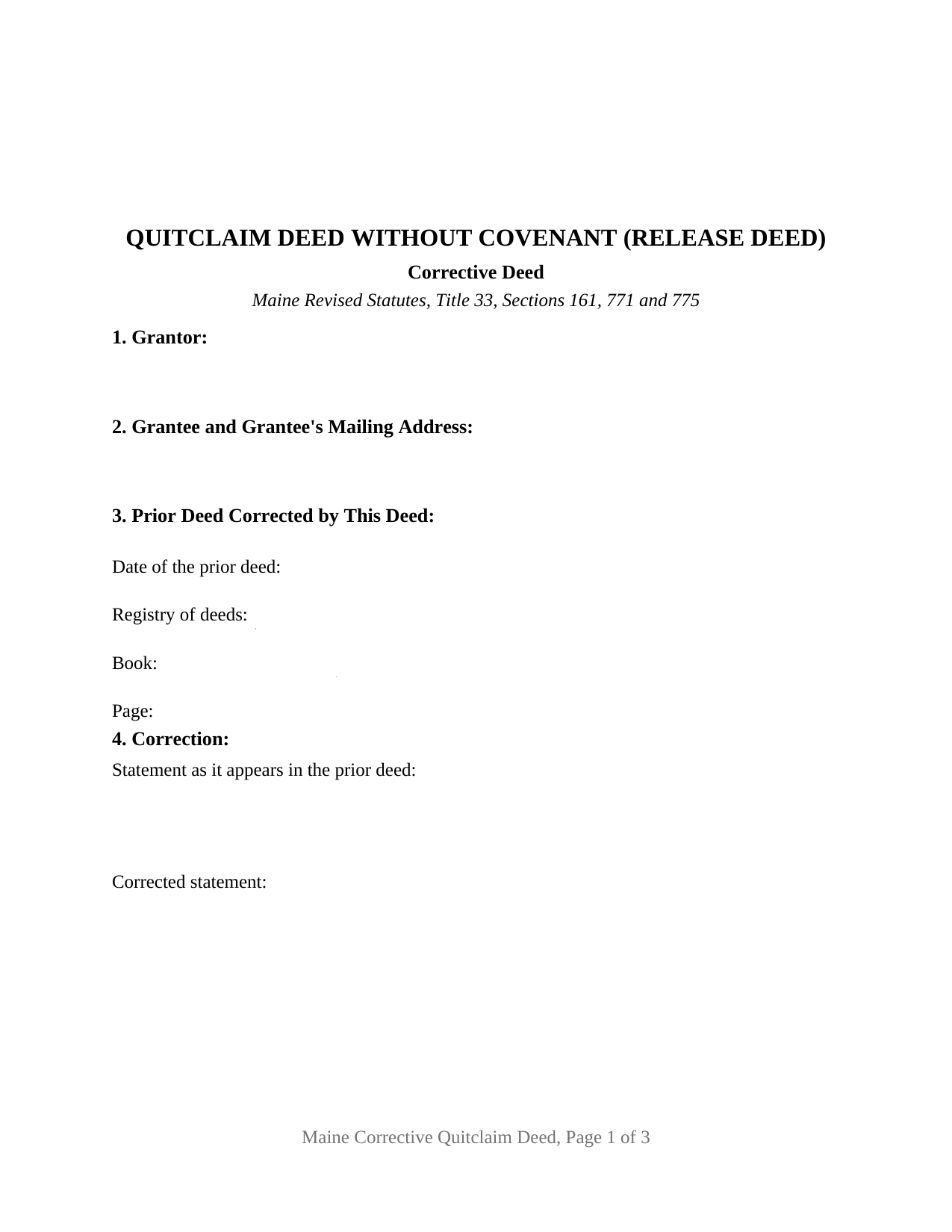
A Maine registry erases nothing. A deed recorded with the grantee's surname misspelled, or with a source of title line pointing at the wrong book and page, stays in the index as written, and Maine's answer is a second recorded instrument naming the first. This quitclaim deed without covenant is configured for that job: one grantor, one earlier deed identified by registry, book and page, and a numbered section holding the statement as recorded beside the statement as corrected.
The sentence Maine writes three times
No Maine statute sets out a corrective deed as its own species of conveyance. Three statutes instead describe it by what it does, in nearly identical words, each subtracting something. 36 M.R.S. Section 4641-C, subsection 3, captioned Deeds affecting a previous deed, takes the real estate transfer tax off a deed that, without additional consideration and without changing ownership or ownership interest, confirms, corrects, modifies or supplements a deed previously recorded. 36 M.R.S. Section 4641-D, subsection 4 repeats the formula to lift the declaration of value, and 33 M.R.S. Section 172, subsection 12, captioned Corrective deed, lifts the residential property disclosure statement. Two conditions run through all three: no added consideration, and no change in ownership or ownership interest.
The deed that comes to the counter alone
Nearly every Maine deed reaches the register accompanied by a Real Estate Transfer Tax Declaration. County registries publish the short list of deeds that arrive without one, and corrective and confirmatory deeds head it. So it arrives as a document and a fee, 40 dollars for an ordinary submitter under 33 M.R.S. Sections 751 and 752, with no tax to compute and no declaration to fill in. That economy lasts exactly as long as the two conditions hold. A correction that hands an interest to someone who held none under the earlier deed, or that carries a price, is a conveyance wearing a corrective title, and the rate table comes back with it.
One grantor, one certificate, one earlier deed
The form recites a single grantor, the individual who signed the deed being corrected, with the typed or printed name beneath the signature that 33 M.R.S. Section 651-A makes a condition of recordability, and one acknowledgment certificate in the individual capacity short form of 4 M.R.S. Section 1917, taken under 33 M.R.S. Section 203. Section 3 collects the earlier deed's date, its registry, and its book and page, the volume and page reference 33 M.R.S. Section 201-A treats as the working currency of a Maine record reference. Section 4 carries two entries side by side, the statement as it appears in that deed and the corrected statement, so the change sits on the face of the new instrument. Shapes arriving this way include a grantee surname written wrongly, a plan reference naming the wrong plan book, and a mistyped municipality inside the description. Deeds signed by two grantors, by companies, by trustees, and by agents under a power of attorney present configurations this form does not recite. Marriage adds no second signature here: 33 M.R.S. Section 480 states in terms that a correcting deed does not require the nonowner spouse's signature.
Released, and what a correction cannot reach
The instrument sits in the without covenant slot of the 33 M.R.S. Section 775 appendix, Form 4, and Sections 161 and 771 give the word release its reach: whatever estate the grantor could pass by a deed of any other form, with no covenant implied. Section 10 states that the deed corrects and confirms the earlier deed and conveys no estate greater or less than the estate that deed conveyed. What it cannot do is pull the earlier deed out of the index. Both instruments stay, and a later examiner reads them together, with anything recorded in between keeping the priority 33 M.R.S. Section 201 gives it. Time cures some defects on its own, since 33 M.R.S. Section 352 makes a record valid and enforceable after two years even where the acknowledgment was never taken, but that section waits, and a corrective deed does not.
The download holds the blank deed as a fillable PDF, a plain language guide to the ten numbered sections and to recording, and a completed example filled in for an Oxford County parcel where the earlier deed spelled the grantee Whitcombe instead of Whitcomb. Searchers reach this instrument as a correction deed, a deed of correction, or a scrivener's error deed; the materials are informational and are not legal advice.
Important: County-Specific Forms
Our quitclaim deed (corrective) forms are specifically formatted for each of the 16 counties in Maine.
After selecting your county, you'll receive forms that meet all local recording requirements, ensuring your documents will be accepted without delays or rejection fees.