Maine Quitclaim Deed (Married Couple as Grantors)
County Specific Legal Forms Validated as recently as October 6, 2026 by our Forms Development Team
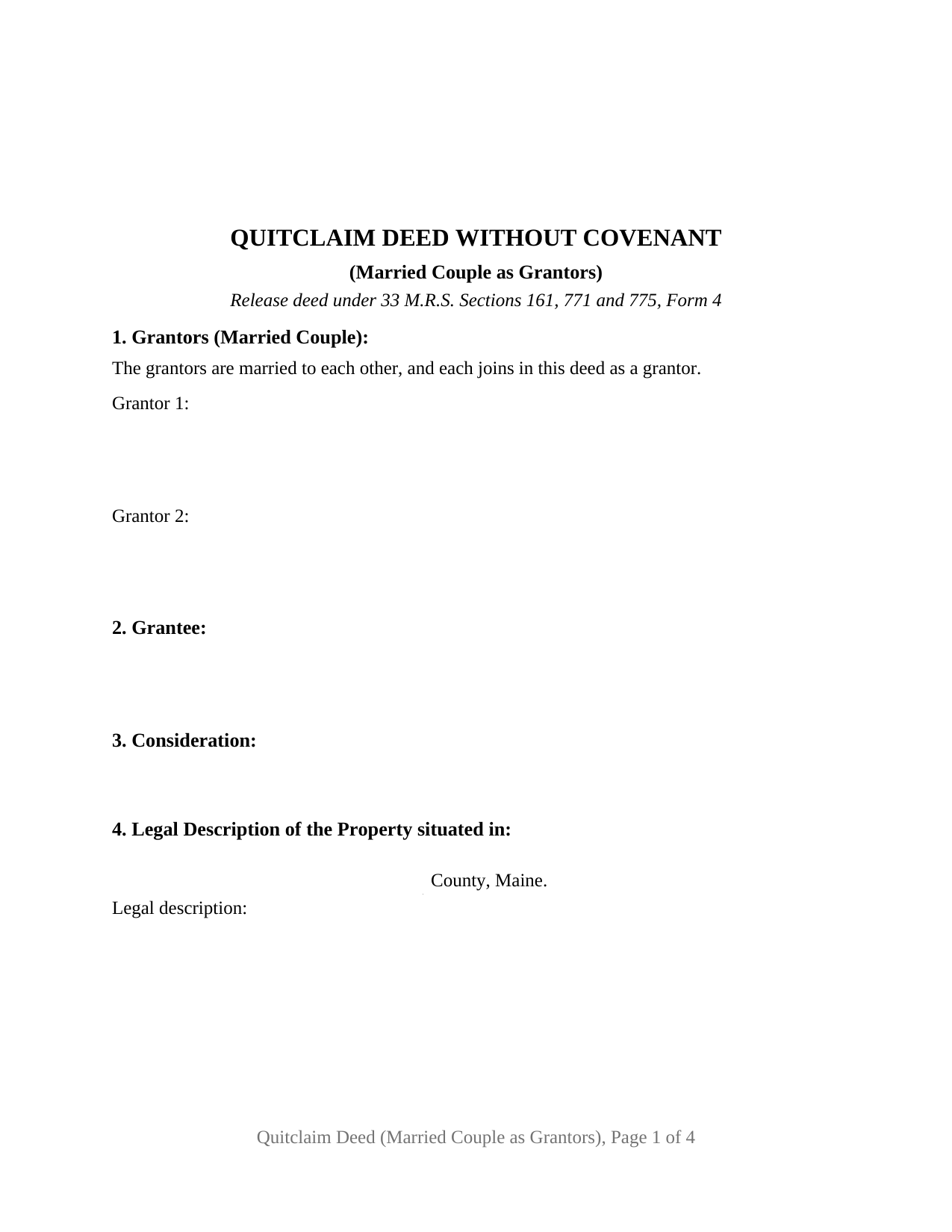
About the Maine Quitclaim Deed (Married Couple as Grantors)
How to Use This Form
- Select your county from the list
- Download the county-specific form
- Fill in the required information
- Have the document notarized if required
- Record with your county recorder's office
What Others Like You Are Saying
"Worked great. Not being real tech savey was no problem."
"very user friendly!"
"The entire process was simple and easy, from purchasing, downloading and saving the documents."
"Very easy to do. Will use them in the future."
"Great service, well worth the $15 fee. Especially helpful was the review of my documentation and the…"
4.8/5 from 4,828 reviews. Read all
Marriage puts two kinds of interests behind a Maine title: the record interest the registry shows, and the rights a spouse can hold without ever appearing on it. This Maine quitclaim deed without covenant, the state's release deed, is configured for a married couple as grantors, so both spouses sign the same instrument and both kinds of interests leave the record in one conveyance.
Why the deed names the marriage
The form recites that its two grantors are married to each other, and the operative clause puts that recital to work: each spouse releases all right, title, and interest in the described property, expressly including any interest arising from the marriage. Maine statute keeps the mechanics short. A release conveys everything the releasing grantor holds and could pass by a deed of any other form under 33 M.R.S. Sections 161 and 771, and 33 M.R.S. Section 772-A reflects the long Maine practice of a spouse joining a deed to release all rights by descent and all other rights, a release the statute says conveys every interest of the joining spouse in the property. On this form the joining spouse stands as a full grantor rather than a testimonium signer, and the marital release travels inside the deed's own operative sentence.
Two title patterns, one grantor block
Maine records show the married-couple grantor block in two shapes. In the first, the spouses hold record title together, most often as joint tenants, since 33 M.R.S. Section 159 reads survivorship wording, tenants by the entirety wording included, as creating a joint tenancy; both owners join and the whole title moves at once. In the second, one spouse alone holds the record title and the other joins to place the marital release on record. Maine abolished dower and curtesy (18-C M.R.S. Section 2-111), and 33 M.R.S. Section 480 generally lets an owner convey without the nonowner spouse's signature, with exceptions tied to the elective-share statute and to a recorded divorce claim; a deed carrying both spouses' releases writes the answer to those questions into the record itself. The form recites exactly two grantors, married to each other; unmarried co-owners, single owners, and entity or fiduciary signers present configurations this deed does not recite.
Everything released, nothing promised
The instrument is the without-covenant member of the Section 775 appendix. Its text states that it carries no warranty covenants and no quitclaim covenant, so neither spouse promises to defend the title, and the grantee takes what the two releases actually move, subject to recorded easements, restrictions, and liens. An encumbrance section lists those recorded matters, and a printed sentence states that the listing is informational and creates no covenant, keeping the no-warranty posture unambiguous on the face of the deed.
From the kitchen table to the registry
Both spouses sign with their names typed or printed beneath the signatures, the entry 33 M.R.S. Section 651-A makes a condition of recordability. Maine law does not require a separate acknowledgment certificate for each signer, and the form's two certificates, one per spouse in the 4 M.R.S. Section 1917 short form, are a layout choice that lets a couple acknowledge on different days or in different states when life scatters the signing. The deed then goes to the registry of deeds of the county where the land lies with the 40 dollar statutory fee and, unless an exemption applies, a real estate transfer tax declaration; 36 M.R.S. Section 4641-C exempts transfers between spouses without actual consideration and no-consideration transfers to children and grandchildren, and the declaration states the exemption claimed. The completed example follows a York County couple releasing a platted subdivision lot to their adult daughter without consideration, with the exemption claim carried on the consideration entry.
The download delivers the blank married-couple deed as a fillable PDF, a plain language guide to each of the form's nine numbered sections, and the completed York County example filled in from the marriage recital through the second certificate. Searchers reach this instrument as a husband and wife quitclaim deed, a spousal quitclaim, or a marital release deed; whatever the search words, the materials are informational and are not legal advice.
Important: County-Specific Forms
Our quitclaim deed (married couple as grantors) forms are specifically formatted for each of the 16 counties in Maine.
After selecting your county, you'll receive forms that meet all local recording requirements, ensuring your documents will be accepted without delays or rejection fees.