Maine Quitclaim Deed (LLC Grantor)
County Specific Legal Forms Validated as recently as October 6, 2026 by our Forms Development Team
About the Maine Quitclaim Deed (LLC Grantor)
How to Use This Form
- Select your county from the list
- Download the county-specific form
- Fill in the required information
- Have the document notarized if required
- Record with your county recorder's office
What Others Like You Are Saying
"Very useful information"
"Information requested was provided and time to reply was quick!"
"Easement deed contract was easy to complete, however after additional research raises some concerns …"
"I was hoping to find information of a property belonging to my grandparents. Your site says it can g…"
"Great service... patient with me through the process."
4.8/5 from 4,828 reviews. Read all
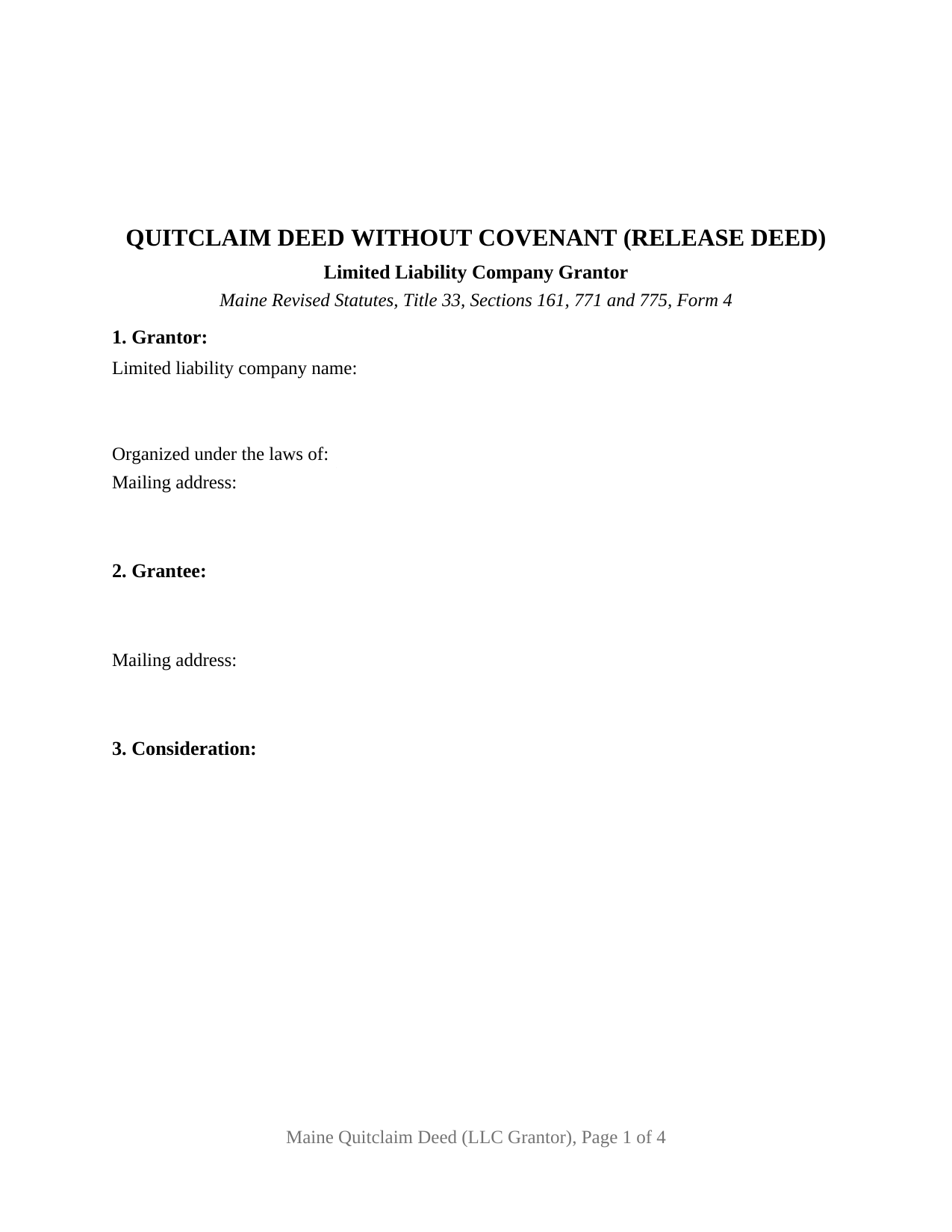
The grantor on this Maine deed has no hand to sign with. Record title stands in the name of a limited liability company, so one individual authorized to act for it executes the release in the company's name, and the instrument shows who that was and on what authority. The deed itself is Maine's quitclaim deed without covenant, the release deed of the statutory short forms, configured for a company grantor.
An entity releases, a person signs
Maine keeps the authority question in one statute. 31 M.R.S. Section 1541, power to bind limited liability company, recognizes four routes: the company agreement, an authorization by the members under Section 1556, a statement of authority filed with the Secretary of State under Section 1542, and, where no statement of authority is in effect, the power of any manager, member, president or treasurer to bind the company. Section 7 takes the signer's name, the capacity, and the source relied on, so the land records carry that answer rather than leaving it to be reconstructed.
A second statute speaks to entity deeds already on file. Under 33 M.R.S. Section 353-A, a deed given in the name of a Maine entity organized more than 20 years ago, once of record at least two years, may not be held invalid for lack of authority or informality in its execution if the execution was in good faith by acting officers, officials or members. That protection arrives with time on the record.
Everything released, nothing promised
Maine measures warranty by the covenant phrase a deed prints rather than by the words in its title. Warranty covenants carry the full promises of 33 M.R.S. Sections 763 and 764, a quitclaim covenant the narrower undertaking of Sections 765 and 766. This deed prints neither, which places it in the without-covenant slot of the Section 775 appendix, and its own text says so. Reach comes from the word release: 33 M.R.S. Sections 161 and 771 move whatever estate the company could move by any other form of deed. Section 8 collects the recorded easements, restrictions and liens that stay fastened to the land, above a printed line stating that the listing creates no covenant.
One company, one signature, one certificate
The form recites one grantor, a company holding record title in its own name, with the jurisdiction of organization beside it, and one signature line whose typed or printed name entry 33 M.R.S. Section 651-A directs. One acknowledgment certificate follows under 33 M.R.S. Section 203, its wide blank after the date line holding the signer's name, capacity, and company. Patterns reaching a Maine registry in this shape include a property-holding company selling to unrelated buyers, and a company releasing a lot to its own members as it winds up. Title held in members' individual names, two entity grantors on one deed, a corporation signing through an officer, and a trustee or personal representative present configurations this form does not recite. Nothing on it asks about marriage, because a company has no spouse.
The declaration line that belongs to a company
Unless an exemption applies, the deed reaches the counter with a real estate transfer tax declaration, and two of its entries belong to an entity seller. Maine Revenue Services directs a business entity seller to enter the entity's federal identification number rather than a social security number, and it carries evidence of compliance with nonresident withholding under 36 M.R.S. Section 5250-A, which looks through a company to nonresident members. On a taxable sale, value is taxed at 2 dollars and 20 cents per 500 dollars to the first 1,000,000 dollars and at 6 dollars per 500 above that line, halved between the sides. Two subsections of 36 M.R.S. Section 4641-C sit close to this configuration: subsection 16, deeds between a family entity and its members in the organization, dissolution or liquidation of that entity, and subsection 19, a transfer that is a mere change in identity or form of ownership. Recording costs the statutory 40 dollars for an ordinary submitter.
The download brings the blank deed as a fillable PDF, a plain language guide to the ten numbered sections and to recording, and a completed example set in Sagadahoc County, where a company releases a platted Topsham lot for 265,000 dollars, each side owing 583 dollars of tax. Searchers reach it as an LLC quitclaim deed, a company quit claim deed, or a manager signed release deed; the materials are informational and are not legal advice.
Important: County-Specific Forms
Our quitclaim deed (llc grantor) forms are specifically formatted for each of the 16 counties in Maine.
After selecting your county, you'll receive forms that meet all local recording requirements, ensuring your documents will be accepted without delays or rejection fees.