Maine Quitclaim Deed
County Specific Legal Forms Validated as recently as October 14, 2026 by our Forms Development Team
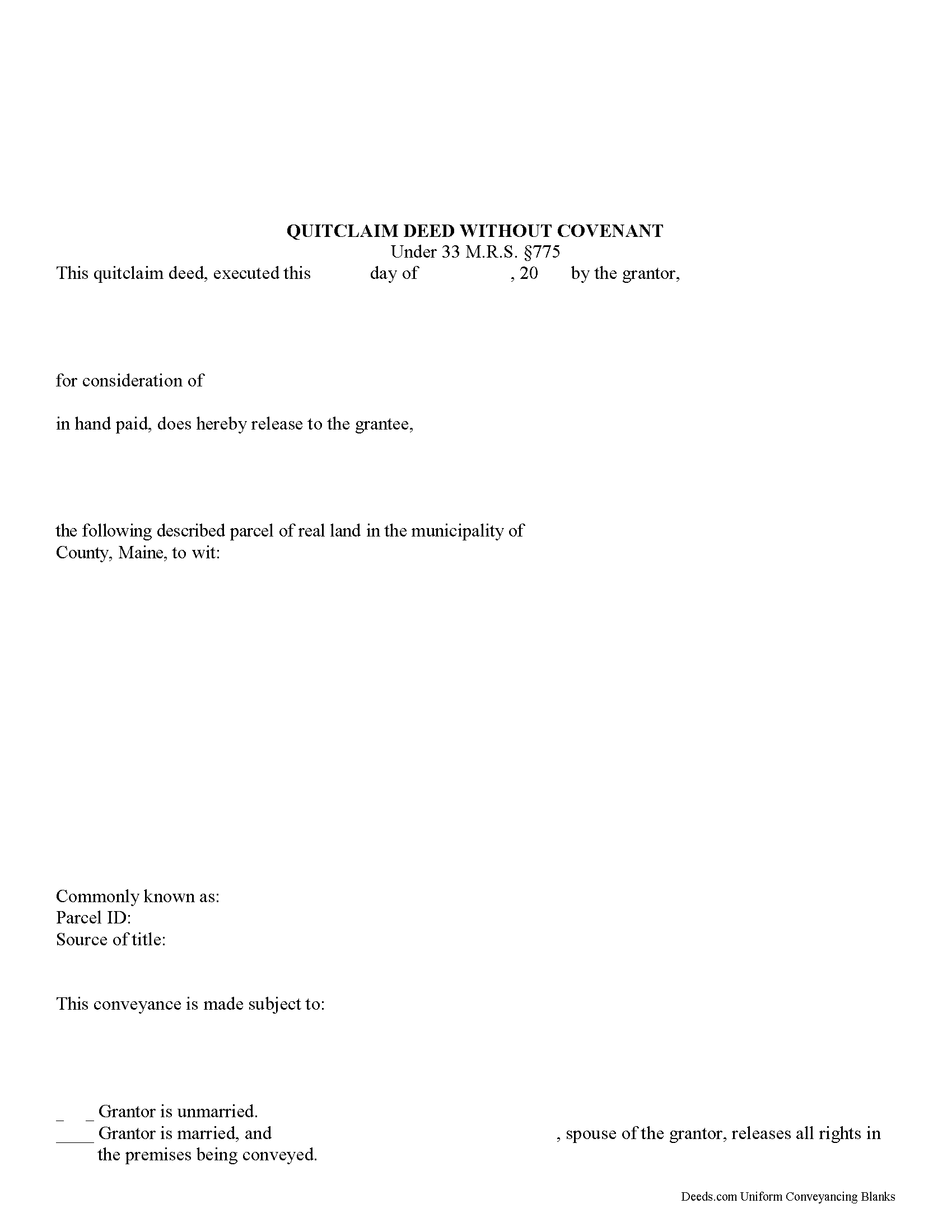
About the Maine Quitclaim Deed
How to Use This Form
- Select your county from the list
- Download the county-specific form
- Fill in the required information
- Have the document notarized if required
- Record with your county recorder's office
What Others Like You Are Saying
"The site provided exactly what I needed when I needed it."
"I ordered a Quit Claim Deed for my county. Once I read the detailed instructions and filled it out I…"
"Get Rid of the places to initial each page on the Trust Deed. The Co. Recorder (Davis) does not requ…"
"I'm not too bright. Ordered one thing when I wanted something else. Deeds staff fixed it for me."
"I loved using this process to record my deeds. it was fast and everytime I sent a message I received…"
4.8/5 from 4,828 reviews. Read all
Maine wrote its conveyancing law to let short words carry long meanings. A single verb, release, moves an entire estate under 33 M.R.S. Section 771. No seal is needed and no price has to be recited, under Section 774. And Section 761 makes the appendix of statutory forms permissive rather than compulsory, so parties may alter a form as circumstances require. This Maine quitclaim deed is Form 4 of that appendix, the quitclaim deed without covenant, drawn for one or two individuals releasing to one or two individuals.
What one word moves
Section 161 supplies the reach: a quitclaim or release in the usual form passes whatever estate its maker holds and could have passed by any other kind of deed. Section 771 says as much from the other end, that release by itself suffices and that no covenant is read into grant or convey. The instrument is therefore wide in what it transfers and empty of promises. It states that posture in its own text rather than in its title, because Maine sorts deeds by the covenant phrase they print. Warranty covenants carry the four full promises of Sections 763 and 764; a quitclaim covenant carries the narrower defense of Sections 765 and 766, reaching only claims that arise through the grantor. Form 4 prints no covenant phrase at all, and this deed says so where a later reader will find it.
Who signs, and how many
The party blocks are deliberately clear of preprinting. One free-form Grantor(s) block receives one or two individuals with whatever status words the parties use, and a matching Grantee(s) block receives one or two names plus any designation of how they will hold, drawn from the ownership forms 33 M.R.S. Section 159 recognizes. Four count patterns fit the same instrument: one to one, one to two, two to one, and two to two. Two signature blocks follow, headed GRANTOR and SECOND GRANTOR (if applicable), each with its own acknowledgment certificate, and a deed signed by a single grantor leaves the second of each blank. Maine does not require a certificate per signer; the pair is a layout choice, since Section 1917 prints its blank as Name(s) of individual(s) and Section 203 accepts the acknowledgment of one of several signers. What the form does not recite is a signer acting for another: an entity releasing through an officer, member, manager or partner, a fiduciary signing in a trustee's or personal representative's office, an agent under a power of attorney, and three or more owners on a side all present configurations this deed is not set up as.
What the record still asks for
Economy in the operative words buys no economy in the record. Section 456 directs a Maine deed to carry the grantee's address down to street and number, municipality and state. Section 651-A conditions the register's acceptance on a typed or printed name under each signature, the signer's and the officer's alike, and the registry indexes from those printed names. Section 201-A makes book and page the working currency of a reference, which is what the source of title and encumbrance blanks collect. Recording is a notice rule under Section 201: the deed binds the grantor and anyone with actual notice from delivery, and everyone else once it reaches the registry serving the county where the land sits.
Forty dollars, and a declaration
Maine fixes the recording charge by statute rather than by county. Since January 1, 2026, Sections 751 and 752 put an ordinary submitter at 40 dollars for a deed of any length, whatever its page count. A transfer tax declaration travels with the deed unless an exemption applies. On transfers made on or after November 1, 2025 the tax runs 2 dollars and 20 cents for each 500 dollars of value through the first million and 6 dollars per 500 above that line, borne half by each side; the completed example prices a Hampden lot at 195,000 dollars, or 429 dollars apiece. Section 4641-C holds the exemptions reaching family transfers and transfers made without actual consideration, and an exemption lifts the tax without lifting the paperwork.
This package delivers the blank deed as a fillable PDF, a plain language guide covering the eight numbered sections, the certificates and recording, and a completed example filled in for a Penobscot County parcel. Searchers look for this instrument as a Maine quit claim deed, a quitclaim without covenant, or a release deed; the materials are informational and are not legal advice.
Important: County-Specific Forms
Our quitclaim deed forms are specifically formatted for each of the 16 counties in Maine.
After selecting your county, you'll receive forms that meet all local recording requirements, ensuring your documents will be accepted without delays or rejection fees.