Maine Quitclaim Deed (Individual Grantor by Attorney-in-Fact)
County Specific Legal Forms Validated as recently as September 21, 2026 by our Forms Development Team
About the Maine Quitclaim Deed (Individual Grantor by Attorney-in-Fact)
How to Use This Form
- Select your county from the list
- Download the county-specific form
- Fill in the required information
- Have the document notarized if required
- Record with your county recorder's office
What Others Like You Are Saying
"This site was very easy to use. Great direction on how to complete the form."
"This has been the most seamless process I have ever experienced. Thank you for addressing my needs s…"
"Purchasing the real estate deed form from your platform was a breeze. The form was easy to fill out …"
"Quick results with accurate information and thorough information."
"So far so good. Looks nice but a more condensed version, when the recorder charges by the page, shou…"
4.8/5 from 4,836 reviews. Read all
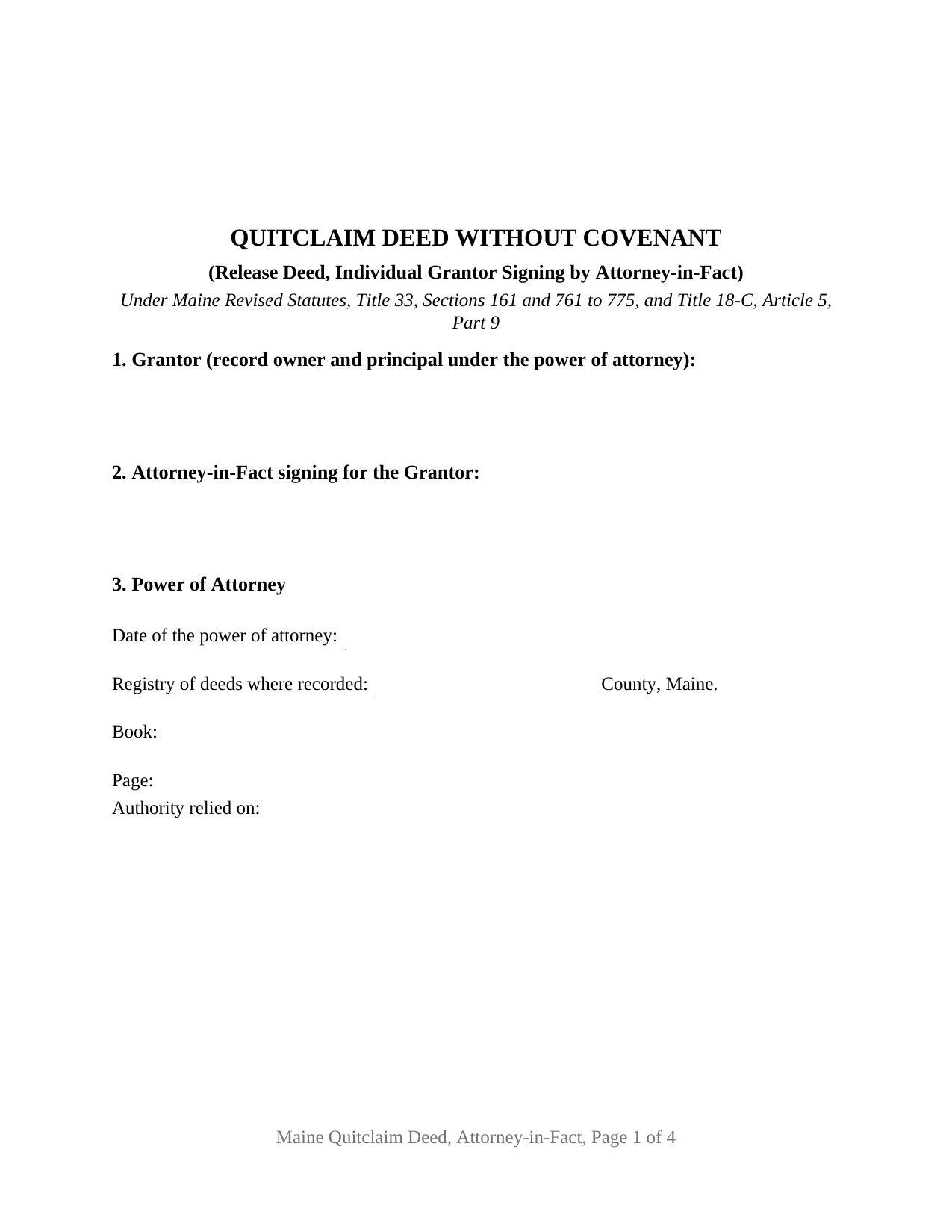
The hand that signs this Maine deed owns nothing. Record title stays exactly where the registry index shows it, in the name of one individual, while the signature at the foot of the instrument belongs to that owner's attorney-in-fact, acting under a power of attorney. Maine's quitclaim deed without covenant, called a release deed in the Short Form Deeds Act, carries that split cleanly: the owner releases, the agent signs, and a numbered section names the authority.
Where an agent gets power over land
Authority comes from the Maine Uniform Power of Attorney Act, 18-C M.R.S. Article 5, Part 9. Section 5-934 provides that general authority with respect to real property lets an agent sell, exchange, convey with or without covenants, quitclaim, release, encumber, partition, lease, and otherwise dispose of an interest in real property, unless the power of attorney provides otherwise. Subsection 7 of Section 5-931 supplies the consequence: an act the agent performs under a power of attorney binds the principal and the principal's successors in interest as if the principal had performed it. Two ceilings sit above that. Gift authority takes an express grant, and subsection 2 bars an agent outside the ancestor, spouse, domestic partner, and descendant classes from creating an interest in the principal's property in the agent.
The section that answers a title examiner
A numbered section on the face of the deed collects the power of attorney: its date, the registry, book, and page where it has been recorded, and the granting language relied on. No Maine statute conditions this deed's recordability on the power of attorney being of record. 33 M.R.S. Section 353-A, subsection 4 exists because agent-signed deeds have reached Maine registries for generations with no authority document behind them, repairing that gap only after 20 years of record and occupancy. Practice does not wait 20 years: Maine State Bar Association Title Standard 302 treats recording the power of attorney, or a copy, in the registry for the county where the land lies as the ordinary course.
Everything the owner holds, promised by nobody
Warranty in Maine attaches to the covenant phrase a deed prints. This one prints none, the without-covenant slot of the 33 M.R.S. Section 775 appendix, while Sections 161 and 771 give the operative word its scope: a release moves whatever estate the owner could pass by any other form of deed. An encumbrance section gathers the recorded matters that stay fastened to the parcel, above a printed line stating that the listing creates no covenant.
One signer, acknowledging in a capacity
The form recites one grantor, the record owner, and one signer, the agent named from the power of attorney, with a single signature line whose typed or printed name entry answers 33 M.R.S. Section 651-A. The individual who appears before the notary public is the agent rather than the owner, because the agent is the person who signed, so the certificate's wide blank takes that name with the capacity, the content of the representative capacity short form at 4 M.R.S. Section 1917, subsection 2. Patterns arriving in this shape include an owner wintering out of state whose agent closes a sale at home, and a durable power of attorney used after the owner's capacity declines. An owner signing personally, coagents, two owners, and entity or fiduciary signers present configurations this form does not recite, and a transfer after the principal's death belongs to the estate, because 18-C M.R.S. Section 5-910 ends the agent's authority there.
At the counter
Recording happens at the registry serving the county where the parcel sits, for the statutory 40 dollar fee, on pages laid out to Maine's all-county registry standards. A transfer tax declaration rides along unless an exemption applies, and the agent signs it in the capacity in which the deed was signed; the Franklin County example carries a 168,000 dollar price, which works out to 739 dollars and 20 cents of tax, half to each side.
The download holds the blank deed as a fillable PDF, a plain language guide to the eleven numbered sections and to recording, and the completed Franklin County example filled in from the grantor block through the acknowledgment. A copy of the power of attorney is commonly recorded beside such a deed; it is prepared and recorded separately and is not included here. Searchers reach this instrument as a power of attorney deed, a POA quit claim deed, or an attorney-in-fact release deed; the materials are informational and are not legal advice.
Important: County-Specific Forms
Our quitclaim deed (individual grantor by attorney-in-fact) forms are specifically formatted for each of the 16 counties in Maine.
After selecting your county, you'll receive forms that meet all local recording requirements, ensuring your documents will be accepted without delays or rejection fees.