Maine Quitclaim Deed (Trustee Grantor)
County Specific Legal Forms Validated as recently as October 13, 2026 by our Forms Development Team
About the Maine Quitclaim Deed (Trustee Grantor)
How to Use This Form
- Select your county from the list
- Download the county-specific form
- Fill in the required information
- Have the document notarized if required
- Record with your county recorder's office
What Others Like You Are Saying
"Getting the forms and paying the fee was very simple and easy to follow. Now we"ll see how it g…"
"Using www.deeds.com was super ez even for a non-technical person like me, it saved me lots of time a…"
"Documents exactly as described, no complaints."
"So far all is perfect! Thank you for all your help!"
"Very helpful and efficient!"
4.8/5 from 4,828 reviews. Read all
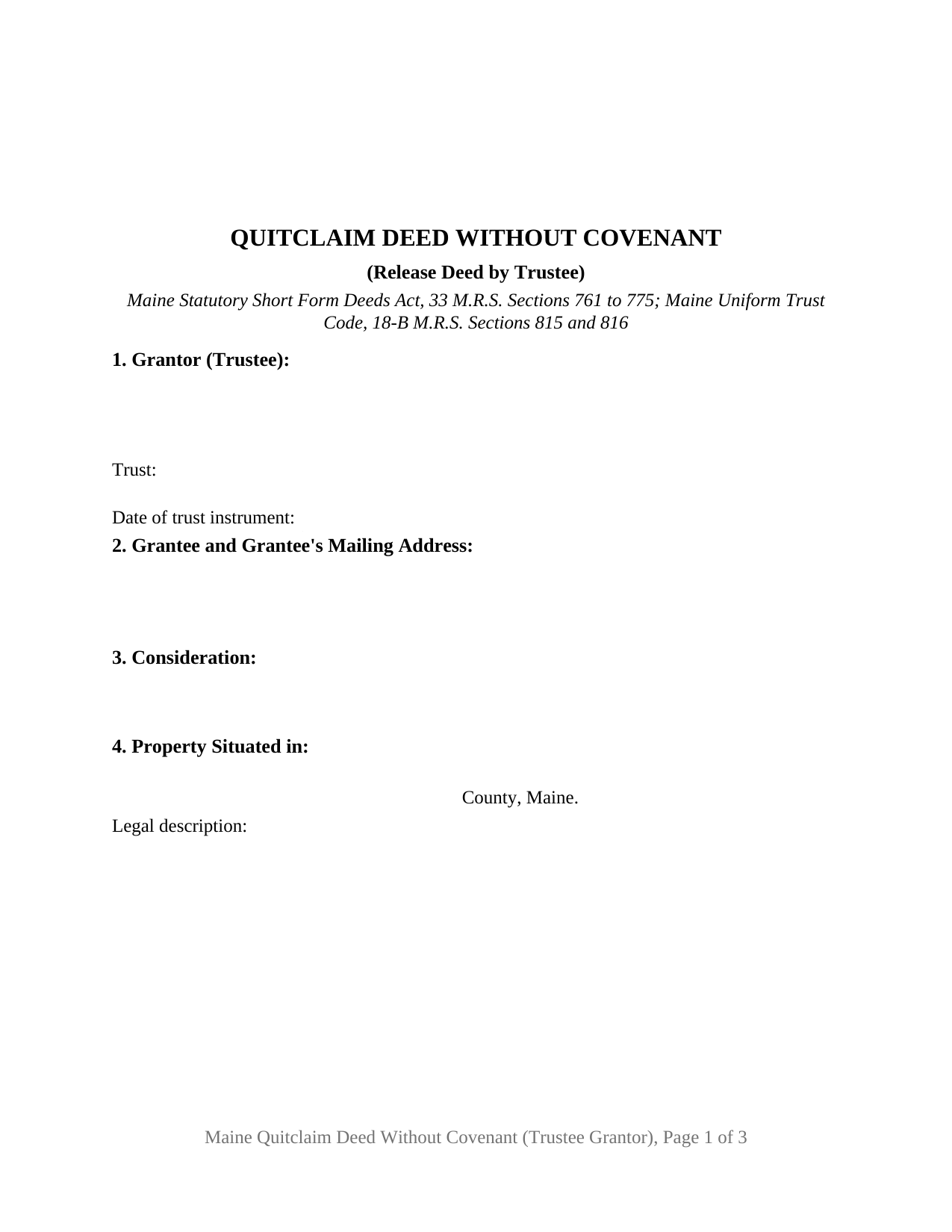
Every signature on a Maine deed belongs to somebody. On this one it belongs to a trustee, and the interest it lets go is not the signer's own: record title stands in the trustee's name for a named trust, and the trustee signs in that capacity to release it. The instrument is Maine's quitclaim deed without covenant, the release deed of the statutory short forms, configured for a trustee grantor.
Two statutory patterns, one deed
The Short Form Deeds Act supplies the pieces separately. In the appendix at 33 M.R.S. Section 775, Form 4 is the quitclaim deed without covenant, or release deed; Form 3 is the deed of a trustee or other specified authorized representative, running from the signer's name and capacity through the words by the power conferred by law, and every other power. This deed carries both at once, capacity and power language with release words and no covenant phrase, which Section 761 permits when it provides that the statutory forms may be altered as circumstances require.
How far the release reaches is statutory rather than a matter of the document's title: Sections 161 and 771 of Title 33 give the word its scope, and warranty attaches to whichever covenant phrase a deed prints, the full covenants of Sections 763 and 764 or the narrower promise of Sections 765 and 766. Neither appears here, so the grantee takes the trust's record position as it stands.
Signing in a capacity, and why the deed states it
Maine does not treat a trust itself as a holder of title. 33 M.R.S. Section 851-A deems a deed given by a trust that names no trustee to be made by the trustee or trustees who sign it. Section 1 of the form names the trustee, states the capacity, and identifies the trust and the date of its instrument; Section 7 carries the power relied on, citing the trust instrument alongside 18-B M.R.S. Sections 815 and 816, the Maine Uniform Trust Code's grants of trustee power, which include selling property at private sale. Stating the capacity does work beyond description: under 18-B M.R.S. Section 1010, a trustee who discloses that capacity is not personally liable on a contract properly entered into in it while administering the trust.
One trustee, one certificate
The form provides one grantor signature line, for a single trustee, carrying the typed or printed name that 33 M.R.S. Section 651-A requires beneath a recorded signature, and one acknowledgment certificate taken under 33 M.R.S. Section 203. A trustee acknowledges in a representative capacity, the subject of 4 M.R.S. Section 1917, subsection 2, and the wide blank in the certificate takes the signer's name with that capacity. Patterns bringing this configuration to a Maine registry include a trustee of a revocable living trust releasing a parcel back to the settlor as beneficial owner before a refinancing, and a trustee releasing a parcel to the person entitled to it as a trust winds up. Deeds signed by two or more cotrustees, by a personal representative under Title 18-C, by a corporate trustee acting through an officer, or by an individual in that individual's own right present configurations this form does not recite.
The tax side of a release out of trust
36 M.R.S. Section 4641-C, subsection 15 exempts a deed from a trustee, nominee, or straw party to the beneficial owner, the branch a release out of a revocable trust to its settlor reaches, and the completed example claims it on the declaration of value. A release to a purchaser for a price is taxable like any other transfer, at 2 dollars and 20 cents for each 500 dollars of value through the first 1,000,000 dollars, then 6 dollars for each 500 beyond it, borne half by each side and collected by the register under 36 M.R.S. Section 4641-B. One declaration entry is particular to trust sales: 36 M.R.S. Section 4641-D calls for evidence of compliance with the withholding statute, 36 M.R.S. Section 5250-A, which reaches a trust administered outside the State as a nonresident seller.
Downloading brings three files: the blank deed as a fillable PDF, a plain language guide covering the ten sections and recording, and a completed example set in Waldo County, where a trustee releases a Belfast lot to the settlor of her revocable living trust. Searchers reach this instrument as a trustee's deed, a deed out of trust, or a quit claim deed signed by a trustee; the materials are informational and are not legal advice.
Important: County-Specific Forms
Our quitclaim deed (trustee grantor) forms are specifically formatted for each of the 16 counties in Maine.
After selecting your county, you'll receive forms that meet all local recording requirements, ensuring your documents will be accepted without delays or rejection fees.