Massachusetts Quitclaim Deed (Divorce)
County Specific Legal Forms Validated as recently as September 30, 2026 by our Forms Development Team
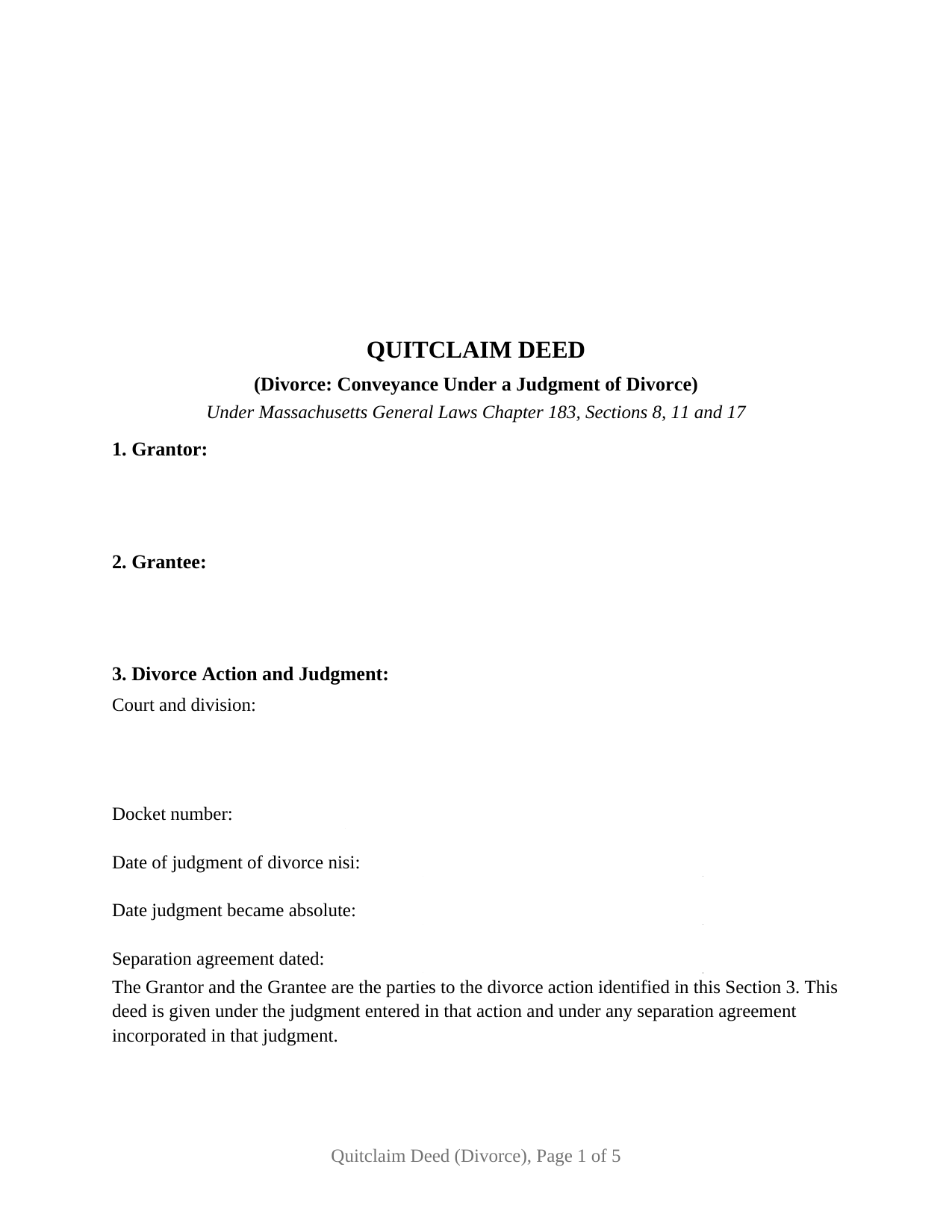
About the Massachusetts Quitclaim Deed (Divorce)
How to Use This Form
- Select your county from the list
- Download the county-specific form
- Fill in the required information
- Have the document notarized if required
- Record with your county recorder's office
What Others Like You Are Saying
"I was searching information about my boyfriend family home and received the results in a timely mann…"
"I needed to cut and paste my phone number with the dashes in order to use this website with my iPhon…"
"I got what I needed very quickly. Thank you."
"Great way to do business with Dc Government! I submitted my documents and received everything back a…"
"Quick and easy to use and with the provided instructions and example it took a lot of the guess work…"
4.8/5 from 4,821 reviews. Read all
Whether a Massachusetts divorce conveyance draws excise stamps is settled by what the deed says about itself. Standard 16-4 of the Massachusetts Deed Indexing Standards, Deeds Excise Tax and Divorce, keeps a deed from one spouse to the other outside the excise even where money changes hands, on one condition: the deed states specifically that the amount paid is a division of marital assets pursuant to the divorce, and lists the court and docket number. A deed reciting a price and nothing about the judgment behind it meets the ordinary stamp calculation. This fillable deed is built around that condition, with one former spouse conveying to the other.
The judgment on the face of the deed
Section 3 is where the standard is answered: the Probate and Family Court division that heard the case, the docket number, the date of the judgment of divorce nisi, the date it became absolute, and the date of an incorporated separation agreement. Those dates sit ninety days apart in the ordinary course, since General Laws Chapter 208, Section 21 makes a divorce judgment a judgment nisi that becomes absolute ninety days after entry unless the court orders otherwise. Section 7 states the dollar figure twice: as full consideration, measured without subtracting a mortgage the property is taken subject to, and as a division of marital assets in the action Section 3 names.
What the judgment already did to the title
A divorce reorganizes co-ownership before any deed is signed. Chapter 190B, Section 2-804 severs interests former spouses held at the divorce as joint tenants with right of survivorship, leaving tenancies in common, and protects a purchaser who relied in good faith on apparent survivorship until a writing declaring the severance is recorded. Where the couple held by the entirety the authority is judicial: Bernatavicius v. Bernatavicius holds that a divorce decree dissolves that estate by operation of law. So the operative section conveys the grantor's whole interest, naming one held before the judgment by the entirety, in joint tenancy or in common, and its capitalized close confines the Chapter 183 covenants to claims traced through the grantor.
A homestead that outlasts the marriage
Chapter 188 does not end with the marriage. Section 7 continues an estate of homestead existing at the divorce of its holder for the former spouse and minor children, through a later remarriage. Subsection (b) of Section 10 governs this deed: no deed between spouses or former spouses holding a homestead ends it unless each person entitled to its benefit executes an express release. Section 9 of the form carries that release for the grantor under clause (2) of Section 10(a), and says that no homestead of a person who does not sign is released. Clause (9) reaches a different instrument, releasing the homestead of a spouse the judgment orders to convey the home to the other.
One grantor, one grantee, one divorce action
The form names one record owner as grantor and one grantee with the residence and post office address Chapter 183, Section 6 requires, over one signature line and one certificate in the substance of the Chapter 222, Section 15 short form. Former spouses who held by the entirety, one taking the other's half after the judgment; a judgment assigning a two-family rental to one party; and a conveyance given years later to record a transfer the judgment called for but no deed ever completed, all present the pattern this deed recites. It is not set up for two grantors, a grantee outside the divorce, or a trustee, attorney-in-fact or corporate signer. Searches for a Massachusetts divorce deed or a quit claim deed after divorce describe this configuration.
At the registry counter
Filing happens in the registry district covering the land, at the statewide $155 deed fee, and one wrinkle follows the exemption: the indexing standards keep a deed exempt from the excise off the electronic channel without prior registry approval. Nor is a deed the only route: Chapter 183, Sections 43 and 44 let a certified copy of a judgment directing a conveyance be recorded with the force of a deed, obtained from the court and recorded separately rather than supplied here.
Three files arrive with the purchase: the fillable deed, the completed example, filled on an Essex South District pattern in Beverly, and a guide walking each numbered section, the certificate, the homestead release and the recording steps. Everything in them describes Massachusetts law in general terms, and none of it is legal advice.
Important: County-Specific Forms
Our quitclaim deed (divorce) forms are specifically formatted for each of the 14 counties in Massachusetts.
After selecting your county, you'll receive forms that meet all local recording requirements, ensuring your documents will be accepted without delays or rejection fees.