Massachusetts Quitclaim Deed (Interspousal)
County Specific Legal Forms Validated as recently as September 25, 2026 by our Forms Development Team
About the Massachusetts Quitclaim Deed (Interspousal)
How to Use This Form
- Select your county from the list
- Download the county-specific form
- Fill in the required information
- Have the document notarized if required
- Record with your county recorder's office
What Others Like You Are Saying
"Got access to the forms immediately after ordering. Lots of helpful information, forms were easy to …"
"Fast and easy to use. Nice to have available online."
"Deeds.com consistently provides excellent service at a fair price, and we rely and are thankful them…"
"Thank you the service was prompt and efficient."
"Absolutely the best ever!!!"
4.8/5 from 4,831 reviews. Read all
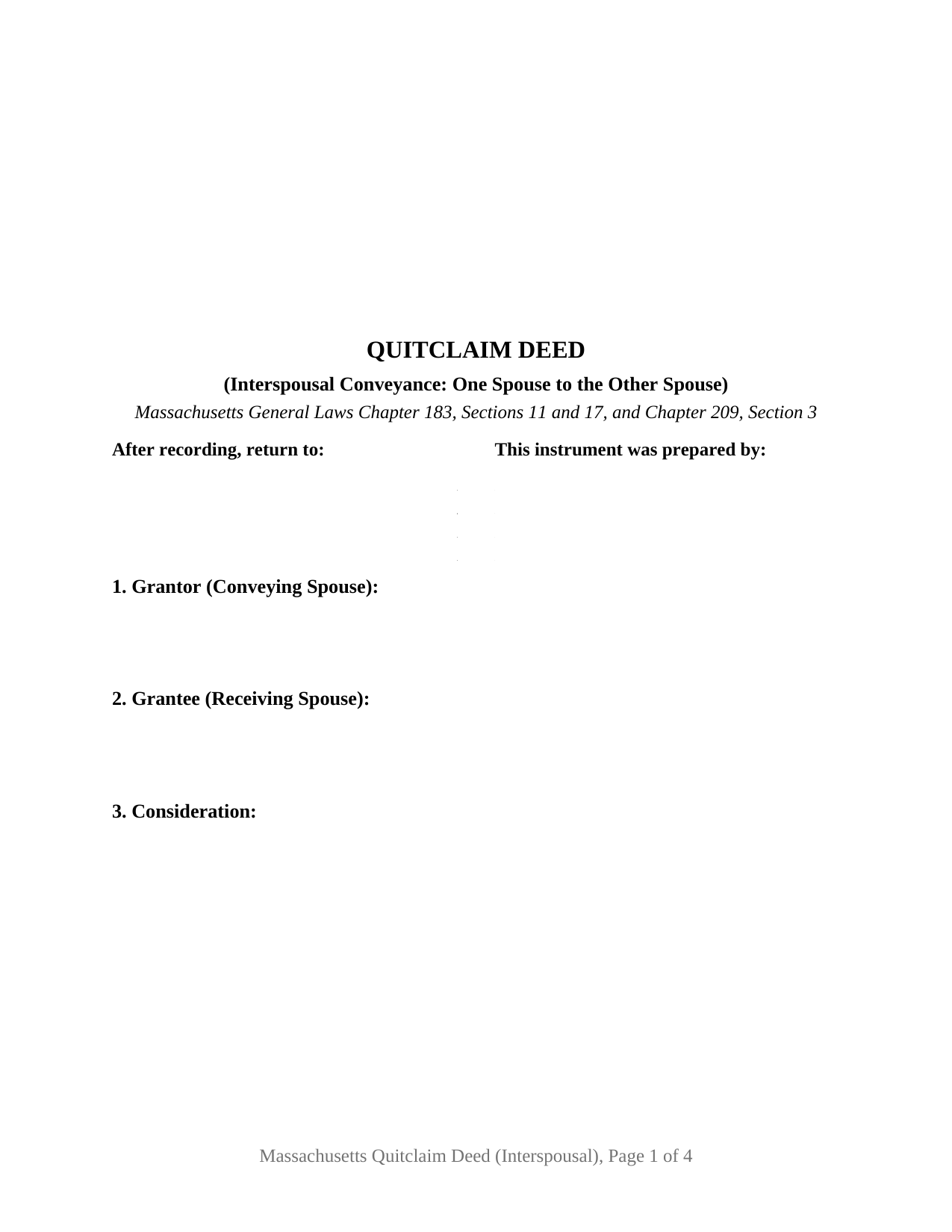
Massachusetts keeps a one-sentence statute for the deed that moves a home from one spouse to the other. General Laws Chapter 209, Section 3 provides that transfers of real and personal property between husband and wife are valid to the same extent as if they were sole, and it is what lets a married owner of record hand title across a marriage rather than out of it. This fillable Massachusetts quitclaim deed recites that single pairing: one grantor, one grantee, and the fact that the two are married to each other, with the limited covenants of Chapter 183 running between them.
The spouse who would sign a joinder is the grantee here
Chapter 188 gives a Massachusetts home an automatic estate of homestead of $125,000, and as much as $1,000,000 where a declaration is recorded, and it protects an owner's spouse whether or not that spouse holds record title. On a conveyance out of the family, clause (1) of Section 10(a) makes a non-owner spouse's signature the hinge on which an existing homestead ends. An interspousal deed meets that same person from the other side of the transaction: the only spouse who could hold homestead rights against this title is the grantee, so the form carries no joinder line, and the deed answers instead to Section 10(b), the clause for a deed between spouses, under which a homestead survives unless everyone entitled to its benefit executes an express release. Section 10 of the form carries a release spoken by the conveying spouse alone and says so in terms.
One grantor, one grantee, one certificate
Section 1 names the conveying spouse, and Section 2 names the receiving spouse with the residence and post office address that Chapter 183, Section 6 makes a condition of acceptance at the counter. The words of grant reach all of the grantor's right, title, and interest, so one recital serves a spouse who owns the whole record title and a spouse who holds a co-owned interest alongside the grantee; in Hale v. Hale the Supreme Judicial Court sustained a deed of an entirety interest running from one spouse directly to the other under the predecessor of Section 3. One person signs, so the instrument carries one signature line, one printed name, and one acknowledgment certificate in the substance of the Chapter 222, Section 15 form. Section 4 collects the court, docket number, and date of a divorce or separation judgment where the transfer is made under one. A conveyance ordered by a judgment of divorce nisi, a couple placing record title in the name of the spouse who will hold it going forward, and and a spouse releasing a co-owned interest all present the pairing this deed recites. Searches for a Massachusetts interspousal deed or a quit claim deed between spouses describe this configuration; the form is not set up for a grantee outside the marriage, for two grantees taking together, or for an entity or fiduciary signer.
Nominal consideration, and what the excise reaches
Chapter 183, Section 11 gives a deed drawn on the statutory quitclaim form the effect of a conveyance in fee simple with limited covenants, and Section 17 compresses them into two words: the grantor answers for encumbrances the grantor made and defends against claims traced through the grantor, and against none other. Section 6 wants a dollar figure, measured without subtracting a mortgage the conveyance is taken subject to, and the deeds excise under Chapter 64D reaches consideration above $100, at the rate registries state as $2.28 for each $500 or fraction, and $3.24 in Barnstable County. A nominal dollar between spouses therefore carries no excise, while a transfer made in connection with a divorce is treated under Department of Revenue guidance and the registry indexing standards on the strength of what the deed states about the judgment.
At the registry counter
The finished deed goes to whichever registry district covers the town where the land sits, with the statewide $155 deed fee and any excise paid then, and the top three inches of the first page stay clear for the recording information. The completed example runs a Hampden County pattern: a Longmeadow plan-book description, a one dollar consideration, a mortgage left of record, and a filled notarial certificate. The package delivers the fillable deed, the completed example, and a guide covering each numbered section, the certificate, the homestead release, and the recording and assessor filings. This package describes Massachusetts law in general terms, and it is not legal advice.
Important: County-Specific Forms
Our quitclaim deed (interspousal) forms are specifically formatted for each of the 14 counties in Massachusetts.
After selecting your county, you'll receive forms that meet all local recording requirements, ensuring your documents will be accepted without delays or rejection fees.