Massachusetts Quitclaim Deed (Married Couple as Grantors)
County Specific Legal Forms Validated as recently as October 7, 2026 by our Forms Development Team
About the Massachusetts Quitclaim Deed (Married Couple as Grantors)
How to Use This Form
- Select your county from the list
- Download the county-specific form
- Fill in the required information
- Have the document notarized if required
- Record with your county recorder's office
What Others Like You Are Saying
"Fast, Easy and with great assistance! I will definitely use their services again!"
"Fast, easy, helpful instructions. I’ll use them again!"
"Great site. Official. Easy to use. Less expensive than those other sites as well. Saved me approxima…"
"This was Awesome!"
"Download was easy to complete, but difficult to revisit site to review purchased forms on line. Sugg…"
4.8/5 from 4,828 reviews. Read all
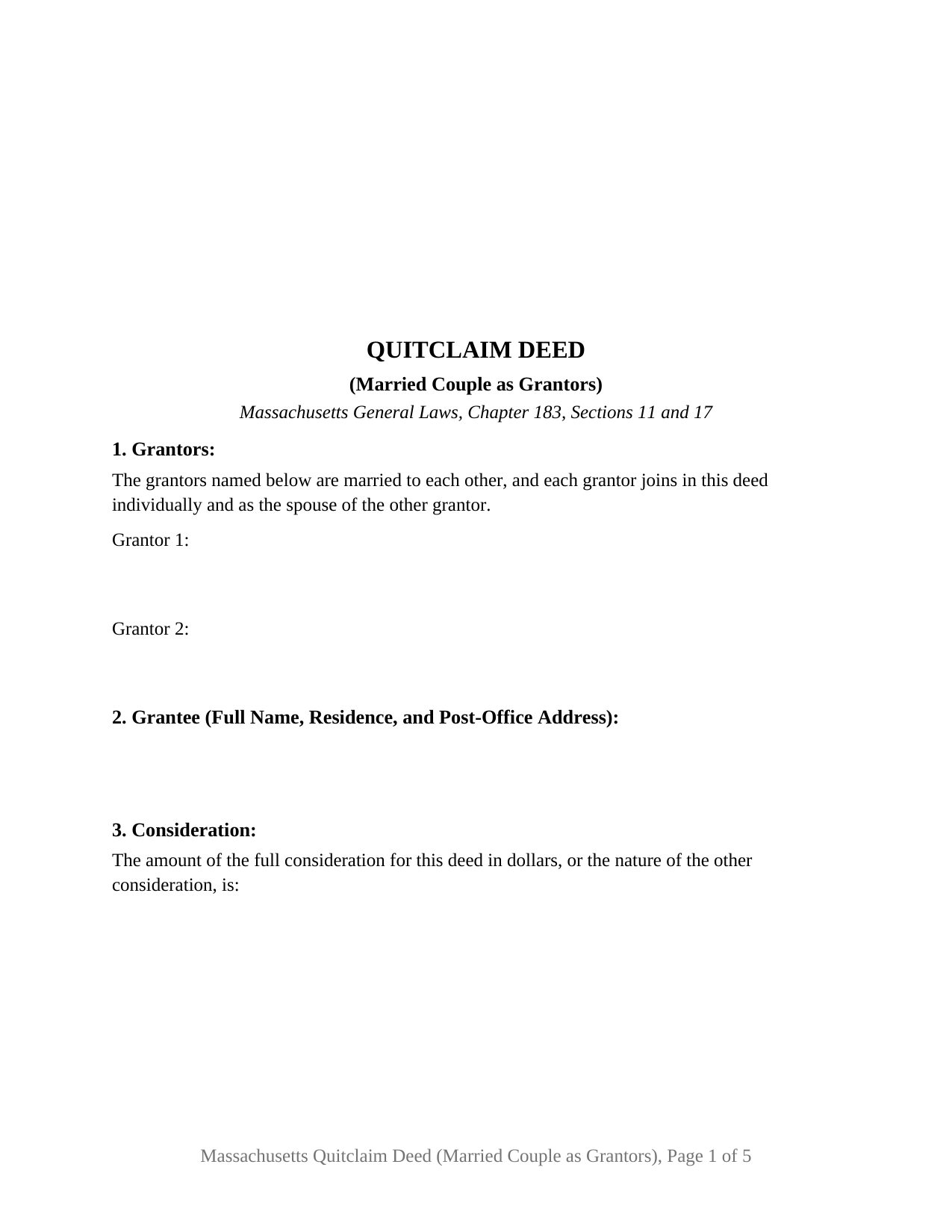
A married couple's deed out of Massachusetts real estate is more than two signatures that happen to share a last name. When spouses hold title as tenants by the entirety, the estate belongs to the marriage itself: neither spouse acting alone can convey the whole property, and the Supreme Judicial Court's account of the equalized entirety estate in Coraccio v. Lowell Five Cents Savings Bank keeps both halves of the couple in every disposition. This Massachusetts quitclaim deed form is drawn for exactly that pairing: two grantors who are married to each other, each signing individually and as the spouse of the other, with the limited statutory covenants of General Laws Chapter 183 running from both spouses to the grantee.
An estate the spouses convey together
Chapter 209, Section 1 gives each spouse equal rights to the control, management, and possession of entirety-held property, so the conveyance out of that title is inherently a two-person act. The operative section of this deed conveys each grantor's entire right, title and interest, language that passes the whole of the couple's holding whether the record shows a tenancy by the entirety, a joint tenancy between spouses, or spousal shares held in common. The deed then writes out what the two words quitclaim covenants mean under Sections 11 and 17 of Chapter 183, and the promise is deliberately bounded: encumbrances the couple made, and claims traced through the couple, and nothing reaching further back in the chain. A mortgage staying of record or a recorded easement goes in the encumbrances section, where the deed carves it out of the covenant.
The marriage written into the deed
Section 1 of the form recites that the grantors are married to each other and that each joins in the deed individually and as the spouse of the other grantor; that recital is the variant's architecture, and the rest of the instrument follows from it. Both spouses sign above printed names, and each signature takes its own certificate carrying the substance of the Chapter 222, Section 15 acknowledgment: personal appearance, identification proved to the notary, a voluntary signing for the deed's stated purpose. A single certificate naming both spouses would satisfy the statute; the per-spouse layout simply means an acknowledgment made on a different day, or in a different state, never holds up the couple's deed. Spouses consolidating a jointly held rental in an adult child's name, a couple moving entirety-held title to the trustee of an estate-planning trust, and married sellers whose purchase and sale agreement calls for a deed with quitclaim covenants all present the married-grantor pattern this form recites. The form is not set up for a sole owner, for co-owners outside a marriage, or for entity or fiduciary title; a search for a spousal quit claim deed or a married couple deed form in Massachusetts describes this configuration.
A homestead release inside the signature pattern
Massachusetts homestead protection follows the family home automatically to $125,000 under Chapter 188, and a declared homestead now reaches $1,000,000 after the 2024 Affordable Homes Act raised the figure. Chapter 188, Section 10 ties termination of an existing homestead on a conveyance outside the family to the signatures of the owner and any non-owner spouse residing in the home, and a married couple conveying together supplies both signatures by design. This deed does not leave the point to inference: Section 9 carries an express release of homestead rights spoken by each grantor, individually and as the other grantor's spouse, so the release is on the face of the record.
From the registry district to the excise stamps
The finished deed goes to the registry of deeds for the county or registry district where the land lies, with the grantee's name, residence, and post-office address and the full consideration recited as Chapter 183, Section 6 directs, and a Section 6A title reference pointing to the couple's own vesting deed. Deeds excise stamps are computed on the stated consideration at recording. The completed example carries a Norfolk County fact pattern from start to finish: a Walpole plan-book description, a $739,000 consideration, the marital recital, and a filled certificate for each spouse.
The download delivers the fillable deed, the completed example, and a guide covering every numbered section, the certificates, the homestead release, and the recording steps, including the excise and the assessor transfer reporting that travel with a Massachusetts deed. The materials describe Massachusetts law in general terms and are not legal advice.
Important: County-Specific Forms
Our quitclaim deed (married couple as grantors) forms are specifically formatted for each of the 14 counties in Massachusetts.
After selecting your county, you'll receive forms that meet all local recording requirements, ensuring your documents will be accepted without delays or rejection fees.