Massachusetts Quitclaim Deed (Individual Grantor by Attorney-in-Fact)
County Specific Legal Forms Validated as recently as September 11, 2026 by our Forms Development Team
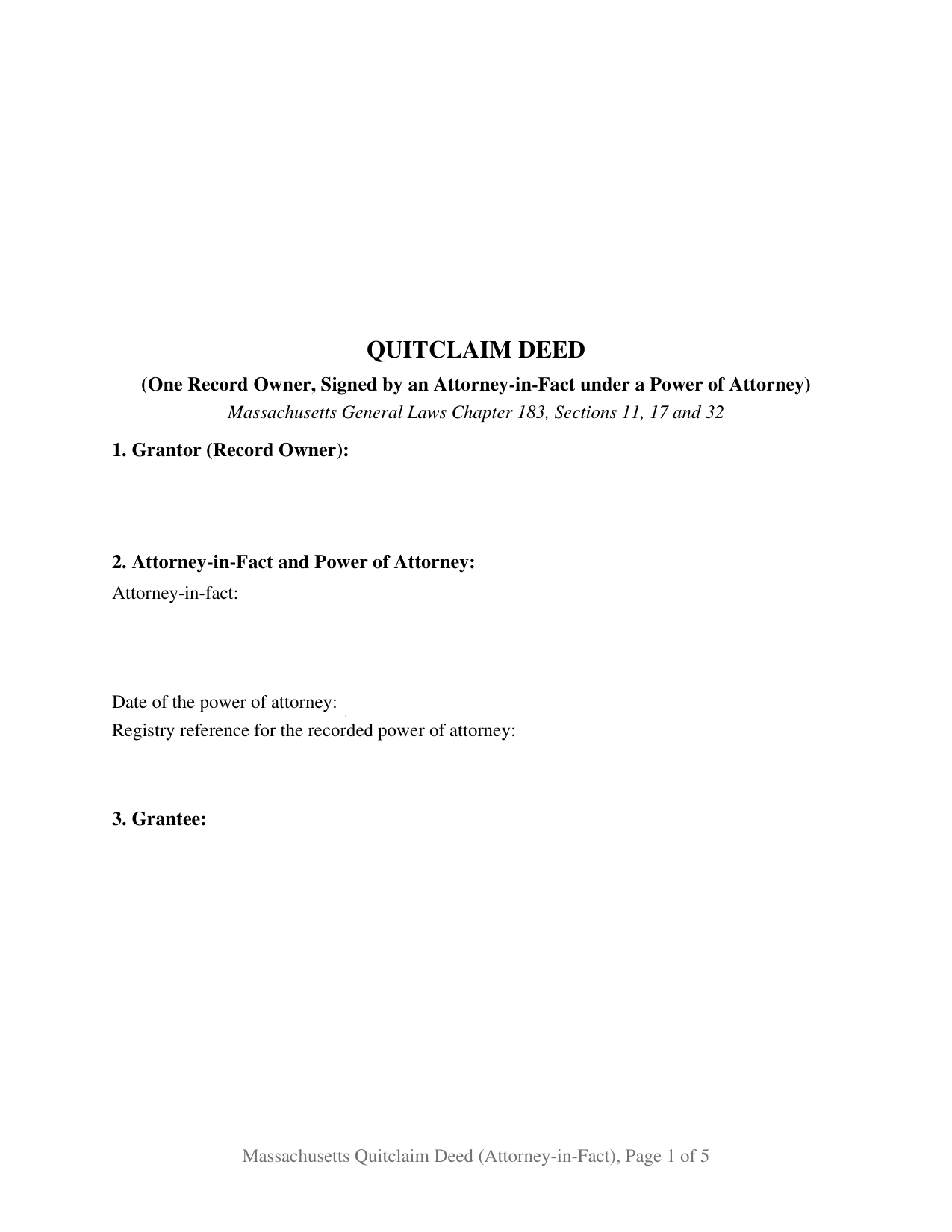
About the Massachusetts Quitclaim Deed (Individual Grantor by Attorney-in-Fact)
How to Use This Form
- Select your county from the list
- Download the county-specific form
- Fill in the required information
- Have the document notarized if required
- Record with your county recorder's office
What Others Like You Are Saying
"I needed a Missouri Notice of Intent to Sell without a named designated buyer. Mo Statutes require n…"
"World class forms and service. Downloaded and prepared the deed in minutes. Used the recording servi…"
"The deed form served my purpose and saved the expense of using an attorney. Easy to use. It would ha…"
"Nice. Quick and very easy to find and download the exact forms I needed."
"Very easy to use, found the forms I needed right away. Downloaded and paid for within minutes! Excel…"
4.8/5 from 4,829 reviews. Read all
Massachusetts names the agent in the same breath as the owner. General Laws Chapter 183, Section 1 makes a deed executed and delivered by the person conveying the interest, or by that person's attorney, sufficient to convey the land, and Section 32 applies the law on the acknowledgment and recording of deeds to letters of attorney for the conveyance of real estate. This fillable deed is drawn for that arrangement: one record owner as grantor, one attorney-in-fact who signs in the owner's name, and the limited covenants Chapter 183 calls quitclaim covenants.
Where the power of attorney is identified
Section 2 is the half of the instrument an examiner reads first: the attorney-in-fact with an address, the date the power was signed, and the registry reference for the recorded power, so the deed points at a document already on the record. Closing practice records the power in the same district immediately before the deed. Registered land has its own sentence: Chapter 185, Section 110 lets any person deal with registered land by attorney, but the letters of attorney are acknowledged, filed with the recorder of the proper district, and registered.
What the agent states, and what a separate affidavit proves
Massachusetts never adopted the uniform act other states use; its durable power provisions sit in Chapter 190B, Article V, Part 5. Section 5-501 makes durability a matter of the writing's own words, and Section 5-504 keeps the agency alive as to a person acting in good faith without actual knowledge of a revocation. Section 10 of the form states what belongs on the face of the deed: the attorney-in-fact signs in the name of the grantor and not individually, and has no actual knowledge of the power's termination. The conclusive-proof affidavit of Section 5-505 is a separate sworn instrument, prepared and recorded separately, and not part of this package.
Covenants that belong to the owner
Quitclaim is not a promise-free word here. Section 11 of Chapter 183 gives a deed drawn on the statutory form the force of a fee simple conveyance carrying the covenant that the premises are free from encumbrances made by the grantor, with a defense against claims by, through or under the grantor and against none other; Section 17 folds that into two words. The promises are the owner's, made through the agent's hand, and the encumbrances section lifts a listed mortgage or easement out of them.
Homestead when the owner is not the signer
Chapter 188 protects a principal residence automatically to $125,000 and to $1,000,000 under a recorded declaration, and clause (1) of Section 10(a) ends an existing homestead on a deed outside the family only when the owner and any non-owner spouse residing there sign. Section 11 releases the grantor's homestead to the extent the power authorizes it, and Section 12 carries a labeled release line, with its own certificate, for a non-owner spouse who resides in the property.
One owner, one agent, one certificate for each signature
The form recites a single record owner in Section 1 and a single grantee in Section 3, whose name, residence and post office address Chapter 183, Section 6 makes a condition of acceptance at the counter. An owner living out of state whose durable power names a relative to sign, an owner whose power came into use after a loss of capacity, and an owner who gave a power limited to one parcel all present the pattern this deed recites. The agent's certificate is a representative-capacity acknowledgment in the substance of the Chapter 222, Section 15 form. Searches for a Massachusetts power of attorney deed, a POA deed, or a quit claim deed signed by an attorney-in-fact describe this configuration; the form is not set up for an owner signing personally, for two record owners, for an entity or trustee, or for a court-appointed fiduciary.
Stamps, and two instruments at one counter
Recording happens in the registry district covering the town where the land sits, at the statewide $155 deed fee, the power carrying its own charge. Chapter 64D excise stamps are computed on the full consideration the deed recites, $2.28 for each $500 or fraction, and $3.24 in Barnstable County. The completed example runs a Hampshire County pattern in Easthampton at $465,000, drawing $2,120.40 in stamps.
The download delivers the fillable deed, the completed example, and a guide covering each numbered section, both certificates, the power of attorney entries, and recording. The materials describe Massachusetts law in general terms and are not legal advice.
Important: County-Specific Forms
Our quitclaim deed (individual grantor by attorney-in-fact) forms are specifically formatted for each of the 14 counties in Massachusetts.
After selecting your county, you'll receive forms that meet all local recording requirements, ensuring your documents will be accepted without delays or rejection fees.