Massachusetts Quitclaim Deed (Corrective)
County Specific Legal Forms Validated as recently as September 1, 2026 by our Forms Development Team
About the Massachusetts Quitclaim Deed (Corrective)
How to Use This Form
- Select your county from the list
- Download the county-specific form
- Fill in the required information
- Have the document notarized if required
- Record with your county recorder's office
What Others Like You Are Saying
"Even for a novice like me, this site was easy to use, with very clear & simple options and instr…"
"Thank you for making this process so convenient."
"How easy was this. I was pleasantly surprised by the speed and price. Saved me several days of snail…"
"Using Deeds.com could not have been easier. The examples and line-by-line instructions helped a lot!…"
"your service is more than I expected easy to navigate, great info, easy to understand. other other s…"
4.8/5 from 4,815 reviews. Read all
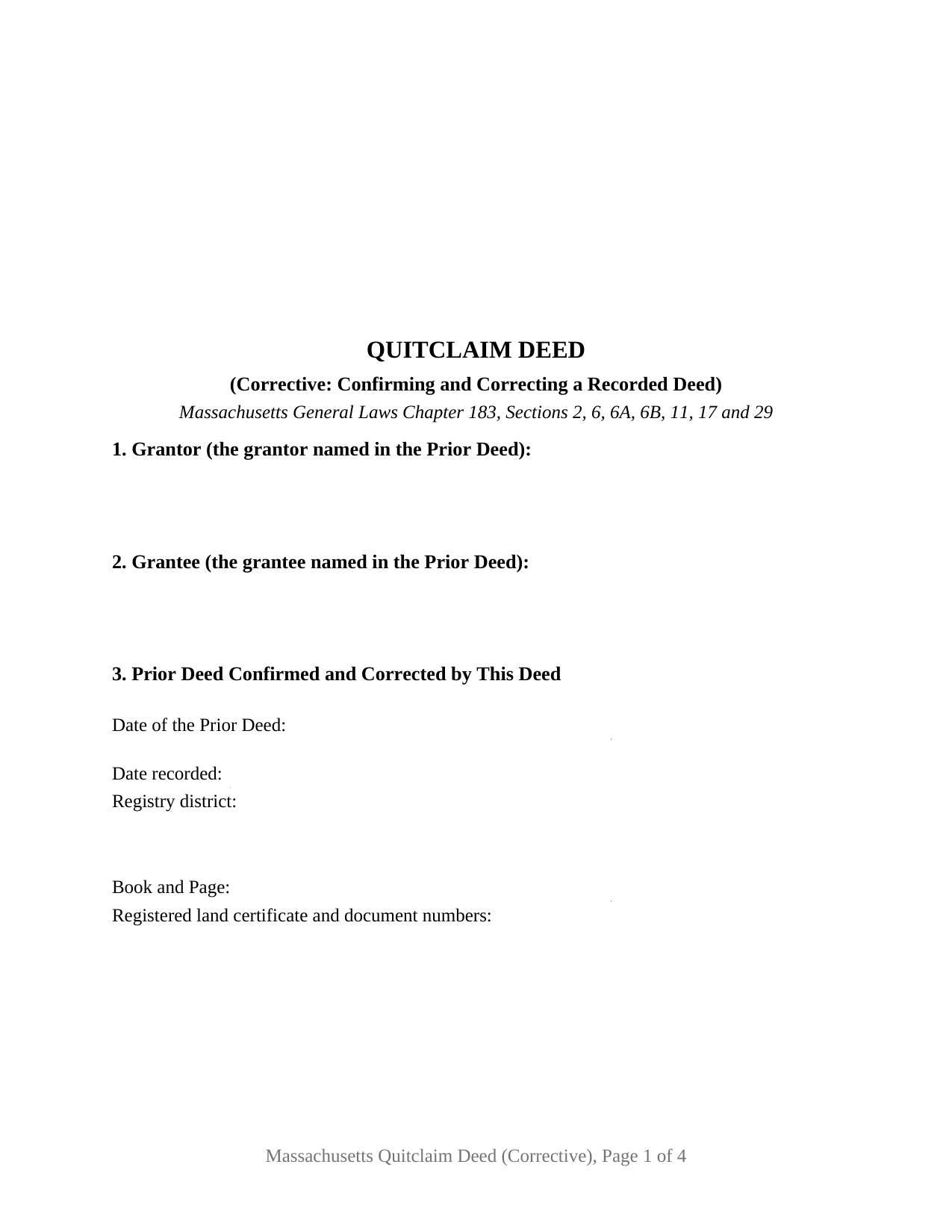
The rule that shapes a Massachusetts corrective deed is not in the General Laws. It is Standard 10-1 of the Massachusetts Deed Indexing Standards, which asks any document intended to confirm or correct a previously recorded document for three things: the book and page number of the earlier document, a brief explanation of the purpose of the confirmatory document, and a statement that no other changes have been made. This fillable Massachusetts quitclaim deed is built around those three items, for one grantor putting right one deed already on the record.
Three items a registry standard asks for
Section 3 of the form takes the first: the date of the earlier deed, the date it was recorded, the registry district that recorded it, its book and page, and the certificate of title and document numbers where the land is registered. Section 7 takes the second, the brief explanation of purpose, in a sentence or two naming the error. Section 10 carries the third in capital letters, along with the limits that travel with it: the deed passes no interest beyond the interest the earlier deed passed, adds no grantor and no grantee, and terminates no estate of homestead that the earlier deed left standing. Section 6 sits between them, setting out the term as the earlier deed had it and as this deed puts it, side by side.
A deed signed and acknowledged on its own day
Standard 10-2 is why a correction arrives as a fresh instrument rather than a marked-up copy: a document that has already been recorded may not be recorded again unless it has first been re-executed and re-acknowledged. So this deed carries its own date, its own signature, and its own acknowledgment certificate in the substance of the General Laws Chapter 222, Section 15 short form, and the completed example shows a July 2026 signature on a deed correcting a March 2026 conveyance in Deerfield. The covenants stay the ordinary Massachusetts ones. Chapter 183, Sections 11 and 17 attach to the two words quitclaim covenants a promise that the premises are free of encumbrances the grantor made, plus a defense against claims by, through or under the grantor and against none other, and a corrective deed carries the same package the deed it corrects carried.
One grantor, one grantee, one earlier deed
Sections 1 and 2 name the grantor and the grantee of the earlier deed, and Section 3 identifies exactly one recorded instrument. A misspelled surname, a dropped middle initial, a wrong plan book page in a title reference, an omitted marital status, and a mistaken date each present the single-deed pattern this form recites. What the form is not built to do is move an interest: adding a person to the title, dropping one, switching a tenancy in common to a joint tenancy, or describing land the earlier deed never described are conveyances whatever the caption says, and they answer to the deeds excise and to the covenant analysis of a conveyance. One signature block appears, for the grantor who signed the deed being corrected; a deed signed by co-owners, by an entity, by a trustee, or by an attorney in fact follows that deed's own signature pattern. Searches for a Massachusetts correction deed, a confirmatory deed, or a scrivener's error deed describe this configuration.
Stamps already bought
Chapter 64D taxes a deed whereby realty sold is conveyed for more than one hundred dollars, and Department of Revenue Directive 89-16 states that the excise reaches only transactions in which realty is sold, and not deeds given without consideration. Section 9 is what tells the registry which case it has: the excise paid on the earlier deed, the book and page where that deed sits, and the fact that nothing passes under this one. One electronic filing rule follows: the indexing standards keep a deed exempt from the deeds excise off the electronic channel unless the submitter clears it with the registry beforehand. Filing happens in the registry district covering the land, at the statewide $155 deed fee, and Chapter 36, Section 24B sends the transfer information on to the local assessors.
The download delivers this corrective quitclaim deed as a fillable PDF, the completed example filled through every blank, and a guide walking each numbered section, the acknowledgment certificate, and the recording steps. The materials describe Massachusetts law in general terms and are not legal advice.
Important: County-Specific Forms
Our quitclaim deed (corrective) forms are specifically formatted for each of the 14 counties in Massachusetts.
After selecting your county, you'll receive forms that meet all local recording requirements, ensuring your documents will be accepted without delays or rejection fees.