Massachusetts Quitclaim Deed
County Specific Legal Forms Validated as recently as October 16, 2026 by our Forms Development Team
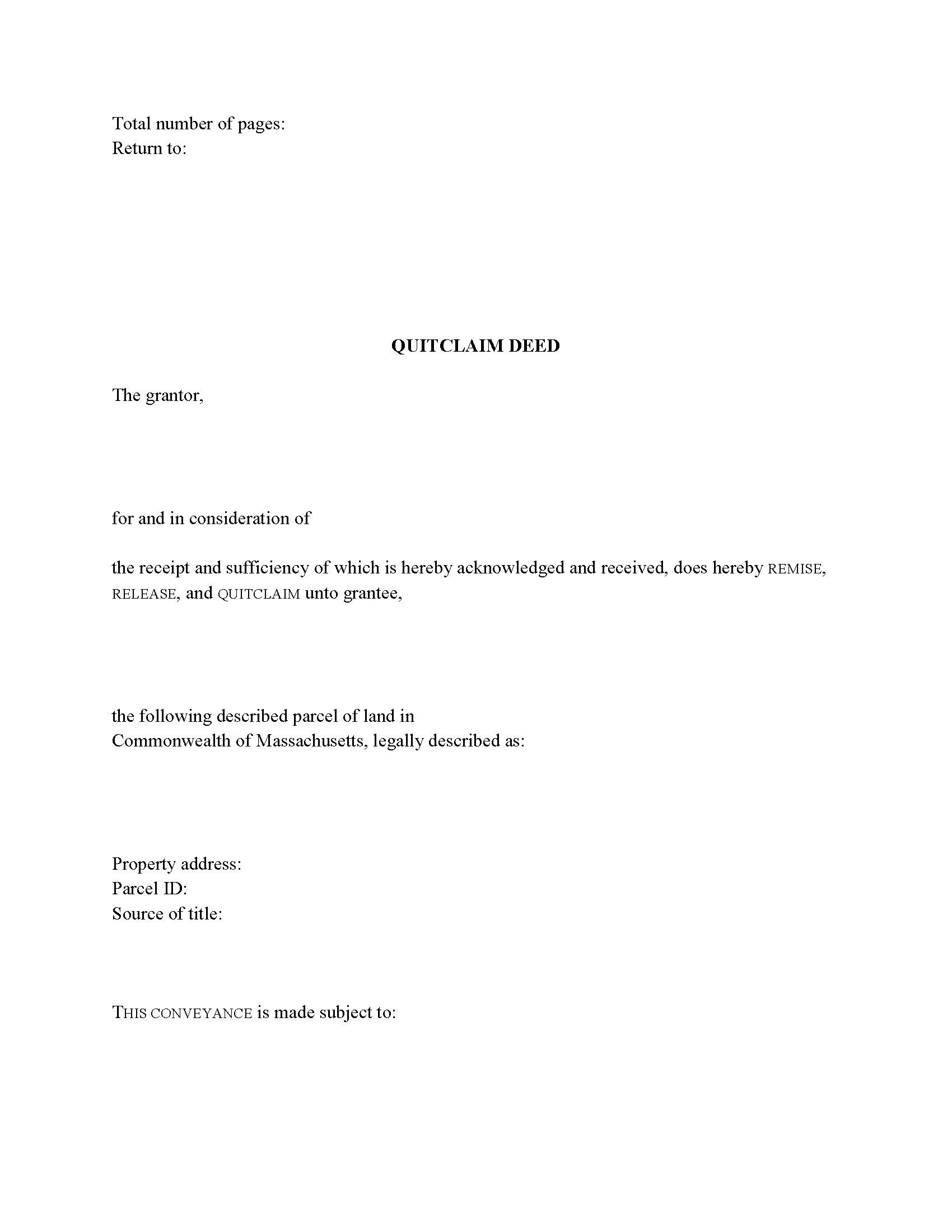
About the Massachusetts Quitclaim Deed
How to Use This Form
- Select your county from the list
- Download the county-specific form
- Fill in the required information
- Have the document notarized if required
- Record with your county recorder's office
What Others Like You Are Saying
"Easy to use, found what I was looking for."
"Great service! Easy to navigate and the instructions were perfectly understandable."
"It was very simple and easy to fill out the information need to do the warranty deed."
"Thank you for the feedback. I reviewed this with my client/friend and she is following up with the a…"
"I needed a Missouri Notice of Intent to Sell without a named designated buyer. Mo Statutes require n…"
4.8/5 from 4,828 reviews. Read all
Massachusetts writes short deeds on purpose. General Laws Chapter 183, Section 9 states its own object as avoiding the unnecessary use of words in deeds, and Section 12 makes the single word grant enough to pass land while implying no covenant at all. What a deed promises is whatever the parties add to that word, and the usual addition is two of them: with quitclaim covenants. This fillable form is that instrument in its general configuration, for one or two individual owners conveying to one or two grantees.
The paragraph behind two words
Section 17 gives the phrase quitclaim covenants the force of a paragraph the statute writes out, and Section 11 attaches the same promises to a deed drawn in substance on the form entitled Quitclaim Deed: the premises were free of encumbrances the grantor made, and the grantor defends against claims by, through or under the grantor, but against none other. Older links in the chain stay outside it. Section 8 of this deed carries the shorthand and prints the covenant under it, so the page reads whole on its own. The appendix of statutory forms Section 42 preserves is not published online by the Legislature; Section 11 asks only that a deed follow the form in substance.
One or two names on each side
The granting side takes one or two natural persons signing in their own capacity, and the receiving side takes one or two names, so one instrument carries four count patterns: one to one, one to two, two to one, two to two. Two signature blocks headed GRANTOR and SECOND GRANTOR (if applicable) each carry an acknowledgment certificate, and both stay blank where a single grantor conveys. Nothing about status, capacity or the manner of holding is preprinted: Section 1 takes the names with whatever the deed states about them, and the operative section applies the grant and the covenants to each of two grantors, each granting the whole of that person's right, title and interest. The form is not set up for a corporation, limited liability company or partnership, for a trustee or court-appointed fiduciary, for an attorney-in-fact, or for three or more owners on either side. Searches for a Massachusetts quitclaim deed form or a quit claim deed describe this configuration.
A blank where the statute keeps a default
Chapter 184, Section 7 answers the two-grantee question when the deed does not. Two or more persons take as tenants in common unless the instrument says they take jointly, as joint tenants, in joint tenancy, or to them and the survivor of them, and a tenancy by the entirety belongs to spouses and takes express words of its own. None of it is preprinted here: Section 2 takes the grantee names and whatever designation goes with them, and the operative section conveys in the manner Section 2 states. The completed example fills that line as tenants by the entirety.
What the register reads before accepting
Three sentences of Chapter 183 decide whether a deed is taken at the counter. Section 6 asks that the grantee be named with a residence and post office address, and that the deed recite its full price, before any mortgage the land carries is subtracted. Section 6A asks that the land be locatable from the record, by a same-premises reference to an earlier instrument, a no-new-boundaries statement, or a plan. Section 6B asks for the street address. All three add that a failure spoils neither the deed nor the recording, and two add that no register shall accept an instrument lacking the entry.
Stamps, and a district that is not always the county
The deed is recorded where the land lies, and Chapter 36, Section 12 treats each registry district as a county, so a divided county sends the deed to one district and not the other. The statewide fee for recording a deed is $155, and Chapter 64D stamps are bought at recording on the consideration recited, at $2.28 for each $500 or fraction and $3.24 in Barnstable County, with a Dukes County or Nantucket transfer clearing the island land bank first. The example runs a Plymouth County pattern in Hanover at $645,000, drawing $2,941.20 in stamps.
The download delivers this Massachusetts quitclaim deed as a fillable PDF, a completed example, and a guide covering each numbered section, both certificates, homestead, and recording. The materials describe Massachusetts law in general terms and are not legal advice.
Important: County-Specific Forms
Our quitclaim deed forms are specifically formatted for each of the 14 counties in Massachusetts.
After selecting your county, you'll receive forms that meet all local recording requirements, ensuring your documents will be accepted without delays or rejection fees.