Nebraska Quitclaim Deed (Reserving Life Estate)
County Specific Legal Forms Validated as recently as October 12, 2026 by our Forms Development Team
About the Nebraska Quitclaim Deed (Reserving Life Estate)
How to Use This Form
- Select your county from the list
- Download the county-specific form
- Fill in the required information
- Have the document notarized if required
- Record with your county recorder's office
What Others Like You Are Saying
"Thank you for your help on my Quit Claim deed. I am very pleased with your patience and the resolvin…"
"Happy with the forms and the service, would recommend to others."
"Quick and easy. Had what I was searching for. Simple to pay and download."
"Second time using Deeds.com. Easy and professional"
"Program works well. Saves a lot of time trying to find out what you need to do."
4.8/5 from 4,831 reviews. Read all
A quitclaim deed ordinarily empties the grantor's side of the record. This one holds part of it back. The grantor releases the described Nebraska real estate to a named grantee and, in the same operative sentence, keeps a life estate: possession, use, rents, and profits stay with the grantor for life, and what reaches the grantee is a remainder that waits.
What Section 76-106 lets a grantor keep
Nebraska's Uniform Property Act, Neb. Rev. Stat. Sections 76-101 to 76-123, supplies the machinery. Section 76-106 provides that an otherwise effective reservation of property by the conveyor reserves the interest the conveyor had prior to the conveyance unless an intent to reserve a different interest is effectively manifested. Walters v. Sporer reads the section as clearing away common-law technicalities about reservation language: what makes a provision a reservation is its character and effect, not a particular word. Section 9 of this deed answers the statute on its own terms, stating that what is held back is a life estate only.
Two estates, one instrument
What the grantee takes is a present interest with postponed possession. Section 76-210 recognizes estates created to commence at a future day, and Section 76-107 provides that conveying an existing future interest is not ineffective on the sole ground that the interest is future or contingent, so the remainder can be sold or mortgaged by the people holding it while the life tenant lives. Nothing in the deed reserves a power to call it back. Section 76-120 caps the remedy for conduct claimed to be waste at compensatory damages, without multiple damages or forfeiture, except as binding covenants, agreements, or conditions provide. At the life tenant's death, Section 76-2,126 supplies the death certificate filing showing the reserved estate has expired.
One signature, and nobody signs for the remainder
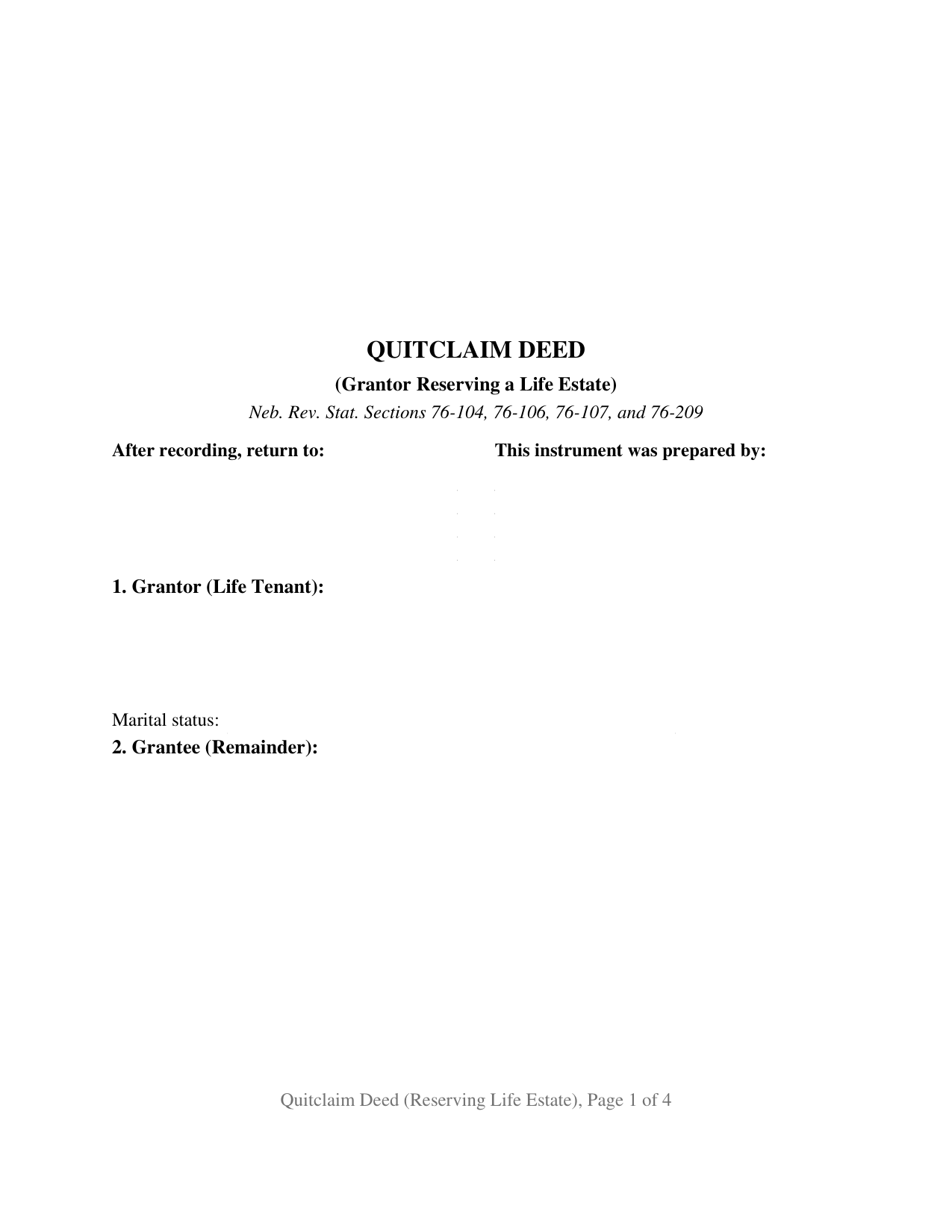
The form recites exactly one grantor, who is also the life tenant whose life measures the estate: a marital status line, one signature line, one acknowledgment certificate. A Nebraska grantee takes under a delivered deed without executing it, so the remainder holders have no signature line; their block carries their names, a mailing address, and the words of the estate they take together, joint tenancy with right of survivorship in the completed example. An owner deeding the family home to adult children and continuing to live there, and an owner passing farm ground to a younger relative while keeping the income for life, present the reserved life estate pattern this deed recites. A conveyance of the whole fee with nothing held back, two record owners each reserving an estate, and a reservation stated in favor of someone who is not the grantor follow architectures this version is not set up as. A married grantor's homestead is the boundary case: Section 40-104 conditions that conveyance on both spouses executing and acknowledging the instrument, a condition the Nebraska Supreme Court reads strictly.
Tax measured on the remainder, not on the parcel
Section 76-901 places documentary stamp tax on the grantor at $3.32 for each $1,000 of value, computed and collected before the deed is accepted. A reserved life estate moves the base: 350 Neb. Admin. Code Chapter 52, Reg-52-009.03 provides that a transfer of a life estate or remainder interest to a grantee not entitled to an exemption is taxed on that portion of the value, the portion being the present value set under the Internal Revenue Code regulations for life estates and remainders. Section 8 takes either the computed figure or an exemption subdivision from Section 76-902, each exemption running on the certification that section describes, and the example enters $557.76 on a $168,000 remainder in Cass County. Form 521, the Real Estate Transfer Statement the grantee signs, is prepared separately; Section 76-214 withholds recording until it is furnished.
What the download contains
Page one leaves three inches clear at the top for the register of deeds under Section 23-1510, and Section 33-109 prices the filing at $10.00 for the first page, $6.00 for each page after. The package holds this reserved life estate version of the Nebraska quitclaim deed as a fillable PDF, the completed Cass County example, and a plain language guide that walks the reservation clause, every entry, the acknowledgment, the ways remainder holders may take title, and the trip to the counter. Buyers reach the instrument as a life estate deed or a deed with a reserved life estate; the Nebraska record calls it a quitclaim deed. The materials are informational and are not legal advice.
Important: County-Specific Forms
Our quitclaim deed (reserving life estate) forms are specifically formatted for each of the 93 counties in Nebraska.
After selecting your county, you'll receive forms that meet all local recording requirements, ensuring your documents will be accepted without delays or rejection fees.