Nebraska Quitclaim Deed (Divorce)
County Specific Legal Forms Validated as recently as October 23, 2026 by our Forms Development Team
About the Nebraska Quitclaim Deed (Divorce)
How to Use This Form
- Select your county from the list
- Download the county-specific form
- Fill in the required information
- Have the document notarized if required
- Record with your county recorder's office
What Others Like You Are Saying
"The service was fast and professional. So much easier than going to the courthouse. I recommend this…"
"I wanted the Lady Bird Deed for my estate, and it was very easy to download, fill out and file. My c…"
"This platform made electronic filing of a lien easy and quick. I was able to accomplish everything f…"
"Very helpful!"
"Great forms! Quick, easy, and to the point. The completed document, when printed out, looks really p…"
4.8/5 from 4,836 reviews. Read all
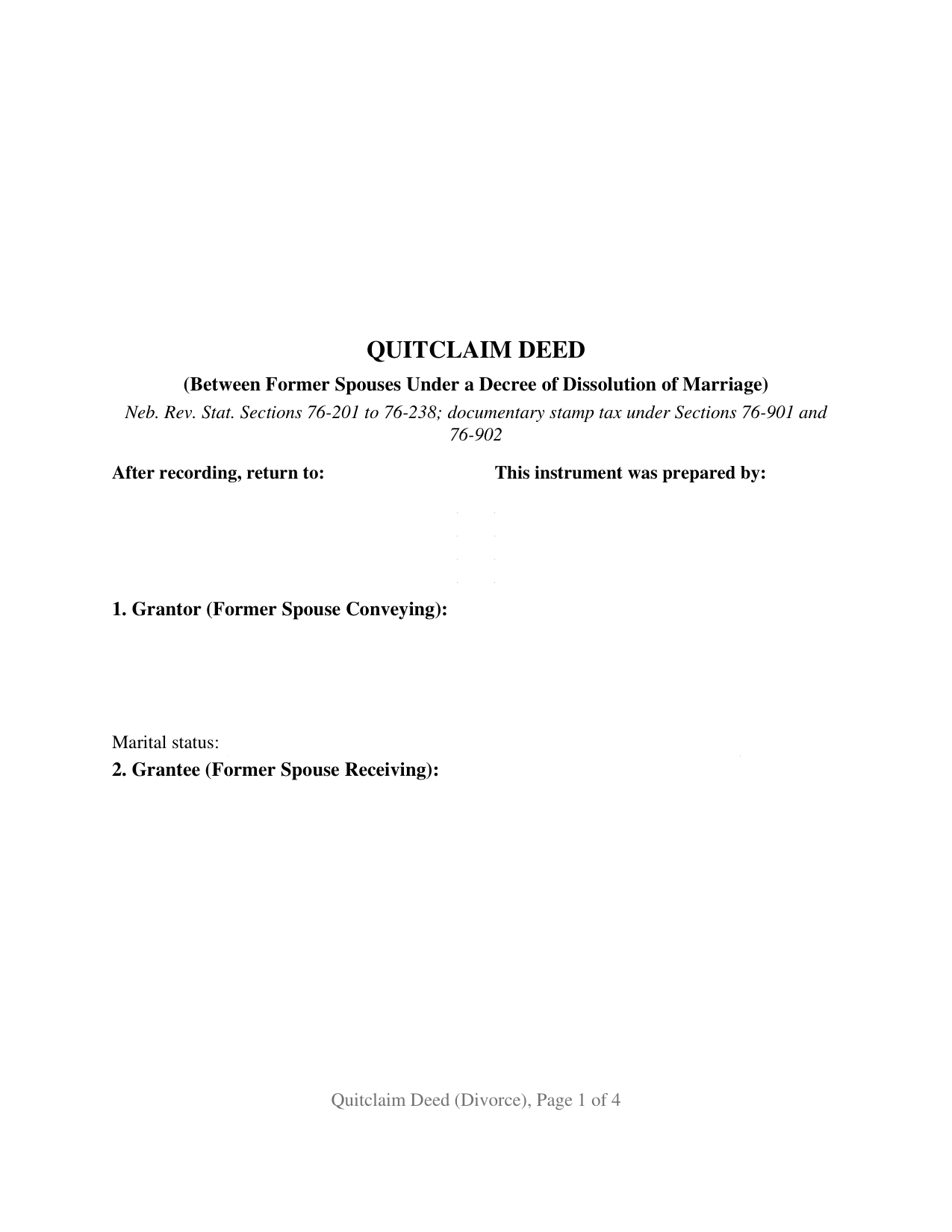
Nebraska keeps one sentence in its recording statutes for exactly this moment. Neb. Rev. Stat. Section 76-248.01 lets a clerk of the district court issue a certificate of dissolution of marriage, then provides that it shall not be used in lieu of a deed or other conveyance to carry out the decree's terms. A decree awarding the house to one party still leaves a deed to sign, and this is that deed: one former spouse conveying Nebraska real estate to the other under the decree it names.
Why the decree alone leaves work at the register of deeds
Section 42-372.02 supplies a court route into the county record, an affidavit filed with the clerk and a clerk-signed certificate per party and county, and Section 76-248.01 caps what it reaches. The Nebraska State Bar Association title standards separate a decree that operates on title by itself from one directing a conveyance or approving a property settlement agreement. Section 76-238 then rewards recording: a recordable instrument takes effect from delivery to the register of deeds against creditors and later good faith purchasers without notice.
One former spouse signs, and the other does not
The form is fixed at one grantor and one grantee, both described as former spouses, with a single signature line and one acknowledgment certificate for the conveying party. A Nebraska grantee takes under a delivered deed without executing it, so the receiving former spouse has no signature line here. A marital status line sits under the grantor block, because Section 40-104 attaches its two signature condition to the homestead of a married person, not to the name in the grantor index. Patterns arriving in this shape include a former spouse releasing a jointly titled residence the decree assigned to the other, and a party clearing a name out of the chain after an equalization payment. Spouses still married to each other, two owners each conveying a share, and a signature made by an agent under a power of attorney follow architectures this form is not set up as.
A release measured against the marriage, not just the parcel
The conveyance section carries the operative words: the grantor remises, releases, and forever quitclaims to the grantee every right, title, interest, claim, and demand in the described real estate, conveying that position as it stands and stating that no covenant or warranty of title travels with it. Under Section 76-209 an interest reaching the grantor afterward stays there, the statute leaving quitclaim deeds out of its after-acquired-title rule. Printed text then reaches past the parcel, releasing all homestead right in the real estate along with every claim in it arising out of the marriage, and stating that the deed carries out the decree without modifying it. Section 30-2333 already severed any former spouse joint tenancy into equal tenancies in common at the divorce; the deed adds a recorded instrument saying so.
Timing the signature against the decree
Section 42-372.01 makes a decree final and operative thirty days after entry, or at a party's death if sooner, and Choat v. Choat, annotated under Section 42-372, states that the marital relation continues throughout its pendency. Section 3 records the court, case number, and entry date beside the signature date.
Two exemption lines written for this transfer
Section 76-901 charges the grantor for the privilege of transferring title, currently $3.32 for each $1,000 of value or fractional part, collected before the deed is accepted. Two grounds reach divorce conveyances, and Section 8 prints both: Section 76-902(5)(a)(i), for deeds between ex-spouses conveying rights to property acquired or held during the marriage without actual consideration, and Section 76-902(12), for deeds executed pursuant to court decrees, which Reg-52-003.02M of 350 Neb. Admin. Code Chapter 52 reads to include deeds executed under court-approved property settlement agreements. Each ground runs on a signed certification, and the Seward County example claims subdivision 12.
What the download contains
Form 521, the grantee-signed Real Estate Transfer Statement Section 76-214 makes a condition of recording, is prepared outside this package, and Section 33-109 prices the filing at $10.00 for a first page, $6.00 after. The package holds the fillable deed, the completed example, and a plain language guide covering every entry, the acknowledgment, the estates a Nebraska grantee may take, and the recording steps. Searches reach this instrument as a divorce deed, a deed after divorce, a quit claim deed, or a quick claim deed; Nebraska's records index it as a quitclaim deed. The materials are informational and are not legal advice.
Important: County-Specific Forms
Our quitclaim deed (divorce) forms are specifically formatted for each of the 93 counties in Nebraska.
After selecting your county, you'll receive forms that meet all local recording requirements, ensuring your documents will be accepted without delays or rejection fees.