Nebraska Quitclaim Deed (Two Grantors)
County Specific Legal Forms Validated as recently as September 23, 2026 by our Forms Development Team
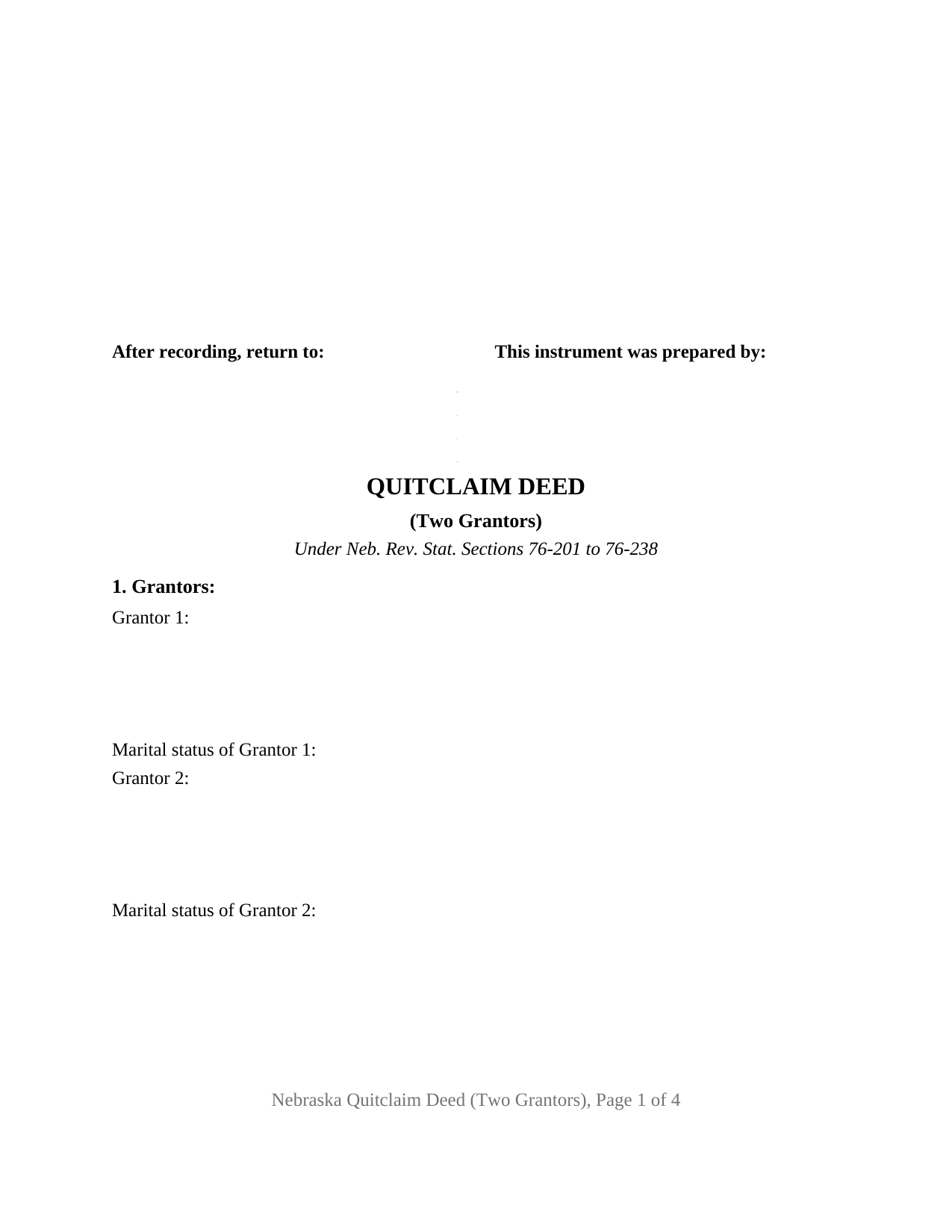
About the Nebraska Quitclaim Deed (Two Grantors)
How to Use This Form
- Select your county from the list
- Download the county-specific form
- Fill in the required information
- Have the document notarized if required
- Record with your county recorder's office
What Others Like You Are Saying
"Very good!"
"They sent me everything I would need to do this. Easy purchase -Easy download. Great!! I'll be back …"
"The website was easy to navigate and great communication on every step of the process."
"Seamless and prompt service."
"The requested forms were easy to access. Thank you."
4.8/5 from 4,828 reviews. Read all
One Nebraska quitclaim deed can carry two owners' interests out of the record at once. This form prepares that deed for exactly two grantors: both sign a single instrument, each acknowledges before a notarial officer, and together they release to a named grantee whatever right, title, and interest each of them holds in the described Nebraska real estate.
Two grantors, two certificates, one release
The form recites exactly two grantors. Each grantor block carries a name, a mailing address, and a marital status line; each grantor has a signature line with a printed name beneath it, satisfying the name-under-signature rule of Neb. Rev. Stat. Section 23-1503.01(3); and an acknowledgment certificate follows for each signer, so the two grantors are free to acknowledge on different days, before different officers, or in different states. Nebraska law does not require a separate certificate for each signer, since Section 64-204 accepts any certificate containing the words acknowledged before me; the two-certificate layout is how this form is built. Co-owner pairs present the pattern the deed recites: spouses who both hold title, two relatives releasing undivided half interests to a single grantee, and two heirs joining in one instrument after an estate distribution. A deed by a sole owner, or by three or more owners, follows a different architecture than the two-grantor layout here.
Where the second signature is the whole point
Nebraska attaches a hard execution rule to the homestead of a married person. Under Section 40-104, a conveyance or encumbrance of that homestead operates only when the instrument is executed and acknowledged by both spouses, and the Nebraska Supreme Court holds in Mutual of Omaha Bank v. Watson that a homestead instrument lacking either spouse's acknowledgment on its face is void as a homestead conveyance. A married couple conveying the home they both own presents exactly the two-signature, two-acknowledgment pattern this deed carries on its face. The marital status lines under the grantor blocks record the status each grantor asserts, and the included guide sets out the homestead rule with its citations.
A release that reaches exactly what the signers hold
The operative words remise, release, and forever quitclaim, together with the deed's express no-warranty statement, give the instrument its quitclaim character; Nebraska publishes no prescribed form, and Section 76-209 keeps a quitclaim deed outside the after-acquired-title rule. The two-grantor version adds a boundary worth noticing: the deed conveys the interests of the two people who sign it, and nothing from anyone who does not. Where a parcel stands in two names, a deed reciting both co-owners retires the whole title question in one recording rather than two.
One trip to the register of deeds
The deed goes of record with the register of deeds of the county where the land lies. Nebraska's format statutes shape the page itself: a blank space of at least 3 by 8.5 inches across the top of page one for recording information under Section 23-1510, the instrument title and return address printed below it, and 1-inch margins on the vertical sides and bottom under Section 23-1503.01. The recording fee under Section 33-109 runs $10.00 for the first page and $6.00 for each page after it. Two companion filings ride with the deed: a Form 521 Real Estate Transfer Statement signed by the grantee, which Section 76-214 makes a condition of recording, and the documentary stamp tax that Section 76-901 lays on the grantors, at $3.32 per $1,000 of value for transfers made before January 1, 2032, collected at the counter before the deed is accepted. Family and other exempt transfers listed in Section 76-902 are claimed with a signed certification, a step the guide covers in detail.
What the download contains
The download holds three pieces: this two-grantor quitclaim deed as a fillable PDF, a completed example filled in for a Douglas County husband-and-wife fact pattern, and a plain-language guide covering every entry, both acknowledgments, the ways grantees may take Nebraska title, and the recording process. Written out in searches as a quit claim deed or quick claim deed for two owners, the instrument enters the Nebraska record as a quitclaim deed. The materials are informational and are not legal advice.
Important: County-Specific Forms
Our quitclaim deed (two grantors) forms are specifically formatted for each of the 93 counties in Nebraska.
After selecting your county, you'll receive forms that meet all local recording requirements, ensuring your documents will be accepted without delays or rejection fees.